Monday, 10 August 2009

Support the Vestas Workers - Bangor and Wrexham Public Meeting

Organised by North Wales Socialist Party

6.30pm
The Harp Inn, High Street, Bangor

or

7.30pm
Barracuda Bar, Wrexham

All welcome!

Thursday, 6 August 2009

Protest Against the Eviction of Vestas Workers

I repost below a message from Vestas workers,

Dear friend,

An eviction notice has been served on the occupation at Vestas IoW. The eviction is due to take place tomorrow, Friday 7 August, at 12 noon.

Please get to the Island if you can. The workers want support tomorrow. There is a minibus leaving London tonight. Email vickimorris@btinternet.com if you want to be on it and we will forward your number to the driver. If anyone else can drive or offer transport, please let us know. We can post details on the blog or put you in touch with people seeking transport.

If you can't go, please organise a protest in your town or join one of those already planned. Protests we know about are
-tonight, 6pm outside Department of Energy and Climate Change, 3 Whitehall Place, London
-tonight Bristol: demonstrate 5.30pm Bristol fountain
-tomorrow Manchester: demonstrate 5pm in Piccadilly Gardens, tel Hugh 07769 611320

Let us know if you are organising something and we can advertise it.Please contact Climate Change and Energy Secretary Ed Miliband now. ps.ed.miliband@decc.gsi.gov.uk and tell him to step in to save wind turbine blade production at Vestas, IoW, for the sake of renewable energy, green jobs and his credibility as a politician. His phone number in his Doncaster constituency is 01302 875 462, and at Westminster, 020 7219 4778. And on Twitter http://twitter.com/edmilibandMP

Please forward this email to contacts or post up on your blogs/website.

Thank you,Save Vestas

Monday, 3 August 2009

Vestas Occupation – Socialist Party Bulletin Number Two

Nationalise to save jobs!

Now entering the second week of occupation, working class people across the UK are looking towards the lads occupying Vestas as a source of inspiration for how to stand up and fight in defence of jobs. In the face of a viciously anti-union employer, Vestas workers have stood firm and stared down management. Is it any wonder, however, that Vestas workers are compelled to struggle? There are 625 jobs on the line at Vestas and currently only 124 job vacancies on the entire island! The economic crisis that greedy bosses and pro-market politicians have helped mold means this fi ght is more critical than ever. But Vestas workers have got the employer on the back foot; the adjournment of the court hearing to obtain an injunction doesn’t just represent Vestas management’s incompetence but also the popularity of the occupation – which has made New Labour hesitant to use the courts against it. The support of the local transport union – RMT – and their commitment to provide legal support for the court hearings has been a huge boost to the occupiers; now, Saturdays demonstration in St Thomas’s Square is an opportunity for trade unionists from across the island and further afi eld to express solidarity with Vestas workers – we need to build mass action to bring Vestas bosses to their knees and force the hand of the weakened New Labour government!

Vestas diet plan

Prisoners in Camp Hill get three hot meals a day, yet Vestas bosses have been allowed to try and starve out occupying workers! When Luke was forced to leave the occupation on Thursday, he was pale and shaking and paramedics found his blood sugar levels to be unusually low. How can Vestas bosses sleep at night when they know that they have sanctioned a brutal siege? We need to make sure that vital supplies get to the occupiers – not through short-term stunts, but by mobilising hundreds of people, occupier’s families, trade unionists and others to put pressure on everywhere we can. The employers have dragged Vestas workers to the courts for occupying; we should drag them to the courts for starving people! This, alongside mass action, could force supplies in.

Mass action for victory

If attempts are made to physically remove the workers from the factory a massive trade union
demonstration outside the plant should be immediately organised in their support. The workers movement in Britain should learn the lessons from South Korea, where more than 800 workers have been occupying the Ssangyong car plant since May. Despite riot police storming the plant, the occupation has continued. The Korean Congress of Trade Unions has called a two day general strike to support them. There are differences in the situation, but any moves to clamp down on the occupiers would have deep reverberations. The trade union movement needs to be prepared to harness the anger that any moves against Vestas workers would create, including organising industrial action in their defence.

Nationalise to save jobs & the environment

If this factory goes, what does the future have in store? Occupiers who’ve been separated from their families for over a week now fighting for a decent future would be forced to up sticks and leave the island. To find work and support a family there’s no other option, and even then nothings guaranteed. Vestas management have callously made it clear that they have no interest in keeping the plant open when its easier and cheaper to screw workers in the United States. In that context, appealing to the government to increase subsidies, as Green MEP Caroline Lucas has, makes no sense – Vestas have already said they don’t care about the subsidies! We have to be clear about it – this plant should be nationalised to ensurea future for workers on the Isle of Wight and the environment.
Across the country, over 80% of people support wind power – but none of us want unemployment in our back yard! Yet the government, and Tory local councils, are allowing a very small minority to block turbines being built. Contrast this to their attititude to nuclear power stations, which endanger local peoples health, but the government just impose.
Brown and Milliband might make the occasional green noise, but they’re so wedded to the ‘free market’ that they’re desperate to avoid further nationalisations. But this economic crisis has shown that the market doesn’t work and New Labour have been forced to nationalise – Northern Rock, RBS,the East Coast rail line; the list is getting longer and longer! As the lads in the occupation have put it: “If the government can spend billions bailing out the banks – and even nationalise them – then surely they can do the same at Vestas.” The governments hand can be forced, and we need to be clear that this is what we’re demanding. Of course, what happened at RBS and the like wasn’t genuine nationalisation –we’ve taken the risks off the bosses for them. What we really need is socialist nationalisation – where working people have a direct say in how companies are organised and run. Vestas needs to be retooled for the British market – who knows how to organise that best? The workers on the shop floor or managers whocan’t even fill in an injunction application properly?

Workers need a political voice

None of the establishment parties support the action that Vestas workers have been forced to take – a Labour MP in Pompey has refused to even sign apetition supporting them! This is hardly much toask. Workers at Vestas have waged a heroic struggleand shown their strength on the industrial front. Butimagine how much easier the fight would have been if a political party with a national profile had thrown its weight clearly behind them. Criminally, there isn’t a mass political party in Britain that stands in workers interests! Rather, New Labour helped push through the liberal employment laws that make it legal forVestas to dump workers in the Isle of Wight and move to the States without a bye-or-leave. That’s why the Socialist Party along with others, including the RMT, who’ve played an important role in this dispute, participated in a list of working class candidates in the European elections. We’re hoping to get a workers list together for the General Election when it happens, so workers have candidates who stand in their interests to vote for. This could be an important step towards the sort of mass working class party that could play a decisive role in struggles like this in the future.

“People on the island have realised that the reality is, if this places shuts down, a lot of small businesses can go under too. And there’s also the environmental side of it – which is massively important.
I’ve got two small children, twins, and we’re doing this for their future as well. The government needs to step up and act now, not 2012 or 2020 or whenever – something needs to be done now, not when they set their stupid deadlines.”
Sean, Vestas worker

Vestas workers demand:

• Immediate union recognition.
• No to job cuts – Keep the factory open.
• Nationalise the factory under workers’ control – power to the shop fl oor.
• Make the plant a building block for a new publicly owned green sector to provide more jobs.

Demo outside court hearing

Tuesday 4th August, 9:30am
Newport Magistrates Court, Quay Street, Newport

Socialist Party Meetings

Sunday 2nd August, 3pm + Tuesday 4th August, 2pm
Wheatsheaf Hotel, upstairs room, St Thomas Square, Newport

Solid Rallies

Outside the plant every day at 6pm

For more information contact Ben Norman on 07957 505263
www.socialistparty.org.uk 􀁑 0208 988 8777 􀁑 join@socialistparty.org.uk

Sunday, 2 August 2009

Review – Teamster Rebellion by Farrell Dobbs

I have to say, that when I recently read this book it was not for the first time, rather this book is one that I hold in great regard and wished to re-read it to clarify in my mind some of the issues that the 1934 Minneapolis Teamster strikes raises.
These strikes which the book covers marked the beginning of an upsurge in union activity in the United States that eventually led to the formation of the industrially based CIO. Moreover it was really the first serious labour dispute that the Communist League of America, part of the International Left Opposition, became involved in. The book depicts these strikes in a very easily readable format whilst pointing out the steps taken, tactics chosen that the union local took and why they were taken. To my mind this is a book that all militant trade unionists should read.
But one thing I want to focus on is the way that the defence of the pickets from police attacks and brutality during the strike was organised. Unlike some on the left who seem to cry for workers to be given arms at any occasion as if the main issue is some desire to beat up the police (or at least this is the impression that can often be given), Dobbs is rather more sane as he explains why the strike committee deemed it necessary to arm pickets against attacks from the police as well as from the employer-organised special deputies.

“Up to now the workers had gone about their activities bare-handed; but they found that attempts to exercise their right to peacefully picket were being repressed with police clubs and blackjacks. They decided to take steps to enforce their democratic right to prevent scabs from grabbing their jobs. It would have been a tactical blunder for members of an isolated vanguard to attempt measures such as the strikers were about to take; they would only get themselves clobbered by the police. In this case, however, the means used in self-defence had their origin in a spontaneous mass mood that had been generated by capitalist repression. Since these means were appropriately limited in the given situation to matching the police club for club, the tactics employed were completely valid.”(pg.81)

Later on in the book he deals with the run-up into the third strike, when workers were making preparations for this and the question was raised again.

“At the first strike committee meeting, chaired by Kelly Postal, the question of ‘picketing equipment’ was put on the agenda. For the first time since the truce at the end of the May strike, the bosses would be trying to operate trucks in defiance of the pickets. The last attempt had been stopped when the pickets won a pitched battle with the cops, fought club against club. At this new juncture many pickets were inclined to start where they left off in May, again arming themselves with clubs. In the changed circumstances, however, this would have been tactically inadvisable. It would have given the cops a pretext for immediate violence against strikers who were trying to peacefully picket; and the union would have lost the tactical advantage of reacting to police violence under defensive slogans.”

And finally he discusses the question again in the aftermath of the police shooting at the strikers and killing two whilst injuring several others.

“In the meantime Local 574’s pickets were reacting to the police assault in full keeping with their magnificent fighting spirit. After the shooting, many who had escaped injury dropped from sight briefly, only to return soon armed with various kinds of weapons. They now had shotguns, deer rifles, revolvers, hunting knives, and various types of souvenirs from World War I, which the veterans among them had brought back from France. Having bested the cops club-against-club in May, the strikers were now prepared to face them gun-against-gun. Although their cause was just and their courage admirable, it would have been a grave tactical mistake to attempt to go through with such an undertaking.
“The situation was now qualitatively different from what it had been during the earlier battle with clubs. Despite the fact that a club can kill, it is not usually classified as a deadly weapon. By virtue of that fact, self-defence of the kind used in May could be sustained tactically for several reasons: it was carried out by a massive body of pickets who had widespread sympathy within the city as a whole; for reasons described previously, Governor Olson found it difficult to use the state militia against the union; and due to the insular nature of the conflict and the local politics involved, President Roosevelt had little inclination and no ready pretext to intervene with federal troops. Consequently the fighting in May remained confined to a showdown between pickets and the local cops.
“As matters stood after Bloody Friday, however, the situation was entirely different. Being so deadly, their use in self-defence against the gun-toting cops could have been twisted around by capitalist propaganda into the appearance of an ‘insurrectionary offensive’ by the strikers. The bosses would have screamed bloody murder, claiming proof of their contention that our aim was not to build a union but to make a revolution. At the first armed skirmish between strikers and police a clamour would have been raised for Olson and Roosevelt to send in troops against the union…
“Local 574, against which such military repression would have been directed, was engaged in an isolated local action. Nationally, our struggle was paralleled only by two other similarly isolated conflicts… Hence, it could not have withstood the heavy military pressure; the strike would have been broken and the union crushed.
“This was a situation in which the central strike leadership had to act swiftly and decisively. Otherwise impulsive pickets, looking for a showdown with the cops, could have done irreparable damage to the union’s cause while the policy question was being debated. The pickets had to be disarmed forthwith, and the central leaders had to do it on their own responsibility…
“…Once again, Local 574’s incomparable soldiers went out barehanded to face cops with riot guns.
“Our action was promptly reported to a meeting of the strike committee, and the reasons were given for the policy we had followed. After considerable debate the committee approved the course taken, issuing picketing orders accordingly. The orders, which were published in The Organizer, contained a deliberately obscure formulation: “All pickets are hitherto instructed to continue tactics of peaceful picketing as hitherto. They are, however, to defend themselves against any attacks.” Since we hadn’t troubled to let the cops know whether or not the pickets were armed, they weren’t sure what permission to ‘defend themselves’ meant and being aware of the strikers’ anger, the cops weren’t in a hurry to find out.”

As these quotes amply demonstrate, at each stage the strike committee measured the objective situation facing the workers and prepared themselves accordingly. The task was not to repeat demands for arming of the workers but to act in a manner that sought to defend the interests of the workers at each stage in response to the course the struggle took. It is a lesson that some ultra-lefts who repeat demands blindly should do well to note.

Friday, 24 July 2009

North Wales suffers in Race to the Bottom

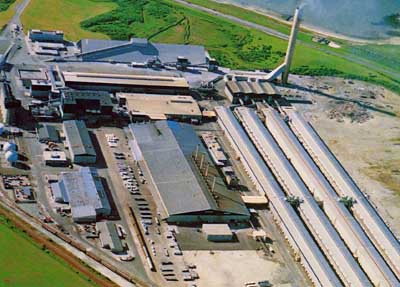
From Socialist Party Wales website -original with references can be read http://www.socialistpartywales.org.uk/front5.html. Photo is of Anglesey Aluminium.

Dylan Roberts (Socialist Party, North Wales)

Historically, the economy of the north west of Wales has been based upon agriculture and tourism; the economy of the north east of Wales upon heavy industry and manufacturing. However, over the past few decades, we have witnessed the death of heavy industry, and an agricultural sector decimated by the globalisation of food consumption. In both west and east we have watched as steelworks, collieries, quarries, and agricultural smallholdings have disappeared, to be replaced by unskilled manufacturing and service sector jobs which are inherently low paid and insecure.
The end result is that North Wales is one of the most highly skilled yet poorly paid regions of the UK, and which has witnessed rapidly increasing unemployment in recent times. According to the 2008 figures from the Annual Survey of Hours and Earnings (ASHE) report from the Office of National Statistics, the average annual wage in Wales is around 13% lower than the equivalent wage for across the UK, with the UK average wage sitting at £25,123 per annum in 2008, compared to £21,831 per annum for Wales. The reality in north Wales is likely to be even lower again. (1)
North Wales has been heavily hit by the capitalist crisis in 2009. We have already witnessed the loss of a vast number of jobs in the region, with major employers such as JCB, Indesit, Deep Stream Technologies, Corus, Marshalls Cement, and many others, either laying off staff or closing altogether. Many other employers have frozen pay, reduced working hours, terminated the contracts of temporary and fixed term workers, or are threatening to take such measures in the near future. In the past month we have seen a number of key employers undertake job cuts or site closures in both the west and the east of the region.
Air Products
On June 30th, Air Products, an American owned multinational, announced their site in Acrefair, Wrexham, would close, with the loss of around 200 jobs. Air Products are switching production to China. While the loss of 200 jobs in a relatively under populated area is reason enough to be concerned, the Air Products case is worthy of further comment for a number of reasons. Air Products’ Acrefair plant opened in 1950, at a time when the bulk of the workers of Wrexham were employed in heavy industry. However, in the modern day, Air Products was one of very few remaining employers of skilled manual labour in the area. The fact is that the skilled workers at Air Products will struggle to find similar work anywhere within this region. This means they will potentially face a long period of unemployment, and when they do find employment it is likely to be low paid and insecure work within unskilled manufacturing or the service sector. The alternative is, like many before them, to leave the region.
But why is Air Products closing their site? Well, naturally management blamed the recession, citing a drop in profits in the first quarter of 2009 and “on-going cost pressures and the changing demand for our products, which is shifting to other parts of the world, notably Asia". (2) Yet Air Products are not struggling, and neither was the Acrefair plant unprofitable, as management conceded at the beginning of the consultation period in April. Indeed, in 2008 they recorded a global turnover of £11 billion pounds, with profits of nearly £1 billion. Whilst they have seen a downturn in profits in comparison to previous years, it is nonetheless evident that they remain extremely profitable.Indeed, in the first quarter of this year they turned a profit of US $189 million, which equated to more than US $60 million a month, or in even starker terms, more than US $2 million a day. Less profit than they were used to perhaps but hardly a struggling company. (3)
What they are doing is using the cover of the recession to move production to where labour costs are lower, in order to squeeze the profit margin some more. Janet Ryder, Plaid Cymru AM for north Wales, described it as a "betrayal" of a workforce that had been "consistently profitable" for Air Products. (4)
Air Products had announced a consultation period in April, which of course meant that the decision had already been made. The workforce and Unite had put forward an alternative strategy that would have saved jobs and kept the plant alive, whilst conceding to some of Air Products' demands. Whilst offering concessions – job cuts – isn’t necessarily the right path to take, nonetheless this would have preserved some jobs and retained a much needed employer of skilled labour in the area. Air Products, however, were not interested.
As unpalatable as this is, it might not be quite so devastating if it was an isolated incident. Unfortunately, it is anything but.
Anglesey Aluminium

Anglesey Aluminium is, along with the Wylfa nuclear power plant, a major employer on the Isle of Anglesey, and in fact one of the largest employers in north Wales. It is estimated that the firm amounts to around a third of the entire economy of the isle of Anglesey. (5)

Anglesey Aluminium, a joint venture between Rio Tinto (who own 51% of shares) and Kaiser Aluminium (49%) announced in early July that they would be offering voluntary redundancy to 140 workers, with the remaining jobs almost certain to go in September when the plant ceases production. Anglesey Aluminium intends to retain only 80 workers from the 500+ strong workforce. The effect that the closure of Anglesey Aluminium will have on the island cannot be emphasised strongly enough. The north west of Wales is an overwhelmingly rural area with an over reliance on tourism, and the loss of such a significant employer will have long term consequences for many generations of workers on the island.
The plant is closing due to the end of a contract for cheap energy supply with Wylfa, with management citing this as the primary motivation for the closure. The only way the 400 jobs due to go in September could be preserved is if Anglesey Aluminium obtains another source of subsidised energy, which seems highly unlikely.
The closure of Anglesey Aluminium had been on the cards for some time. The closure of Wylfa was announced back in 2006, with the nuclear plant expected to close in 2010. However, earlier this year the Nuclear Decommissioning Authority (NDA) announced that they may extend the lifetime of the existing Wylfa plant (Wylfa A), with a second nuclear plant (Wylfa B) having been proposed back in 2006. One of the reasons given back in 2006 for the creation of Wylfa B was for the need to continue the supply of energy to Anglesey Aluminium, although this would no longer be at the reduced rate.
The proposal for the second generation nuclear plant, Wylfa B, was voted through by Anglesey County Council, following a propaganda drive by the council and local Labour MP Albert Owen, who heralded the proposal for Wylfa B as a boon for the island and claimed that 1,500 jobs would be at stake if Wylfa B didn’t go ahead.
Iain Dalton, of the Socialist Party Bangor branch, has written previously about Wylfa. On 6th February 2006, Iain noted that:
“They claim that without it, the island will lose 1,500 jobs. This figure has been inflated by Wylfa taking on temporary workers, and by including 400 jobs at Anglesey Aluminium, which the company has publicly stated will not be threatened by closure of Wylfa, although they may use it as a pretext to move production to a lower wage economy. However, a new nuclear station would employ far fewer people than the current station due to new technologies, and that is before cost-cutting practices of the new station's private owners (Wylfa is presently publicly run).” (6)
Indeed, Iain’s words have been borne out. Despite the claims of Albert Owen and Anglesey CC, the fact that the proposal for Wylfa B has been given the go ahead has not prevented Anglesey Aluminium from using the end of the discounted energy supply as an excuse to close the plant, with Rio Tinto and Kaiser Aluminium exploiting the situation in order to switch production to cheaper labour markets.
The Welsh Assembly Government (WAG), in conjunction with Westminster, offered a financial package of £59 million over four years to compensate for the loss of the discounted energy supply, which amounted to an astounding £1 million a month state subsidy. 7
However, management at Anglesey Aluminium, Rio Tinto, and Kaiser Aluminium rejected the deal, claiming that they would need at least double that figure in state subsidies to retain production on Anglesey. Yet Anglesey Aluminium has been extremely profitable in the 36 years it has been on the island. Furthermore, both Rio Tinto and Kaiser Aluminium are vast multinationals turning huge profits.
Rio Tinto, which owns the controlling stake, recorded record profits in 2008, delivering net profits in the first quarter of 2008 of an astronomical US $2.94 billion. They have not faired quite so well in the first quarter of 2009 but that still equates to US $1.6 billion in net profits between January 1st 2009 and March 31st 2009 – or US $177 million per day! 8
Yet again, we see private enterprise demanding that the losses are nationalised while the profits remain private.
As with Air Products, it is evident that the crisis of capitalism and rising production costs are being used as a scapegoat, for attacks on pay and conditions and the switching of production to non-unionised plants in low wage economies, in order to drive these obscene profit margins up yet further. In both cases, there is no pressing need to switch production; it is simply another case of profits coming before people.
As Iain pointed out, and as has been borne out by the impending closure of Anglesey Aluminium, the claim that a new second-generation nuclear facility on Anglesey would not only retain existing jobs but also create new jobs has been proven to be false. As Iain pointed out in the same article:
“Local campaign group Pawb (People Against Wylfa B – Pawb means ‘everybody’ in Welsh) are arguing for an alternative employment plan for the island. Much of this lies around the potential for harnessing renewable energy sources, as the island has near ideal conditions for several technologies including tidal, wind, solar and wave. Additionally, based on the experience of decommissioning Trawsfnydd in nearby Gwynedd, decommissioning the current Wylfa station will provide at least 500 jobs for at least fifteen years.”( 9)
Local politicians such as Albert Owen have argued that building a renewable energy plant on the island would not have been viable, as such a project would take many years, and would therefore leave the skilled workers of Wylfa and Anglesey Aluminium without employment. Yet as Iain points out above, decommissioning the existing Wylfa A plant would have provided significant employment for the next decade and a half, and a new renewable energy plant would have created both long term employment for the people of Anglesey, and shorter term employment as the plant would need to be built. Instead, it appears that Anglesey will retain a nuclear power plant, with all the inherent environmental dangers and impact that come with that, but will still suffer from mass job losses as Anglesey Aluminium ceases production and Wylfa inevitably cut jobs due to new technologies.
The ideal opportunity for a clean, green, environmentally sound mass source of renewable energy has been missed, in addition to the vast number of jobs in the beleaguered construction industry that could have been created by building such a plant.
We can also see further evidence of the short-termist attitude to the construction sector elsewhere in north Wales.
Hanson Cement
Hanson Cement – formerly Castle Cement – in Padeswood, near Buckley, Flintshire (north east Wales) announced on Tuesday 7th July that they had entered a 90-day consultation period, with a view to 96 redundancies. 56 production jobs and a further 37 in distribution are under threat, which would leave only a skeleton staff of 46 at the plant. This is despite promises made by Hanson that there would be secure work for 110 workers. The plant is home to the most modern cement kiln in Europe. (10) Job losses at the plant in Flintshire have been on the cards for some time, with Hanson prepping the turf back in 2008. (11) The threatened job losses have been blamed on the stagnant construction industry, with a spokesman stating that the plant was "reducing output to a minimum in light of the continuing downturn in the construction industry."
This follows the closure of Marshalls Cement, not far from Hanson Cement, in Llay, near Wrexham, which shut down in may with the loss of 55 jobs. (12)
In both cases, management has cited the stagnation of the construction industry and the resultant drop off in demand for cement as the primary reason for the job cuts and closures.
Hanson Cement (and Marshalls) does differ from both Anglesey Aluminium and Air Products, in as much as the capitalist crisis has undoubtedly had a severe effect on construction. Hanson are not switching production; rather, they are ceasing production, at least at the Flintshire plant.
It does, however, seem ridiculous that we are currently seeing massive job losses in the construction industry across the UK when housing remains such an issue, with the BNP in particular using pressure on limited social housing stock and an absence of affordable housing to gain political capital. Whilst the news that the New Labour government intends to undertake a programme to build 3,000 council houses and 20,000 affordable houses over the next two years is to be welcomed, in as much as it is better than nothing, it remains evident that this does not go far enough. (13) A programme could be adopted to build new social housing stock and affordable housing on a mass scale, which, combined with the termination of the right to buy programme, would serve to alleviate the huge pressure on limited existing stock, provide employment for the hundreds of thousands of threatened construction workers in the private sector, and cut off the BNP and the far right's main source of oxygen by providing employment and housing on a vast scale.
Likewise, a similar large scale construction project on Anglesey could have not only provided work for the beleaguered construction workers, but also delivered an environmentally beneficial source of renewable energy, which would have sounded the death knell of nuclear power in the UK.
In addition, key employers such as Air Products and Anglesey Aluminium (Rio Tinto) should have been prevented from switching production to non-unionised plants in low wage economies given that the levels of profits of both multinational companies, and the continued profitability of their north Wales plants, demonstrates their viability.
Both companies should be made to open their books, and if necessary both sites should be nationalised to ensure there are opportunities for skilled workers in the already decimated local economy of North Wales. However, it appears that while the government, and indeed the capitalist establishment as a whole, are more than happy to bail out the bosses and the bankers, there are no such plans to bail out the workers.

Wednesday, 22 July 2009

BNP get police to arrest socialists

From this weeks issue of The Socialist.

On Tuesday 14 July I was arrested, along with two other Socialist Party members, on alleged public order offences following a complaint made by local members of the fascist-led British National Party

Dylan Roberts, Wrexham Socialist Party

The BNP's allegations were entirely without substance, and were a poor attempt at intimidation. The complaint related to campaigning on Saturday 30 May, when we were running a stall in Wrexham town centre.
We were promoting the No2EU-Yes to Democracy European election challenge and campaigning against the BNP. We had spent two hours campaigning prior to the local BNP mob arriving and setting up a stall a few yards away from us.
The BNP outnumbered us, but we did not rise to their deliberate attempts to provoke us. A member of the BNP approached us and made a number of racist comments, while another BNP member filmed us for several hours.

Arrests

One Socialist Party member was arrested at his home on 14 July at around 9am. I went to the police station of my own accord at around midday, where I was arrested. The third Socialist Party member went to the station after finishing work at 5pm, and he was also arrested.
We were detained for up to two hours each. We were asked to provide a statement, and then subsequently to provide fingerprints and DNA, and we were photographed. We also spent time in the 'custody suites'.
North Wales Police (NWP) treated us courteously, and the arresting officer behaved in a very professional manner. Nonetheless, the police had no evidence whatsoever, which leaves the question of why NWP chose to arrest us for what was evidently a fabricated charge.
We were bailed unconditionally, to appear back at Wrexham police station in August. The following morning we were contacted by the arresting officer, who advised us that there would be no further action.
We had to spend a fair amount of time in custody, and our DNA will be retained for 12 years, despite not being charged.
We were told that we had been arrested because NWP had a duty to investigate the complaint, and that the only way in which the police could investigate was to arrest us. It is not acceptable for the police to detain socialists and anti-fascists simply for campaigning against the BNP.

Sunday, 19 July 2009

CWI Summer School 2009

I was one of around 350 members of the CWI who met in Belgium this week for our annual European school. Despite having been a member for a while now I’ve never managed to get along to one of them before. And I have to say I feel really stupid for not doing so because if it has been anything near as good as it has been this year then I have really being missing out.

The school was split up into several discussions with big plenary sessions on the situation in the world, one focussing in more detail on the situation in Europe and one on building the Committee for a Workers’ International. There were also several sets of commissions on various topics and for the contents of all of these sessions I would direct people to the excellent report on the CWI website http://www.socialistworld.net/.
I went along to the commissions on Africa, Marxism & Science and Racism & the far-right and I have to say the debates in these were excellent. The one thing that really stood out in all of them was how many really capable young members we have in all the various sections, for example:
In the Africa commission there were several contributions on the finer points of countries that I’ve never discussed before such as Algeria as well as some really interesting points made on the role of China in Africa. In the Marxism and Science discussion some important points about dialectics were discussed and in the Racism and the Far-Right session the bravery of the comrades in Northern Ireland in defending Roma families in Belfast was discussed as well as the equal bravery of the Swedish section in defending our members against around 11 attacks in the last year and a half.
But the week was also an opportunity to relax and I’m proud to say I was on the winning team of the yearly football match, with England & Wales & Irish sections beating the rest of the CWI 5-1. And most of the school had a good laugh when a senior member of the CWI managed to lock themselves in the lavatory.
On a more serious note the school showed the tremendous progress being made by the CWI, obviously one of the main highlights was the election of Joe Higgins to the European Parliament which is already leading to the further development of the Irish section of the CWI as well as allowing us the ability to work more closely with other left groups in Europe. The growth in the England and Wales section also shone through, particularly as a result of our recent leadership of several important industrial disputes, with the recruitment of important layers of workers and trade unionists. The fusion between the former CWI section and another group in Brazil to form the new CWI section Liberdade, Socialismo, Revolucao. The growth of the CWI in new areas, especially Malaysia was also discussed. Even where we are experiencing a really difficult objective situation at the present time in Sri Lanka due to the civil war, we are still managing to function despite state harassment and death threats against our members.
If this sounds like I’m mostly going on about how great the CWI is then you are right. One of the points raised in the discussion was how quite a lot of the times we are too modest about the work we do around the world, of course we publicise what we do, but there’s also a lot more that goes unreported. I have to agree, I think I have underestimated how important the CWI is until this week. Due to the history of our organisation in Britain and with England & Wales being the largest section to a certain extent I think I thought of the International as sort of tagged on to our section. But this week has shown me that we make a serious difference to the lives of ordinary working class people in many areas of the world and it has made me really want to commit myself to living up to example that members of the CWI are setting around the world.

Thursday, 9 July 2009

A British Prison in Nigeria?

Note: I'm going to be away for a week or so, so don't expect any posts until next saturday at the earliest.

The government has announced that it is in negotiations with the Nigerian government over proposals to upgrade the prison infrastructure in that country to allow them to forcibly transfer around 400 prisoners back to Nigeria.
The current UK prison service policy is to offer foreign national prisoners a transfer back to their country of origin where a treaty for such a course of action exists with that country. Such prisoners would then serve out the remainder of their sentences in their country of origin. However, given the appaling prison conditions in many countries around the world it is somewhat unsuprising that many imprisoned foreign nationals do not take up this offer. Even with the governments Facilitated Returns Scheme, with the 'incentive' of giving prisons who opt for a transfer £46 in cash (the equivalent of the amount that all prisoners receive upon release from prison to pay for any immediate needs) has not upped the return rate significantly.
The new plans are similar to a scheme that the prisons service has previously funded in Jamaica, where a prison was partially funded to help speed up prisoner transfers. In both Nigeria and Jamaica prison conditions are notoriously bad, Nigeria's prison system has been condemned by Amnesty International. Over 65% of those in Nigerian prisons have not being convicted of any crime, with waits of up to 10 years for a trial and as a result the prison system there is notoriously overcrowded.
The proportion of foreign nationals imprisoned within the UK prison system has grown largely over the past few decade or so, yet according to the Prison Reform Trust the overwhelming majority of these are first time offenders from some of the poorest countries in the world who have been convicted of drug trafficking. This means that rather than a wave of immigrant violence as some of the press have tried to paint these figures, the rise in foreign national prisoners is mostly down to increases in sentences handed out for drug related crimes, especially given that 4 in 10 male foreign nationals and 8 in 10 female foreign nationals in UK prisons have been convicted of drug offences.
In criminological theory, imprisonment is said to be justified on several grounds, either of incapacitation of those likely to commit crimes or of deterrence of people from committing future crimes. But it is not the people who are getting caught in these cases that are the serious criminals, those at the top of the drug cartels can simply sit back as the capture of another expendable mule means nothing to them. It is the criminological equivalent of chopping off the head of the weed but doing nothing about the roots.
A British funded prison will not do anything about the underlying problems within Nigerian society that lead people into the desperation of becoming drug mules, in particular the rape of the oil wealth by the Nigerian state and capitalist class which has led to poverty for the masses. Incidentally this is the same Nigerian government which has been backed by the British government despite widespread claims of fraud in the most recent national elections. So small are the hopes for even under this scheme convincing Nigerian prisoners to even transfer to a specifically built prison, as being proposed, that the government as part of the proposals is aiming to convince the Nigerian government to change its constitution to allow forcible prisoner transfers.
Schemes like this are only being proposed as a result of years of hiking up the prison sentences for crimes that are either trivial or are committed by those who would be unlikely to re-offend anyway as a repsonse to populist pressure for 'tough' action against crimes. Such prisoners are easily convicted and allow government bureaucrats to present figures that show they are 'winning the war on crime', yet do not tend to represent genuine steps towards seriously dealing with major crime problems. Removing the corrupt, theiving Nigerian ruling class and replacing them with democratic committees of workers and other oppressed layers and giving them control of the countries resources to alleviate the widespread poverty in the country would represent a serious step towards reducing the numbers of Nigerian drug traffickers, far more than any of the prison services schemes. But such a step would never be advocated by the UK government who rely on the Nigerian regime to support the interests of British capitalist companies in the country. Hence why only socialists can seriously solve the criminal justice crisis and under capitalism we see high crime rates and an escalating prison population.

Saturday, 4 July 2009

Review: An Unbroken Agony by Randall Robinson

This is the second, long overdue, post in my series on the 5th anniversary of the second overthrow and exile and Jean-Bertrand Aristide. The first can be found here and a posting dealing with current events in Haiti can be found here.

An Unbroken Agony is a much different kind of book to Damming the Flood, the book we had previously reviewed in this series. Damming the Flood is a highly detailed and well researched account of the rise and fall of Jean-Bertrand Aristide examining how and why he came to power as well as how and why he was overthrown.
Whilst An Unbroken Agony attempts to tell this story too as well as putting the events in a longer historical context than Damming the Flood, there is nowhere near the same amount of depth of research and explanation. Instead the main value of this book is in its insight into the life of Aristide through his friendship with the author.
Indeed, the book solves the question that Damming the Flood suggests an answer to but lacks the inside knowledge to conclude definitively on. That is the question of how Aristide ended up leaving Haiti for the second time on February 29th 2004 – did he flee or was he kidnapped?
Robinson is rather equivocal on the subject, he was kidnapped. In the book Robinson reproduces e-mail correspondence with Aristide and his wife and other information that make it blatantly clear that in the space of a few short hours the plans of the Aristide’s changed dramatically, they had made plans for a major interview on the 29th which was never cancelled. The change was precipitated by the arrival of US soldiers at Aristide’s house who escorted him to the airport.
Robinson points out that US TV news stations showed old footage of Aristide making a trip by himself abroad and attempted to pass this off as Aristide fleeing the country (as Robinson points out, his wife is nowhere to be seen in this footage. Moreover, why would Aristide flee to the dictatorship of the Central African Republic when neighbouring Jamaica had offered him asylum?
Although the book makes contributions on a few other points it is its utter demolition of the argument that Aristide fleed Haiti of his own free will, that is its strongest point.

Wednesday, 1 July 2009

Haitian Election Boycotts: Masses Reject UN Occupation

Whilst the mainstream media maybe talking up US forces pulling out of cities and towns in Iraq there is another occupation that the US initiated that is still ongoing. On February 29th 2004, US special forces kidnapped the Haitian President, Jean-Bertrand Aristide and dumped him in the dictatorship of the Central African Republic after funding guerrilla insurgents and others to destabilise the country. US, Canadian and French forces moved to occupy the country, ostensibly as peacekeepers, and were later replaced by a Brazilian-led UN peacekeeping (read occupation) force.

Even 5 years on thousands still marched through Port-au-Prince to mark the anniversary of Aristide’s overthrow demanding his return to the country. Aristide is still associated with the hope the masses felt with the end of the hated Duvalier dictatorship and is seen as having achieved improvements for the mass of the population (such as increases to the minimum wage) despite the concession he made to imperialist countries to get international aid, such as the privatisation of public services. Indeed, the 2006 election of the Lespwa candidate and former associate of Aristide, Rene Preval, to the presidency was seen as a vote for the return of Aristide. But with huge food shortages leading to rioting in the capital, Post-au-Prince last year and no return of Aristide, support for Preval has massively diminished.

On April 19th the first round of Haiti’s senate elections were held with a record low turnout. According to the Provisional Electoral Council (Conseil Electoral Provisoire - CEP) the turnout was 11%, although other observers place the figure as low as 5%. Prior to the elections, the CEP excluded all 14 candidates of Aristide’s party, Fanmi Lavalas.

In the run-up to the second round of elections, a prominent Fanmi Lavalas supporter, who was imprisoned in the run-up to the 2006 to stop him being a candidate in the Presidential elections, Father Gerard Jean Juste died from cancer. His funeral was used as a rallying call by Fanmi Lavalas activists to call on the population to again boycott the elections. Yet the funeral was yet another scene of vicious attacks by UN troops, killing one of the mourners. Despite denials by the UN force, a video has emerged showing two Brazilian troops firing into the crowd. The boycott appears to have been equally effective the second time round prompting the government to claim that imaginery ‘violence and intimidation’ are to blame for the low turnout.

Whilst Marxists support the right of Fanmi Lavalas to take part in the elections, and the right of Aristide to return to Haiti, neither will solve the problems of the Haitian masses. If either were to return to power, they would be forced into the position that they were in previously of giving concessions to foreign imperialist and capitalist interests in return for meagre aid packages. The Haitian masses must look towards the small but significant working class in Haiti and the development of a revolutionary party that can lead serious struggles to improve their living standards.