Showing posts with label prisons. Show all posts

Sunday, 18 April 2010

20 years ago: the Strangeways prison riot

from this weeks issue of the Socialist

On 1 April it was 20 years since the start of the Strangeways prison 'riot'. The riot was a protest by prisoners against their appalling conditions. They initially barricaded themselves in the prison chapel, then took to the roof to raise the profile of their demands.

Iain Dalton

At the time conditions in prisons were bad. Strangeways had a certified capacity of 970, yet at the time of the riot the prison was holding 1,647 prisoners.

Prisoners on remand were in their cells 18 hours a day. Category A prisoners were in their cells 22 hours a day, only being allowed out to slop out - empty their chamber pots - for an hour's exercise and for a weekly shower. There was no change of kit for most prisoners after showers, and young prisoners had no work and few activities to keep them occupied.

The prisoners put these demands through the Manchester Evening News:

* Improved visiting facilities, including the right to physical contact with visitors and a children's play area.
* Category A prisoners to be allowed to wear their own clothes and be able to receive food parcels.
* Longer exercise periods.
* An end to the 23-hour-a-day lock-up.

Over a period of a few weeks, prisoners surrendered or were recaptured. Eventually the last five were taken off the roof in a cherry-picker.

The riot led to the setting up of a public inquiry under Lord Woolf which concluded that prison conditions were 'intolerable' and urged reform.

But a scurrilous article in the Society Guardian on 3 March this year attempted to put the responsibility for the riot onto violence-seeking prisoners and lazy prison officers who couldn't see the vision of the newly installed reforming prison governor Brendan O'Friel.

Yet the Woolf report noted that his reforms hadn't done much to alleviate the standards of prison life and called the conditions 'still wholly intolerable'.

Prisons had been understaffed for years, resulting in prisoners being locked up for longer and longer periods.

As part of the government's Fresh Start scheme for prison staffing, prisons had been reducing the number of hours overtime worked by prison officers as well as making other 'efficiency savings' whilst not making up for this by increasing staffing levels.

This also led to the increasing use of sedatives to keep control of the prison population.

After the Woolf report there was a slowdown in the growth of the prison population. Many prisons were improved so that they contained integrated sanitation and Strangeways itself was rebuilt at a cost of £55 million after the damage it had suffered during the riot. It was re-opened as Manchester prison.

But since then the prison population has shot up again. It is now over the 80,000 mark, which necessitated the use of police and court cells to hold prisoners during 2007. Although slopping out is supposed to have been phased out, it is still present in a few prisons such as Peterhead.

Some right-wing media portray prison conditions as luxury accommodation, yet as the Strangeways riot showed, it is far from the 'holiday camp' they wish to portray.

Wednesday, 30 September 2009

Review: The Everlasting Staircase: A History of the Prison Officers’ Association 1939-2009

From the September 2008 issue of Socialism 2008.

By David Evans with Sheila Cohen, Pluto Press, 2009, £15

Reviewed by Iain Dalton

WHEN PRISON officers went on their first ever nationwide strike two years ago, it propelled their organisation, the Prison Officers Association (POA), into the spotlight as, ironically, their leaders were threatened with imprisonment if they did not call off the action. Yet the history of trade unionism within the prison service goes back way further than this action or even the formation of the POA in 1939. Until now, it has been a relatively unwritten story, so the publication of a fairly comprehensive history is most welcome.
David Evans begins his narrative with the coming into being of the modern prison in the late 19th century and the attempts of the newly-created salaried gaolers to resolve their grievances. While a few attempts were made to form a trade union organisation in the early 20th century, it was not until the setting up of the National Union of Police and Prison Officers (NUPPO) in 1913 and the Prison Officers Federation (POF) in 1915, that this was achieved. Both unions were illegal, as a Home Office standing order was interpreted by then home secretary, Winston Churchill, as meaning that prison officers should be treated like the police, soldiers and sailors and banned from organising a union.
However, the NUPPO-organised walkout of the Metropolitan police in August 1918 over pay changed everything, with the government verbally backtracking over pay, conditions and the right to form a union. The apparent success of the action led to NUPPO and the POF merging. Yet, within a year of this apparent success, the government felt strong enough to pass the 1919 Police Act which once more took trade union rights away, at the same time attempting to buy off police officers with a substantial pay increase. NUPPO organised strike action in protest, but this was badly undermined with only a small number of police officers coming out as well as a few prison officers in Birmingham and 70 from Wormwood Scrubs. All those who took action were dismissed. The additional disillusionment following the failure of the 1924 Labour government to reinstate the strikers severely disappointed many who had been involved with NUPPO.
Instead of trade union rights, prison officers were left with an ineffectual representative board and, for the next 20 years, pay and conditions deteriorated, steeling the determination of prison officers to secure trade union rights once again. Despite the earlier association with police officers and the fact that the Police Act was used by the Home Office to designate prison officers as having police constable status and so banning them from forming a trade union, the struggle for union rights in the prison service has more in common with those of civil servants. Indeed, it was two leaders of the Civil Service Clerical Association who assisted in spearheading the POA’s right to exist and represented the fledgling POA in negotiations.
The newly-formed POA quickly reached a very high density of membership within the prison service, covering all prisons in England, Wales, Scotland and Northern Ireland. It quickly expanded in 1942 to win rights to represent staff at special hospitals such as Broadmoor. The period after the second world war saw a massive expansion of the prison population, almost doubling between 1945 and 1950. Prisons became overcrowded, with prison officer numbers failing to keep up with the increased population which, when combined with reforms improving prisoners’ conditions, began to breed resentment.
As Evans explains, it was not because prison officers were fundamentally reactionary, as some would claim, but that many of the improvements in conditions came without increasing staffing levels to ensure the safety of both prisoners and staff. This is not to say that the POA did not support improvements in prisoners’ conditions. For example, the POA was instrumental in ending ‘slopping-out’ and forcing the prison service to invest in integrated sanitation. But the overcrowding and extra duties imposed on officers led to the situation in the 1970s and 1980s where prison officers were required to do massive amounts of overtime just to keep prisons functioning.
The period from the late 1960s to the late 1980s was full of POA disputes and struggles which there is not the space to go into here. Importantly, however, this was when the POA discovered one of its most potent dispute tactics: refusing to admit prisoners above the Certified Normal Accommodation (CNA) limits, which highlighted both prison overcrowding and understaffing. There are also other interesting points that Evans raises, such as how prison officers treated the Pentonville Five dockers imprisoned for trade union activities, for instance, by leaving their cell doors open.
But it was the confrontation with the Tory government of John Major in the early 1990s that shaped the major concerns of the POA in recent years. Continued overcrowding of prisons led in 1993 to refusals to accept more prisoners at Hull and Preston, the latter already operating at 200% of the CNA. The Home Office went to court to seek an injunction against this action, and the judge, as well as ruling the action illegal, went further than the Tories in declaring that the POA was not a trade union. This was formalised by the Tories in the 1994 Criminal Justice and Public Order Act, which instituted the infamous section 127 which criminalised calling for prison officers to take industrial action.
Combined with this was the beginning of prison privatisation. Even the Thatcher government thought this was a step too far. But, in the early 1990s, starting with Wolds remand prison and court escort services, the Tories began opening up prisons and related areas to privatisation as well as privatising any new-build prisons. Not only did the privatised prisons attack the pay and conditions of staff, they also refused initially to recognise the POA. Instead, they recognised the scab Prison Service Union, which had been set up by disgruntled ex-POA officials, in ‘sweetheart’ deals. Faced with the market testing of public-sector prisons, the POA decided to organise within privatised prisons and fight for their return to the public sector. The POA’s campaign has been partially aided by some privatised prisons returning to the public sector after private mismanagement, as well as the embarrassing failure of any private-sector tenders to run Brixton prison when it was market tested.
Despite assurances from New Labour in opposition that it would fully reinstate prison officers’ trade union rights and reverse privatisation of the prison service, the POA has been let down on both counts. This led to the POA general secretary, Brian Caton, tearing up his Labour Party membership card at the 2009 POA annual conference. Trade union rights were partially restored on condition that the POA signed up to a no-strike agreement. However, such were the appallingly low pay offers that prison officers were receiving (even compared to other public-sector workers) that the POA pulled out of the agreement and undertook national strike action in 2007. The Ministry of Justice then reinstated the Tory legislation banning strikes by prison officers. This has led to the POA calling for the TUC to organise general strike action against the anti-union laws, as well as bracing itself for the possibility that the courts will be used against it if the POA is forced to take action to defend its membership.
Overall, the book is a very detailed history of the POA. However, there are several areas where more detail on particular issues would be welcome, as well as some areas which are not commented on, such as the alleged influence of the National Front in prisons and the POA in the 1970s. Also, on some points, the narrative is a little confused, jumping backwards and forwards in time rather abruptly. This is partially due to having to cover the specific intricacies of the issues the POA was dealing with in Northern Ireland and Scotland. But these criticisms should not put off anyone who is interested in the POA from reading this well-researched book.

Wednesday, 16 September 2009

Interview with POA leader Brian Caton - Fighting for the right to strike

Below I have reproduced an interview with POA General Secretary, Brian Caton from this weeks issue of the Socialist. Whilst I think the article is very interesting generally, it does also answer some of the questions I raised in the book review published recently in Socialism Today (which will be published on here at the end of the month).

Socialist Party industrial organiser Bill Mullins recently interviewed Prison Officers Association (POA) general secretary Brian Caton. Brian has recently decided to join the Socialist Party, after being a member of the Labour Party for many years.

How did you get into the Prison Service?

I come from a family of nine. I was brought up in Barnsley, my Dad worked as a collier. I was always a rebel at school. In fact I've got a school report which says: "If Brian doesn't improve his behaviour he will end up in prison."
My Dad was a union official when he was 16 and active in the 1960s. He was a very principled man.
I was in the army for 12½ years and I saw at first hand how devious governments of any colour can be.
My intention when I left the army was to be a probation officer. I was interviewed to be an assistant probation officer, then they scrapped those jobs.
They offered me a job in a rehabilitation hostel for drug offenders and alcoholics. But I just couldn't live on the wage. I was living in a council house but I had one child and my wife was heavily pregnant.
I passed the entrance exams for the police, prison and fire services. And because I'd been at Wandsworth prison as a potential probation officer I thought I'd go there.
I was a prison officer for 19 years from 1977. I started at Wandsworth and then went to Wakefield.
I was on the POA national executive, then in 1996 I left the Prison Service to become an assistant secretary.

What do you think about the privatisation of prisons?

Britain is the current leader in the world in having private prisons. In fact, per head of population, Wales is the world leader in private prisons. All of these have been built in the last 20 years.
Most of the companies involved with running prisons have got very long contracts. The public sector was never allowed to bid for them, the Tories just privatised them.
Justice Minister Jack Straw said there would be a level playing field for the running of prisons but then he said he's opening private prisons that the public sector will not be allowed to bid for.
We are not even allowed to bid for the transportation of prisoners. Public servants used to do all of this work.
The idea of Titan prisons - massive warehouses - was checked fully and was scrapped. But many Category C prisons have already got 1,500 prisoners, as big as Titans.
Straw is also pulling prisons together in clusters. The biggest travesty for us concerns Blakenhurst prison in the midlands, which we won back from the private sector.
Straw clustered it with Hewell Grange and Brockhill prisons, which were close to it. Now it's come up for retendering. So the other two which have never been private are now involved in a compulsory tender. He said he wouldn't do that, once again misleading the POA.
Birmingham, one of the biggest prisons in the country, has been named for potential privatisation. There is quite an active POA branch there and they took action in August 2007. So the threat of privatisation is Straw having a kick-back at us.

What do you think of the government's 'modernisation' plans?

We're not opposed to modernisation but the modernisation they are putting forward is dangerous for prison staff, dangerous for prisoners and dangerous for society.
We had the biggest turnout in a ballot ever in our history that rejected that modernisation. We're not allowed to take lawful strike or industrial action, so we go to the negotiating table at a disadvantage. They listen to what we say and then they ignore it.
We rejected workforce 'modernisation' in a ballot and now they're trying to impose it on us. This is alongside pushing forwards this market testing and privatisation. So we are in conflict with them.
I've been fortunate in having Colin Moses to work with. He's one of the few elected black trade union leaders in the country. We're both socialists and have very strong trade union beliefs. We both believe in trade unions doing the job for the members.

How do you deal with members of far-right organisations like the BNP in the union?

We have thrown BNP members out of the union, about six people. We were able to get the Prison Service to say they would sack any prison officers who were known to be members of far right organisations. In order to achieve this we constantly bombarded the Prison Service with the fact that we'd thrown people out for being members of the BNP but they were keeping them employed as prison officers. We got the Prison Service to make a declaration that if they found anyone in those organisations they would sack them. This applies to everyone who works in the Prison Service. This is part of a motion at the TUC this year.
If you get sacked for being in the BNP, if you're a POA member we won't support you.
We couldn't live with the thought of anyone with racist or fascist leanings having a key with a black person behind the door. We discussed it a lot and we decided to throw them out of the union. If we find any more we will throw them out. It's in the union rules.

Why did you leave the Labour Party?

I'm sick and tired of people saying that just because you're a prison officer you're right wing. I had three gold brooches for the amount of prison officers I have recruited to the Labour Party. I'm sad at having to leave the Labour Party but I couldn't stay in it with Jack Straw being politically dishonest to me.
I have respect for some Labour politicians and I have lots of friends in the Labour Party. Lots of my executive are still members of the Labour Party.
But being the general secretary of a union means you get face to face with people and you can ask questions that others can't. I asked questions and got waffle when I expected to be treated with respect and given honest answers.
I left a meeting at our conference with Jack Straw and made a presentation to him of a decanter from the POA to say thank you for coming to the conference. I also gave him a book entitled The Right To Strike and I said: "I've got you a third gift. You can have my Labour Party card after being a Labour Party member for 40-odd years."
I got a standing ovation.
He asked me what I was going to do now politically. I said I'll join the workers' party.
He did say that his father had been locked up for being a conscientious objector. I asked him what the founding fathers of the Labour Party would think of him now - fighting illegal wars and privatising prisons. I got a standing ovation for that as well.

What's happening now in the Prison Service?

From 1 September they're bringing in prison officers at £14,000 a year - £6,000 less than the proper rate. This will mean conflict. We've taken them to arbitration but it's all on the back of our members refusing the modernisation.
They want to scrap the principal officer grade and run prisons with people in suits. We're not up for modernisation if it means cost cutting, cutting our wages and conditions, and the conditions for prisoners.
If prison officers can't rehabilitate, all they can do is confine. That looks like what they really want us to do.
When we send those prisoners back into society under those circumstances, they will rape, rob and murder again. If we can't attempt to rehabilitate them or tackle their mental health problems, drug or alcohol problems then we're wasting our time sending them to prison.
We've said let's have an integrated system where prison officers and probation officers work together. Where non-custodial sentences deliver the same programmes as in the prisons but out in the community. But we can't do that with overcrowded prisons, filling them up with people who are mentally ill.
These things are part of the POA's policies. We argued these points with Labour in opposition. They said they would talk to us when they got into power but 12 years later they haven't done anything.
Cameron's lot will cause a massive increase in crime. They will lock people up for longer, try to cut the prison budget and privatise.
One of the things about the day's strike that we took was that we said: "You push us too far and we'll strike." No law will stop working people saying I will withhold my labour.
My members don't want to break laws but we don't want bad laws either. I'll be arguing at the TUC that for any union to be able to bargain properly with the employers, the union membership must be able to withdraw their labour.

Brian Caton is speaking at the Socialist Party's Socailism 2009 event.

Thursday, 9 July 2009

A British Prison in Nigeria?

Note: I'm going to be away for a week or so, so don't expect any posts until next saturday at the earliest.

The government has announced that it is in negotiations with the Nigerian government over proposals to upgrade the prison infrastructure in that country to allow them to forcibly transfer around 400 prisoners back to Nigeria.
The current UK prison service policy is to offer foreign national prisoners a transfer back to their country of origin where a treaty for such a course of action exists with that country. Such prisoners would then serve out the remainder of their sentences in their country of origin. However, given the appaling prison conditions in many countries around the world it is somewhat unsuprising that many imprisoned foreign nationals do not take up this offer. Even with the governments Facilitated Returns Scheme, with the 'incentive' of giving prisons who opt for a transfer £46 in cash (the equivalent of the amount that all prisoners receive upon release from prison to pay for any immediate needs) has not upped the return rate significantly.
The new plans are similar to a scheme that the prisons service has previously funded in Jamaica, where a prison was partially funded to help speed up prisoner transfers. In both Nigeria and Jamaica prison conditions are notoriously bad, Nigeria's prison system has been condemned by Amnesty International. Over 65% of those in Nigerian prisons have not being convicted of any crime, with waits of up to 10 years for a trial and as a result the prison system there is notoriously overcrowded.
The proportion of foreign nationals imprisoned within the UK prison system has grown largely over the past few decade or so, yet according to the Prison Reform Trust the overwhelming majority of these are first time offenders from some of the poorest countries in the world who have been convicted of drug trafficking. This means that rather than a wave of immigrant violence as some of the press have tried to paint these figures, the rise in foreign national prisoners is mostly down to increases in sentences handed out for drug related crimes, especially given that 4 in 10 male foreign nationals and 8 in 10 female foreign nationals in UK prisons have been convicted of drug offences.
In criminological theory, imprisonment is said to be justified on several grounds, either of incapacitation of those likely to commit crimes or of deterrence of people from committing future crimes. But it is not the people who are getting caught in these cases that are the serious criminals, those at the top of the drug cartels can simply sit back as the capture of another expendable mule means nothing to them. It is the criminological equivalent of chopping off the head of the weed but doing nothing about the roots.
A British funded prison will not do anything about the underlying problems within Nigerian society that lead people into the desperation of becoming drug mules, in particular the rape of the oil wealth by the Nigerian state and capitalist class which has led to poverty for the masses. Incidentally this is the same Nigerian government which has been backed by the British government despite widespread claims of fraud in the most recent national elections. So small are the hopes for even under this scheme convincing Nigerian prisoners to even transfer to a specifically built prison, as being proposed, that the government as part of the proposals is aiming to convince the Nigerian government to change its constitution to allow forcible prisoner transfers.
Schemes like this are only being proposed as a result of years of hiking up the prison sentences for crimes that are either trivial or are committed by those who would be unlikely to re-offend anyway as a repsonse to populist pressure for 'tough' action against crimes. Such prisoners are easily convicted and allow government bureaucrats to present figures that show they are 'winning the war on crime', yet do not tend to represent genuine steps towards seriously dealing with major crime problems. Removing the corrupt, theiving Nigerian ruling class and replacing them with democratic committees of workers and other oppressed layers and giving them control of the countries resources to alleviate the widespread poverty in the country would represent a serious step towards reducing the numbers of Nigerian drug traffickers, far more than any of the prison services schemes. But such a step would never be advocated by the UK government who rely on the Nigerian regime to support the interests of British capitalist companies in the country. Hence why only socialists can seriously solve the criminal justice crisis and under capitalism we see high crime rates and an escalating prison population.

Saturday, 27 June 2009

Titans Scrapped, But Large Prisons Still in Pipeline

An edited version of this article was published in last weeks edition of the Socialist.

The government’s flagship programme for increasing the prison population, 3 2,500 capacity Titan prisons have been scrapped and instead are to be replaced by 5 smaller 1,500 place prisons. These prisons will still be bigger than all but one of the currently existing prisons existing at the present in the UK. As government finances become tightened due to the impact of the recession, combined with the massive barrage of criticism they faced over the issue of ‘warehousing’ prisoners, the governments plan is to build 2 of the 5 immediately whilst leaving the other three prisons hanging in the area with the possibility of being scrapped.
More over, these new prisons will be privately built and run – proving that Straw and New Labour have learnt nothing from the disaster of PFI and privatisation of prisons and other public sector institutions over the past decade or so.
Yet a report in The Times (6 April) says that even before these new prisons are built twenty UK prisons already hold over 1,000 prisoners each. Colossal sums of money have been spent on prison building in the last few years.
This includes £430 million to create over 4,000 extra prison places and £2.3 billion to be spent by 2014 to create 20,000 new places including the five new 1,500 capacity jails as well as eight new prisons with a combined capacity of 5,400 alongside expansions of existing facilities.
However, the government constantly says that crime as a whole is falling and official figures back this up. So why does the prison population keep increasing, reaching a new record of 83,810 last August?
Certainly the nearly 5,000 prisoners serving (up to January 2009) indeterminate sentences for public protection have increased the figure. This is just one of many new sentences and criminal offences that the government has created over the last few years. Average sentence lengths have been creeping up over the last decade too.
But magistrates are pushing for even greater powers, doubling the length of prison sentence they can hand out up to 12 months. They claim they can deal with 18,000 more cases a year making huge savings for the Courts Service (the average cost of a crown court trial is £18,000 compared to £1,800 for a magistrates’ court trial).
The cases at present can be tried ‘either way’, by a magistrate or judge and jury – so this potentially could restrict such cases to magistrates courts only, removing the right to a jury trial. But should these unelected judges be given more powers?
As we have outlined in The Socialist before, only socialist measures using democratic methods to reduce the prison population and tackling the social issues at the root of crime as well as providing serious rehabilitation for prisoners can overcome the crisis.

Thursday, 23 April 2009

Questions on Crime to a Venezuelan Consul

As I mentioned in my blog post about NUS Conference, during that conference I managed to quiz a Venezuelan consul about crime in Venezuela, below is a brief summary of what we discussed.

The discussion started with me asking a general question as to the effect of crime in Venezuela.
In response, the consul noted the problem of crime, in particular violent crime has beset Venezuela for a long time, yet he believed that the Chavez regime has managed to make inroads into it. For example, he cited life expectancy (increased from around 50 years to 70 years), which he admitted was mostly down to improvements in medical care, but he also believe this was due to lower levels of violence in the country. But he also pointed out that violents crime was historic - for example, earlier in Venezuelan history when European immigrants were invited to settle in the country, many refused becuase they believed it was too dangerous.

We then moved on to talking about prisons, as Venezuela does have notoriously overcrowded prisons.
Again, the consul noted that this is a big problem - but did inform me of a process of 'humanisation of prisons' which has been taking place over the last year which he believed to have been quite succesful - given I hadn't heard of it he recommended I look it up on the internet which I have done (See this article http://www.venezuelanalysis.com/news/3260). One thing that he did mention was some of the projects that have taken place to help Venezuelan prisoners to learn useful skills - mentioning one prison creating a classical music orchestra for example.
Yet conditions in Venezuela still rank below those in the UK's overcrowded prisons. To illustrate this he mentioned a scheme for transfer of prisoners between Britain and Venezuela which British prisoners incarcerated in Venezuela can opt to transfer to serve out their sentence in a British prison and vica-versa. Of those who have taken the offer up, the traffic has been entirely one way - from Venezuela to Britain.

Although we weren't able to talk for too long, I think there are some interesting points which need to be examined - particularly with regards to the prison reforms.

Tuesday, 17 February 2009

Straw Attacks Prison Officers’ Pay and Conditions

The Prison Officer’s Union (the POA) looks set to reject the governments latest pay offer. Whilst the 4.75% pay deal over 3 years may seem not so bad against the backdrop of a recession, the deal is tied to a ‘modernisation’ package which includes creating a two-tier workforce in prisons of ‘residential officers’ (ie. Current prison officers) and newly created ‘operations officers’ that are supposed to have the same training but with less pay and less duties (seems like the prison equivalent of PCSOs). Around 30% of all prison officers are to be operations officers by 2010.
This will obviously save the government lots of money, according to the POA press release of 13th Feburary 2009, these proposals alongside others will save £240million in 2009 and upto £500million over the next few years. And if Prison Officer’s reject the deal, the BBC state “Straw said that if the deal was rejected this week he would have to "take stock" of a previous pledge to limit the market-testing of prisons to the five whose service level agreements come up for renewal over the next five years.”
But one potential upshot of the policy is the government spending less on prisons – is this a good thing? As Brian Caton, POA General Secretary, stated in the same press release “POA members want a ‘fair days pay for a fair days work’, we want prisons to be fit for purpose and not warehouses. We demand safe prisons that have adequate professional staff to serve the public.”
The government policy is one of continuing their ongoing expansion of the prison system whilst attacking staff conditions and the resources that actually go into rehabilitation and safety within those institutions. This will not benefit neither staff nor prisoners and should be opposed.
As I wrote in September 2007 in the Socialist

“Socialists argue for a radical decrease in the prison population. Many people are locked up due to debt and poverty.
Moreover, sentences handed out by courts have crept up in length and the proportion sent to prison for more than 30 years, despite the crime rate going down over recent years.
To implement this reduction, socialists call for the democratic election of judges, subject to recall.
Moreover, we demand the release of all people imprisoned for fine defaults, ASBO defaults and other trivial offences, with democratically elected bodies to review all other cases.
Socialists do not necessarily oppose building new prisons. But we would argue that any new prisons need to be part of a plan to reduce the jail population, through replacing older prisons with newer ones, which held fewer prisoners but with more facilities and better conditions.
This would free up staff to reduce the prisoner-staff ratio, whilst providing better prison facilities. But these prisons should not be built and run by the private sector with their history of providing poorer quality prisons.
Moreover, socialists demand that privatised prisons are renationalised too.
Such a programme would reduce the overcrowding crisis in prisons. However, to tackle the problem of crime a socialist programme is needed that would give jobs and training for all on a living wage, with housing and other essentials of life under public ownership and control.
Prisons should be geared towards helping offenders overcome any problems such as not being able to read or write.”

Saturday, 10 January 2009

Socialists on the Criminal Justice System – Eugene V Debs


This, the fourth in my series examining writings by various famous socialists that relate to the criminal justice system look at an article entitled Prison Labor: Its Effect on Industry and Trade which can be found on the Marxist Internet Archive at http:///marxists.org/archive/debs/works/1899/prison.htm, which is a speech given in 1899 in New York.

He starts the article by discussing the conditions in capitalist society for workers and saying that gives rise to “…a thousand streams of vice and crime…” Because of this, “Jails, workhouses, reformatories and penitentiaries have been crowded with victims, and the question how to control these institutions and their unfortunate inmates is challenging the most serious thought of the most advanced nations on the globe.”

He briefly mentions that he would have preferred the title the other way round because “…I am convinced that the prison problem is rooted in the present system of industry and trade, carried forward, as it is, purely for private profit without the slightest regard to the effect upon those engaged in it…”

He then moves on to note that it is universally accepted that prison contract labour undermines ‘free labour’, “…but it should not be overlooked that prison labor itself an effect and not a cause, and that convict labor is recruited almost wholly from the propertyless, wage-working class and that the inhuman system which has reduced a comparative few from enforced idleness to crime, has sunk the whole mass of labor to the dead level of industrial servitude.”

He then goes on to state, what I pointed out in the previous post in this series is a key proposition of a Marxist approach to crime, that the main cause of crime and other problems in society is the economic system of capitalism.

Debs then moves on to the history of prisons where he argues “In the earlier days punishment was the sole purpose of imprisonment. Offenders against the ruling class must pay the penalty in prison cell, which, not infrequently, was equipped with instruments of torture. With the civilising process came the idea of the reformation of the culprit, and this idea prompts every investigation made of the reformation of the culprit, and this idea prompts every investigation made of the latter-day problem. The inmates must be set to work for their own good, no less than for the good of the state.” Debs is wrong on at least one count, the very first sentence is inaccurate as prisons were originally for collect debts, not punishment in and of itself. Whilst I agree that the idea of convict labour does follow from the idea of rehabilitation, this whole paragraph is not the best one in this piece.

After discussing a report of thirty years earlier on prison labour, Debs then goes on to state that “Considered in his most favourable light, the convict is a scourge to himself, a menace to society and a burden to industry, and whatever system of convict labor may be tried, it will ultimately fail of its purpose at reformation of the criminal or the relief of industry as long as thousands of ‘free labourers’, who have committed no crime, are unable to get work and make an honest living”, and then also adds, “Not long ago I visited a penitentiary in which a convict expressed regret that his sentence was soon to expire. Where was he to go, and what was he to do?”

He then discusses another report from about 20 years ago in Ohio and summarises it thus “What a commentary on the capitalist competitive system! First, men were forced into idleness. Gradually they are driven to the extremity of begging or stealing. Having still a spark of pride and self-respect they steal and are sent to jail. The first sentence seals their doom. The brand of Cain is upon them. They are identified with the criminal class. Society, whose victims they are, has exiled them forever…From first to last these unfortunates, the victims of social malformation, are made the subject of speculation and traffic”

He points out in a report from South Carolina that “Out of 285 prisoners employed by one company, 128, or more than 40 per cent, died as the result, largely, of brutal treatment.” And from a report from Tennessee, “Here, as elsewhere, the convicts, themselves brutally treated, were used as a means of dragging the whole mine – working class down to their crime-cursed condition. The Tennessee Coal and Iron Company leased the convicts for the express purpose of forcing the wages of miners down to the point of subsistence.”

Debs moves on to discuss another prison labour system, “The system of manufacturing for the use of state, county and municipal institutions, adopted by the state of New York, is an improvement upon those hitherto in effect, but it is certain to develop serious objections in the course of time. With the use of modern machinery the limited demand will soon be supplied and then what? It may be in order to suggest that the prisoners could be employed in making shoes and clothes for the destitute poor and school books for their children and many other articles which the poor sorely need but are unable to buy.”

“Developing along this line it would only be a question of time until the state would be manufacturing all things for the use of the people, and then perhaps the inquiry would be pertinent: If the state can give men steady employment after they commit crime, and manufacturing can be carried forward successfully by their labor, why can it not give them employment before they are driven to that extremity, thereby preventing them from becoming criminals?”

Debs then discusses how prison labour affects free labour and notes that whilst it can undermine ‘free labour’, “Prison labor is not accountable for the appalling increase in insanity, in suicide, in murder, in prostitution and a thousand other forms of vice and crime which pollute every fountain and contaminate every stream designed to bless the world”

“Prison labor did not create our army of unemployed, but has been recruited from its ranks, and both owe their existence to the same social and economic system.”
He then gets to the crux of issue, “Why is prison labor preferred to ‘free labor?’ Simply because it is cheaper; it yields more profit to the man who buys, exploits and sells it… Prison labor is preferred because it is cheap. So with child labor. It is not a question of prison labor, or of child labor, but of cheap labor.”

What is the effect of this? “The prison labourer produces by machinery in abundance but does not consume… So with the vast army of workers whose wage grows smaller as the productive capacity of labor increases, and then society is afflicted with overproduction, the result of underconsumption. What follows? The panic. Factories close down, wage-workers are idle and suffer, middle-class business men are forced into bankruptcy, the army of tramps is increased, vice and crime are rampant and prisons and work-houses are filled to overflowing as are sewers when the streets of cities are deluged with floods.”

In summary, “Prison labor, like all cheap labor, is at first a source of profit to the capitalist, but finally turns into a two-edged sword that cuts into and destroys the system that produced it.”

Debs explains that this is a castigation of the capitalist system, and outlines an alternative,
“Co-operative labor will be the basis of the new social system, and this will be for use and not for profit. Labor will no longer be bought and sold. Industrial slavery will cease. For every man there will be the equal right to work with every other man and each will receive the fruit of his labor. Then we shall have economic equality. Involuntary idleness will be a horror of the past. Poverty will relax its grip.”

“The army of tramps will be disbanded because the prolific womb which now warms these unfortunates into life will become barren. Prisons will be depopulated and the prison labor problem solved.”

Friday, 31 October 2008

Socialists on the Criminal Justice System – Rosa Luxemburg

This is the first in a series of pieces about writings by various Socialist thinkers that I keep seeming to come across. This pieces is a commentary on Rosa Luxemburg’s ‘Against Capital Punishment’ which can be found http://www.marxists.org/archive/luxemburg/1918/11/18c-alt.htm
(Please note, my quotes are from the text published in Rosa Luxemburg Speaks from Pathfinder Press)

‘Against Capital Punishment’ is an article of Rosa Luxemburg’s from when she was newly released from her imprisonment during the First World War. She had been imprisoned under an administrative order which meant that she wasn’t released during the earlier amnesty of political prisoners and had to wait until the masses of Breslau opened the prison gates.

Suprisingly, given the title, Luxemburg doesn’t actually talk about capital punishment all that much apart from calling for it’s abolition on the basis it is barbaric. What I found more interesting in the article were some of her more general comments on criminality and the criminal justice system.

Her view of criminals is of people barbarised under capitalism, stating that they are “victims of the imperialistic war which pushed distress and misery to the very limit of intolerable torture, victims of the frightful butchery of men which let loose all the violent instincts.”(pg.525)

And she adds that “The justice of the bourgeois classes has again been like a net, which allowed the voracious sharks to escape, while the little sardines were caught.” (pg.525) In her opinion the main criminals did not get caught, whilst it was only those who were plainly guilty or those who got dragged into the criminal justice system for minor incidents who had to face the full force of the capitalist criminal justice system.

They are sentiments I agree with, and I’m sure many of the readers of this blog will. But what she states should be done about it could to a large extent have been written about the criminal justice system today. She believes “The proletarian revolution ought now, by a little ray of kindness, to illuminate the gloomy life of the prisons, shorten Draconian sentences, abolish barbarous punishments – the use of manacles and whippings – improve, as far as possible, the medical attention, the food allowance, and the conditions of labour.”(pg.526)

Although it is a very short piece, it states in clear terms some of the main problems that socialists have with the criminal justice system under capitalism alongside some observations of Rosa’s as to the conditions that criminals endured in prisons at that time. If you are interested in this area it is worth a minute or two of your time to read.

Tuesday, 9 September 2008

Law and Order in Kronstadt

Most people on the left will have heard of Kronstadt – the naval fortress guarding the approach to St. Petersberg. They’ll either know it for one of two reasons, as being a stronghold of the Bolsheviks in the run-up to the 1917 October revolution or for the 1921 uprising. Today, I’m referring to the former, and the running of the fortress by the Soviet during May which Trotsky discusses in his History of the Russian Revolution in the chapter Shifts in the Masses.

So what happened? On May 13 the Soviet resolved that it was the sole power in the fortress and deported the government commissar. According to Trotsky, “Model order was maintained. Card playing in the city was forbidden. All brothels were closed, and their inmates deported. Under threat of “confiscation of property and banishment to the front,” the soviet forbade drunkenness in the streets. The threat was more than once carried into action.”(pg.441)
Of course, the capitalist press at the time tried to slander the soviet, according to them the Kronstadters were “…plundering state property, the women are nationalised(!), robberies and drunken orgies are in progress.”(pg.443) The big contrast here is apparantent, as if the farcical nature of what is being suggested by these newspapers.

The main problem for the dual-power government at the time (the Provisional government and the Soviet ‘executive’) was that eighty officers had been arrested. The government suggested that they were being kept in appalling conditions. Trotsky quotes their appeal as follows “The officers, gendarmes and police arrested by us in the days of the revolution have themselves declared to representatives of the government that they have nothing to complain of in the treatment they have received from the prison management. It is true that the prison buildings of Kronstadt are horrible, but those are the same prisons which were built by czarism for us. We haven’t any others. And if we keep the enemies of the people in those prisons it is not out of vengeance, but from considerations of revolutionary self-preservation.”(pg.442)
In summary, the officers were arrested for purposes of incapacitation are kept in whatever facilities were available. But given that these arrested officers had put down an uprising in 1906 with mass shootings and drownings.

As ever, I much prefer the justice of the oppressed to that of the oppressors.

Wednesday, 3 September 2008

Charities and Private Companies Getting Cosy in a Prison Bed?

This article in yesterday's Financial Times http://www.ft.com/cms/s/0/c7d7d808-7918-11dd-9d0c-000077b07658.html reported that charities are forming consortiums with private companies to bid for new prisons in the UK.

Already NACRO has joined forces with Group 4 Securicor (G4S) and Rayner Crime Concern is teaming up with Serco. Apparently this is so that "involvement of the voluntary sector at an early stage in design and management of new jails would help improve conditions and effective resettlement of inmates" according to NACRO's Paul Cavadino. Previously charaties occasionally subcontracted things like resettlement and drug rehabilitation.

Of course this is presented as far more humane than just letting the private companies run prisons like they already do in 11 across the country. But privately run prisons are on average run worse than public sector ones and are overcrowded so why let the private sector be involved at all, if we assumed that the involvement of charities was a good thing in prisons surely this could be done in the public sector?

The article gives the game away later on when it says "Ministers believe that such building and operational models will make it politically easier to push ahead with the prison-building programme." Exactly, PFI has become so unpopular because it is a disaster waiting to happen (or alreayd happening in many places), and the involvement of charities is meant to make it seem all cute a cuddly and safe.

But there is a further question of whether charities should be involved at all. In my opinion charaties are not fully accountable to the public, but they're seen by some people as more responsive than a state bureaucracy. However, NACRO for example gets over 80% of funding from the state, so its hardly independent in that manner of it. But aren't charities supposed to have stated aims that they abide by that are supposed to guide them and in this way be accountable? NACRO's says nothing about running prisons - the nearest you get is helping people after they've been in prison to resettle.
Far better would be some form of local democratic control over prisons and indeed the whole criminal justice system.

Tuesday, 5 August 2008

A Brief Look at the History of the POA

This piece is work in progress, but it looks at the history of the POA and how it has changed over time, particularly moving to the left in recent years. I've written more recent things about prisons elsewhere on the blog.

Just like the Police Federation, the Prison Officers Association was created as a result of the defeat of NUPPO – although it was in the form of a representative board until 1939 when the POA was formally recognised.
The first coming to prominence of the POA was in the 1970’s. This was in the aftermath of several high profile escapes from prison in the 60’s which led to the imposition of a security culture. The most important part of this was the creation of long-term dispersal prisons for the highest security classification of prisoners.
This led to the creation of the Prisoners Rights Organisation (PROP – Preservation of the Rights of Prisoners) being created by ex-long term prisoners on the outside and finding considerable support from long term prisoners still inside. PROP organised and at least inspired several prisoners strikes, including a national one. Despite PROP’s support only being about 25% or less of the whole prison population it eventually won concessions after riots eventually broke out in some prisons – with violence perpetrated by both prisoners and prison officers.
There is no question that these protests influenced the POA – however, initially this was in the direction of demanding a tougher prison regime. Given the understaffing and overstretching of the prison estate – with overcrowding common as it is now – prison officers were frustrated with the Home Office and even more frustrated when prisoners started disobeying them too.
But the POA had a weapon in its hands, the prison system effectively relied on compulsory overtime. By using what effectively was a work-to-rule policy, local POA branches could extract concessions out of prison management, but this was often at the expense of prisoners themselves. Needless to say the POA and PROP were very hostile to each other.
However, in the aftermath of the concessions in the prison regime granted by the Home Office, PROP withered away. The POA discovered a new tactic too. In a dispute over payments for loss of breakfast breaks, the local branch at HMP Walton refused to accept prisoners over the Certified Normal Accomodation (CNA) level. This was one of the tactics used by prison officers to deal with rising overcrowding in prisons in the 90’s (which of course means staff are stretched even further).
In 1993, the POA balloted over action short of strike in response to crowded prisons whilst suffering from staff shortages. However, the then Home Secretary, Michael Howard took out an injunction against the POA taking industrial action on the basis that whilst working they had the status of a police constable. The right to strike was re-instated by New Labour (but not in private prisons or in Northern Ireland) after the POA signed up to a voluntary no-strike agreement, but after the POA decided to leave the agreement and take unofficial strike action in August 2007 have seen legislation fairly quickly passed to ban strike action again.

Thursday, 26 June 2008

George Monbiot on Prisons

An interesting piece from the Guardian a few days ago, which I thought i'd repost here - worth a good read as its is very well informed. http://www.guardian.co.uk/commentisfree/2008/jun/24/prisonsandprobation.ukcrime

Crime is falling - but our obsession with locking people up keeps growing
Wealth, and the desire to preserve it, is what drives citizens of rich nations to demand an increasingly punitive justice system
George Monbiot
Tuesday June 24 2008
The Guardian

Which of these countries has the most prisoners per head of population? Sudan, Syria, China, Burma, Saudi Arabia, Zimbabwe, or England and Wales? We win, or rather lose: I have ranked these countries in reverse order. On this measure, England and Wales have a more punitive judicial system than most of the world's dictatorships.
On Friday, the government released new figures for the prison population. It broke all records, yet again. It has risen by 38% since Labour came to power, and now stands at 83,181. What does the government intend to do about it? Lock more people up. It is building enough new cells to jail 96,000 people by 2014. At the beginning of this month it laid out its plans for titan prisons: vast broiler units, which will each house 2,500 people. But they'll be only just big enough: the government expects the number of cons to rise to 95,600 in six years.
As ever, Britain appears to be chasing the United States. In both absolute and relative terms, the US's prison population is the highest on earth: 1% of its adult population is behind bars. This is five times our preposterous rate and six times Turkey's. It is over twice the rate of the nearest contender, South Africa. If you count the people under community supervision or on probation, the total rises to more than 7 million, or 3.1% of the adult population (all references are on my website). Black men who failed to complete high school in the US have a 60% chance of ending up in jail. I feel I need to say that again: 60% of unqualified African-American men go to prison. It's beginning to look as if the state has stopped imprisoning individuals and started locking up a social class. Is this what we aspire to?
To judge by the remonstrations of the tabloids, the answer is yes. But why? And why, in the United Kingdom, is imprisonment still rising? It's not because of rising crime. Last year crimes recorded by the police fell by 2%, while the most serious violent offences fell by 9%. Nor does it reflect the conviction rate. That fell by 4% in 2006 (we don't yet have last year's figures). Stranger still, it is not connected to the rate of imprisonment either, which fell by 9% between 2004 and 2006.
The prison population is rising for one reason: people are being put away for longer. Between 1997 and 2004, the average sentence rose from 15.7 months to 16.1. That tells only half the story: the actual time served rose as well, as a result of new laws the government introduced in 1998 and 2003. In 2004 the courts started handing down indeterminate sentences - prison terms without fixed limits. These will be partly responsible for the projected growth in imprisonment over the next six years.
This exposes a remarkable contradiction in government policy. At the beginning of last year, the criminal justice ministers sent a begging letter to the courts asking them not to bang so many people up, as the prisons were bursting. But they are bursting because of the mandatory life terms, indeterminate sentences and other stern measures policy has forced the judges to pass. In 2002, England and Wales had more lifers (5,268) than the rest of the European Union put together (5,046). I can't find a more recent comparison, and since the accession of the former communist states this is bound to have changed. But it gives you a rough idea of how weird this country is.
So why, when the number of crimes - especially serious violent crimes - is falling, are both the government and the courts imposing longer sentences? Why does the UK consistently rank in the top two places for imprisonment in western Europe? Why, as this country becomes more peaceable, does it become more punitive? I don't know. Nor, it seems, does anyone else. But one thing I've noticed is that many of the states with the highest number of convicts are also those with the greatest differential between rich and poor. Within the OECD nations, the US has the second highest rate of inequality. Mexico, which is the most unequal, has the third-highest rate of imprisonment. In the EU, four of the five most unequal nations also rank among the top five jailers. The correlation, though by no means exact, seems to apply across many of the rich countries.
This doesn't demonstrate a causal relationship. But there are three likely connections. The first is that inequality causes crime. This is what Anatole France referred to when he claimed to admire "the majestic egalitarianism of the law, which forbids rich and poor alike to sleep under bridges, to beg in the streets, and to steal bread". But, while this has proved true at most times and in most places, crime is falling in England and Wales while inequality is rising.
The second possible link is that prison causes inequality. The sociologist Bruce Western has shown that jail in the United States is a huge and hidden cause of deprivation. When people are locked up, they can't acquire the skills and social contacts they need to get on outside. Employers are reluctant to take them on when they've been released, and they tend to be hired by the day or to get stuck in the casual economy, which is one of the reasons why so many return to crime. Among whites and Hispanics, wages for ex-cons are severely depressed. Among black people the effect is less marked: the "stigma of imprisonment", Western suggests, appears to have stuck to the entire black underclass.
His groundbreaking research shows that US labour figures, which appeared to prove that the rising tide of the 1990s lifted all boats, were hopelessly skewed. The government's claim that the boom had enhanced everyone's job prospects - even those at the bottom of the heap - turns out to be an artefact of rising imprisonment: convicts aren't counted in household surveys. Western found that while general unemployment fell sharply in the 1990s, when prisoners were included, the rate among unqualified young black men rose to its highest level ever: a gobsmacking 65%.
The third possible reason for a link between the two factors is that inequality causes imprisonment. I can't prove this, and it is hard to see how anyone could do so. But my untested hypothesis runs as follows: the greater the wealth accrued by the top echelons, the more ferociously they demand protection from the rest of society. They have more to lose from crime and less to lose from punishment, which is less likely to strike the richer you become.
The people who help to generate the public demand for long prison terms (newspaper proprietors and editors) and the people who mete it out (judges and magistrates) are drawn overwhelmingly from the property-owning classes. "Those who have built large fortunes," Max Hastings, who was once the editor of the Daily Telegraph, wrote of his former employer Conrad Black, "seldom lose their nervousness that some ill-wisher will find means to take their money away from them."
Money breeds paranoia, and paranoia keeps people in prison.

Monday, 5 May 2008

Women Prisoners in Nothern Ireland

This piece takes a look at Phil Scraton and Linda Moore’s article in the Spring 2008 issue of Criminal Justice Matters on this issue.

One of the big problems with imprisoning women is that not that many get sentenced to imprisonment. By that statement I don’t mean that we should imprison more women, but that female prisoners are only a small proportion of the prison population and this has meant problems in terms of facilities for women prisoners.
The piece details the effects on women prisoners of being held in wings of male prisons. The truth about such imprisonment are shocking – there are limited facilities for recreational activities, education and workshops, prisoners in the two cases they discuss are locked up for a minimum of 17 and 18 hours a day. However, the most horrifying cass they cite refer to prisoners held in solitary and punishment cells, and I shall quote some of the examples they give:

“We found deeply disturbed young prisoners held with adult women and a child, flesh torn and cut from her ankles to her hips, hands to her shoulder, dressed in a canvas gown, no underwear, lying on a concrete plinth, no blanket, no pillow, in a punishment block strip cell… Also down the block was a grandmother, epileptic, diabetic, colostomy bag, weeping varicose veins, held in solitary for abusing officers. Prisoners stated that she was taunted by officers who openly refused to give her tea unless she complied. This was how self-harming and ill women were ‘managed’. During the research, a second woman, Roseanne Irvine, took her own life, having been held in the punishment block, deeply distressed and tearing her own hair out…”

Due to them being held within another prison facility, the women were escorted everywhere and were even forbidden to acknowledge other prisoners – which led to ridiculous instances where women were punished for speaking to their sons. Furthermore women were being humiliated by being strip searched when they were menstruating, for example. Prisons, and especially those for women, are, to paraphrase a former Home Secretary ‘not fit for purpose’. They don’t actually deal with the problems that offenders have and actually serve to aggravate prisoners problems. I agree with the line they take at the end of the article – arguing before for reform of the existing system to meet these needs, but also arguing against prison expansionism and for alternatives to sentencing altogether (although I suppose that would depend on the ‘content’ of these alternatives).

Tuesday, 1 April 2008

Women in a Prison System that just can’t cope

Incidents of self-harm of female prisoners increased by 50% over the last five years. There have been 115 deaths of women prisoners in the last 17 years in prisons in England. These figures should shock – they are a sign that the way the criminal justice system currently treats women offenders should not and cannot go on.

Imprisonment of female offenders has doubled over the last ten years with a current population of 4,430. There has been no corresponding increase in female offending according to official statistics – so this means that sentencing has increased up the scale (from non-custodial to custodial and from shorter to longer sentences). 9 out of 10 female offenders in prison did not commit a violent offence, the most common being handling stolen goods.

Most people imprisoned suffer from mental health disorders, reading through comments about some of the tragedies that happen you see that self-harm and suicidal incidents have points where they could have been prevented. I think it’s clear that if these people need to be in some sort of secure facility, then it needs to be one that can help them deal with the mental health problems rather than exacerbate them. I think one final point about this needs to be made – prison officers are not able to deal with mental health problems and they should really be expected to – whilst I hope they can make the best of the appalling situation they are and try and prevent more incidents, they are simply not able to deal with these situations.

But what to do instead of this current situation? I think it is painfully clear that this level of imprisonment cannot continue. Several groups call for the abolition of prison for women, and indeed extend this to the abolition of prison generally. However, I’m not sure if this stand is correct. Firstly, what do you do with all of those people- what alternative sentence should they get? But secondly, and much more important I think, it doesn’t challenge the control of the criminal justice system by the capitalist class. The only real democratic input into the system comes from jury trials, and even then of pretty much limited to ‘guilty or not guilty’, the sentence is done by an appointed judge. This I think is what needs challenging, the community should be the ones that decide the sentence after hearing all the facts.

More fundamentally necessary is an entire reorientation of the criminal justice system – it should be geared towards the eradication of crime, but the solution to such a problem goes way beyond the criminal justice system, we need a society that doesn’t cause such widespread mental heath problems and isn’t criminogenic.

Saturday, 23 February 2008

Devolution and Justice - a report on a lecture

Yesterday evening I went to hear a public lecture by a Mr Justice Evans on Devolution and Justice at Bangor University. Yes, the man is a senior judge, and their were lots of high officials in the audience including the chief probation officer for wales, assistant police commissioner for north wales, lawyers, politicians and even the High Sheriff of Gwynedd (bet you didn't know we had one of them still!). And myself, sat there in a bright red Socialist Student tee-shirt - in amongst a load of people dressed in tuxedos and suits i felt a little underdressed, but I thought some of the issues raised were worth listening to.

The whole lecture was driven from the point of view of the potential for the assembley to create new laws in Wales, and the potential need for a Wales jurisdiction in response to this with Wales specific legal institutions (Scotland and Northern Ireland already do by the way). He described the moves to form a Wales only legal circuit (before, particularly in the North, had been lnked with Cheshire) and the benefits accrued (in terms of more jobs in Wales - but more importantly from my point of view access to legal services in the Welsh language - important in North Wales where many people are first language Welsh speakers).

He then further went on to talk about the need to expand this to create a welsh high court and court of appeal, as well as making legal services available in Wales. Again (and I can't help feeling this was pandering to Welsh local political interests) the potential job creation was stressed and the language factor also. He discussed this in a gradual way, of having the existing England and Wales court sitting in Cardiff several times a year so that Welsh cases can be heard in Wales, as it would take time for Wales to acquire the expertise to do this on it's own. In fact he liked in to Canadian provinces, and Swiss cantons having their own jurisdictions.

I've written about prisons in Wales before (see A New Prison For North Wales?), and for me this was the most interesting part of the lecture. In Wales there are five prisons (one private), none north of the M4 corridor, and there are no prisons for females. This creates enormous problems, particuarly for those in North Wales who may be held in remand in an English prison and travel up to 8 hours to court hearings. Also they are not permitted to speak Welsh in English prisons, and as I have mentioned given that it is many people's first language in this part of the world. This creates big social problems, it is also a burden on detainees families who struggle to be able to visit those in these situations.

What do socialists say about this. Obviously, we stand for equality and the right of self-determination for nations. That said we do not trust the capitalists (Welsh or not) and their representatives in the State system. Whilst a Welsh jurisdiction may see more localised justice, it will not deliver democraticly accessible justice, or see the eventual withering away of the state and the law that we would wish.
But what do you think?

Sunday, 3 February 2008

Political Economy & Penal Policy: A Comparative Approach

As I have stated before, as a Marxist, I believe crime and the operation of the criminal justice system depend upon to a large extent upon the economical development of society. Certain crimes are impossible under certain economic situations (ie theft (from a shop) and communism) and certain modes of dealing with crime fit better under certain economic systems (imagine cognitive therapy under a slave based or feudal society).
James Dignan and Michael Cavadino are some of the leading penal theorists in the United Kingdom. They have published the key text for courses on the penal system (now in it’s fourth edition I believe) as well as recent material on their own comparative approach to penal systems both in a book and recently in an article in the Winter 07/08 Criminal Justice Matters.
The recent material is what I will focus on, a study of penal practices in 12 different countries. The research has led them to devise a four-fold typology of regime types from these twelve. The first is Neo-Liberal countries, free-market orientated with a minimal welfare state, extreme income differentials and limited social rights. The USA is seen to be the archetypal examples, but in this category falls England and Wales, Australia, New Zealand as well as South Africa.
The second group is what they term Conservative Corporatist countries which are status related but have a much more generous welfare state than neo-liberal countries. Income differentials are pronounced, but not as extreme as neo-liberalism. Germany is seen as the archetypal example of this category, but France, Italy and the Netherlands are also covered by this category.
The third group they describe as Social Democratic Corporatism which have a generous welfare state, minimal income differentials and fairly unconditional social rights. Sweden is the archetype for this group but they also include Finland too.
The fourth and final group is termed Oriental Corporatism which is based on a bureaucratic, private sector ‘welfare corporatism’ with limited income differentials. However there is a distinct hierarchy and a ‘sense of duty’ to those higher up. The archetype (and indeed only country in this group) is Japan.
Their argument is that the group type affects the penal policy in operation in each of the countries. This is backed up by evidence that imprisonment rate varies by these types, thus they present the figures I give below (from the Walmsley, 2007 World Prison Population List)

Country & Prison Population (per 100,000)

USA – 736
South Africa – 335
New Zealand -186
England & Wales – 148
Netherlands – 128
Australia – 126
Italy – 104
Germany – 95
France – 85
Sweden – 82
Finland – 75
Japan – 62

As you can see these figures roughly descend from neo-liberal countries, to conservative corporatist, to social democratic corporatist and finally oriental corporatist.
Cavadino and Dignan argue that this correlation is due to cultural attitudes towards offenders embodied in the political economy of each country. They see this as helping to reinforce certain cultural attitudes towards offending.
I’d argue several things are wrong with this thesis. Firstly, the number of countries covered is very small, this is not a typology that will cover all countries. India, Russia, Brazil and China are all quite large countries and not covered at all by this study. Also there are wide disparities between in particular the neo-liberal countries but also within other groups. Thirdly this argument only takes into account the use of imprisonment, what about non-custodial penalties etc. Finally, I’d argue that although there may be a cultural element involved, neo-liberal countries would tend to have a larger criminal justice system anyway so penal responses are likely to be greater in these countries regardless of cultural differences.

Tuesday, 22 January 2008

Utopia or Reality? Can we create the Perfect Criminal Justice System?

This was an essay I had to submit for my course on the criminal justice system, I post it here because it raises several things I discussed in my post Draft Prinicples of a Marxist Criminology and should be of interest to all readers ps. there's more after the references

Is there such a thing as a perfect criminal justice system and, moreover, what would such a criminal justice system look like? In this essay we will examine these questions. We shall first discuss what a criminal justice system is, before contemplating what the aim and purpose of a criminal justice system is. We will then discuss if and how these systems may be perfected, before discussing the implications of this on individual branches of the criminal justice system and concluding the essay.
The first question that we are presented with is that of definition, what is a criminal justice system? The Sage Dictionary of Criminology (2001:66) defines Criminal Justice as “The process through which the state responds to behaviour that it deems unacceptable. Criminal justice is delivered through a series of stages: charge, prosecution, trial; sentence; appeal; punishment. These processes and the agencies which carry them out are referred to collectively as the criminal justice system”. Cavadino & Dignan (2002:1) note that the criminal justice system consist of the “police, prosecution authorities and courts” in addition to the penal system “the system that exists to punish and otherwise deal with people that have (usually) been convicted of a criminal offence” (most importantly the prison and probation services).
The entry in the Sage Dictionary of Criminology later states “… crime control, or crime reduction, is obviously the overall aim of criminal justice…” (2001:67). But this answer does not yet solve our question; instead we must ask what would the aim and purpose be of a perfect criminal justice system? Given as we have seen crime control and crime reduction are the aims of a criminal justice system, then a perfect criminal justice system would reduce crime to non-existence. However, such an aim is quite contradictory; if such an aim was achieved there would be no need for a criminal justice system to exist any more as there would be no further criminal offending. Here we have our answer, the perfect criminal justice exists when it has served its purpose, when it is no longer necessary and thus no longer exists.
If we consider Lenin’s (1987) notion with regards to the state as a whole withering away when it is of no further use, then the idea of a criminal justice system ceasing to exist when crime is no longer occurring is very similar. In discussing democracy in the state Lenin (1987:339) says “… the more complete it is the more quickly it will become unnecessary…”, we could similarly say the more complete and effective a criminal justice system is in reducing crime (by lowering recidivism for example), the less need there is for it.
One may ask how relevant it is to be talking about the state in relation to the criminal justice system. As Taaffe et al. (1983:25-6) point out that “In the last analysis – as Marx, Engels and Lenin pointed out - the state consists of armed bodies of men and their material appendages ie. prisons etc.” Are not these the main constituents of the criminal justice system – the police and prisons – alongside the judiciary?
It would also be wrong to consider Lenin’s argument on the withering away of the state without noting that there is another criminological tendency which posits the lack of or severe reduction of a criminal justice system. Abolitionism to some would seem a not too dissimilar approach to the one just outlined above. Indeed, in an article outlining the relationship of abolitionism to crime control, Willem de Haan talks of “popular or socialist forms of penality” (de Haan, 1991:214), and the abolition “of the repressive capitalist system part by part or step by step” (de Haan, 1991:213).
However, abolitionism, according to de Haan, (1991:203) “is based on the moral conviction that social life should not and, in fact, cannot be regulated effectively by criminal law and that, therefore, the role of the criminal justice system should be drastically reduced while other ways of dealing with problematic situations, behaviours and events are being developed and put into practice.” Unlike the Marxism of Lenin, its starting point is not class struggle that necessitates the abolition of capitalist relations of production, but moral conviction instead. Whereas the eventual ‘withering away’ of the state and criminal justice system is only possible in a post-capitalist situation for Lenin, Abolitionists want the criminal justice system gone without any pre-conditions.
This difference then leads on to differences of a more practical nature. As de Haan (1991:207) goes on to state “…the criminal justice system is part of the crime problem rather than its solution… Therefore there is no point in trying to make the criminal justice system more effective or more just.” And later “Instead of the panacea which the criminal justice system pretends to provide for problems of crime control, abolitionism seeks to remedy social problems… Abolitionism assumes that social problems or conflicts are unavoidable as they are inherent to social life…” (de Haan, 1991:211) In contrast, as Taaffe et al. (1983:14) point out “It would be absurd for socialists in present day society to stand aside and declare that we cannot support the police in taking action to prevent crime and arrest criminals.” However, Marxists would agree that social problems need remedying too, and it is to this that we now turn.
As Jock Young (1981) discusses, aetiology, or the causes of crime is a pivotal issue in criminology and in how one deals with crime. This is influential, because as he exposes “If, for instance, we view crime as a voluntary act of the individual, we would tend towards a policy of punishing him or her, whereas, if she/he is seen as acting under the compulsion of individual or social forces, the treatment of the criminal might seem to be inappropriate.” (Young, 1981:252)
Indeed, Lenin (1987:340) suggests that with the removal of “the fundamental social cause of excesses”, which he holds to be “the exploitation of the masses, their want and their poverty”, “excesses will inevitably begin to “wither away”… with their withering away, the state (or in our case the criminal justice system) will also wither away”.
From this passage we can see that Lenin suggests two main causes of crime (or excesses); ‘want and poverty’ (deprivation/relative deprivation) as well as ‘exploitation of the masses’ (alienation). These factors are not new, indeed, Lenin being a Marxist drew these concepts from Marx, who exposed them several times in his works, most accessibly in Wage, Labour and Capital (Marx, 1996).
Marx’s theory of alienation can be summed up nicely in the sentences “… the exercise of labour power, labour is the worker’s own life activity, the manifestation of his own life. And this life activity he sells to another person in order to secure the necessary means of subsistence. Thus his life activity is for him only a means to enable him to exist. He works in order to live. He does not even reckon labour as a part of his life, it is rather a sacrifice of his life.” (Marx, 1996:25) Sell (2006:28) adds to this by commenting “Instead of making life easier, the increase in automation has reduced ever more jobs to mind-numbing repetition and boredom”.
Marx’s explanation of relative deprivation is similarly summed up well by his words “A house may be large or small; as long as the surrounding houses are equally small it satisfies all social demands for a dwelling. But let a palace arise beside the little house, and it shrinks from a house to a hut. The little house shows now that its owner has only very slight or no demands to make; and however high it may shoot up in the course of civilisation, if the neighbouring palace grows to an equal or even greater extent, the occupant of the relatively small house will feel more and more uncomfortable, dissatisfied and cramped within its four walls.” (Marx, 1996:39) He concludes, “Our desires and pleasures spring from society; we measure them, therefore, by society and not by the objects which serve for their satisfaction. Because they are of a social nature, they are of a relative nature.” (Marx, 1996:39)
But how does this relate to crime? Sell (2006:30) argues that “The result [of increases in alienation and relative deprivation] has been an increase in street crime and robbery, almost all of it carried out against people who are also living in poverty. There is an increase in drug addiction… The reasons for drug use are wide and varied. Nonetheless, the increase in drug addiction and dependency, both legal and illegal, is primarily the result of a more alienated society.”
She goes on to illustrate this, pointing out “…the experience of the ex-mining villages around the country… the closure of the pits have left previously strong communities suffering the ravages of unemployment, poverty and drug addiction.” (Sell, 2006:30)
Young (1991:154) correctly states that based on this “To reduce crime we must reduce relative deprivation by ensuring meaningful work is provided at fair wages, by providing decent housing in which people are proud to live in, by ensuring that leisure facilities are available on a universal basis…”
However, as Taylor (1981:79) recognises “A welfare state which works on the principle that woman is naturally dependent on man and also currently depends on the expulsion of large numbers of youths into worklessness is not meeting the real needs of women and young people to be self-generating members of the human species.” The problem being that attempting to solve the problem of relative deprivation via a redistributive welfare state doesn’t solve the problem of alienation. It, as Taylor (1981) later notes adds because this is carried out by a layer of professionals which he argues act in lieu of people, rather than under their control.
Engels (1971:32) similarly discusses how “Society had created its own organs to look after its common interests, originally through simple division of labour. But these organs, at whose head is the state power, had in the course of time, in pursuance of their own special interests, transformed themselves from the servants of society into the masters of society.”
To overcome alienation, it is necessary to overcome the fact that most people have no control over a large portion of their life, whether in the workplace, or outside it. Taylor (1981:101) argues that a “thoroughgoing democratisation” is necessary for these interests to be met. What would this look like you may ask?
Engels (1971:33) commenting on the Paris Commune suggests that “In the first place it filled all posts – administrative, judicial and educational – by election on the basis of universal suffrage of all concerned, subject to the right of recall at any time by the same electors. And in the second place, all officials, high or low, were paid only the wages received by other workers… In this way an effective barrier to place-hunting and careerism was set up…”
As Johnstone (2000) points out there are critics who would suggest that such a manner of operation of society as a whole, and the criminal justice system in particular, could not operate. Johnstone (2000:165) goes on to explain “even if it were concluded that today there is widespread and increasing support for a less tolerant and more punitive penal policy, it would not follow that increased public participation in the making of penal policy would automatically result in a harsher penal system.”
He continues “With regard to penal policy, the suggestion that people should be excluded from its making because they do not have the necessary qualities – such as knowledge, active interest and restraint – is easily countered. Through participation in making penal policy, people will develop these qualities. To the extent that they lack such qualities, this is due precisely to the over-centralization and over-professionalization of governance in general and penal policy making in particular. As decisions about the use of the social power to punish are historically removed from ordinary people and placed in the hands of a small elite, people lose the attributes required to make those decisions well. The only way they can recover these qualities is by having these decisions returned to them.” (Johnstone, 2000:158)
And tying this back in with the ideas developed so far, Lenin (1987:339) comments “…the diffusion of democracy among such an overwhelming majority of the population [means] that the need for a special machine of suppression will begin to disappear”, by special machine Lenin means the state (or for our purposes the criminal justice system). Of course such a thing will not happen overnight, as Lenin (1987:334) notes “there can be no question of defining the exact moment of the future withering away – the more so since it must obviously be a rather lengthy process”. Greater and greater participation can only come with time being freed from other areas; in particular the working day must be gradually shortened to allow for “removing the antithesis between mental and physical labor” (Lenin, 1987:344). Additionally, other institutions outside the criminal justice system would also be used to help in this process, most notably the media and the education system would be inherently useful to help people become more informed about crime and the criminal justice system.
As mentioned above, informed journalism could play a role in this. Wacquant (2007:39) gives us an example of how this may look “A rational public debate on crime would differentiate between offences and rigorously measure their incidence and effects. It would eschew the short-term perspective and emotional cast of daily journalism to make a clear cut differentiation between blips and groundswells, incidental variations from year-to-year and long-term trends. It would not confuse the rising fear of crime, intolerance of crime, or concern over crime with an increase in law-breaking itself.”
However, as Feilzer & Young (2006) demonstrate, such journalism cannot be limited to just one columnist in one newspaper. It must become a standard for newspapers and other media to place crimes in their social context, and to be written in a manner that explains the processes behind the topic being reported on. A basic grasp of the workings of the criminal justice system taught to all school pupils would also assist in this manner.
Now that we have a brief outline of what is necessary to achieve such a state of the criminal justice system, it is perhaps worth looking at what the first steps towards this may be in each of it’s branches. Although the comments here are focussed on the Criminal Justice System in England and Wales, the general thrust should be applicable to a greater or lesser extent in other countries too.
Policing is perhaps the most visible part of the criminal justice system. For our purposes it is perhaps useful to look in particular at the disputes in the early 1980’s to do with the accountability of the police. This centred around several issues, from the 1980 Police Authorities (Powers) Bill proposed by Jack Straw MP, the inner city riots of 1980 and 1981 (particularly in Toxteth and Brixton) and conflicts over the role of police authorities, and later the deployment of the police during the 1984-5 miner’s strike (Scraton, 1985).
The link between all these issues was the attempt to subordinate the priorities of local policing to the wishes of the local populace. Kinsey et al. (1986) argue that police are dependent upon the local community for information to help them apprehend offenders and that the pursuance of policy contrary to the wishes of the community (such as operations like Swamp 81 which provoked the 1981 Brixton riots) merely serve to alienate the community further from the police, and thus reducing this flow of information. As they note “People have little incentive to participate in a process over which they have little control” (Kinsey et al., 1986:133) Instead they advocate increasing the powers of police authorities and giving them the responsibility to encourage debate over crime and conducting local crime surveys. This could however be extend to even more local democratic bodies for certain areas or long lasting cases or series of crimes.
Prisons have been said to have been in an almost perpetual state of crisis recently (Cavadino & Dignan, 2003), the most important of which is crisis of resources. This has manifested itself recently with a record prison populations leading to massive overcrowding across the 139 prisons in England and Wales (Dalton, 2007a).
Overcrowding has led to a poor standard of accommodation, which Cavadino and Dignan (2002:189) suggest is ‘a byword for squalor’ with lack of access to adequate toilet facilities, lack of time outside cells and cell sharing. Similary a record 91 self-inflicted deaths in prison was recorded in 1999 (Cullen and Minchin, 2000) and Morgan (2002) notes that about a quarter of all prisons are Victorian buildings, most of these older prisons are local prisons which suffer the most overcrowding. As Dalton (2007b) notes at present the strategy is to release some prisoners early and attempt to build the way out of the problem, creating 9,500 extra places by 2014, but estimates suggest that cells will run out then too.
Fundamentally, a change in policy is necessary here. Cavadino & Dignan (2002) suggest that the judiciary is the ‘crux of the [penal] crisis’ and suggest a list of reforms including empowering bodies to create enforceable guidelines for sentencing to make it more consistent, in addition to other measures to encourage the judiciary to be more lenient. However, why leave the same people running the system if they have been too punitive, and why stick to sentences given out by them if they too are too punitive. As Dalton (2007b) argues, the judiciary should be elected and democratically elected tribunals should review existing sentences.
Overcrowded prisons also don’t help reduce crime either. As government figures show six out of every ten released from prison end up back inside within two years, this cannot be improved by a situation which has seen prisoners being locked up for longer in their cells, rather than tackling some prisoner’s underlying problems such as illiteracy or innumeracy. As Dalton (2007b) points out, a reduction in the prison population would free up resources which could be used towards the rehabilitation of those it is still deemed necessary to detain.
In conclusion, the perfect criminal justice system is both possible and impossible in that on reaching its stated aim it will have fulfilled its purpose and fall into disuse. In the opinion of the author of these words most other approaches tend to keep crime down to manageable levels rather than rid us of it. This solves no-ones problems; people still get victimised, offenders get stigmatised for life and the public foots the millions and billions necessary to make the system work.
This essay has thus taken a distinctly Marxist position, drawing in particular on Lenin’s notion of the withering away of the state. We have discussed what this position would put forward as the reasons for crime and how this influences how the criminal justice system should operate to help alleviate these problems. We have then discussed how to implement these ideas within several branches of the criminal justice system. From this we have shown that perfecting the criminal justice system to the point where it is no longer needed, will take a long time and will generally consist of increasing democratisation. Wider changes in society will also be needed to supplement these processes. Crime breeds inequality, so it seems only apt that achieving real equality is the solution to this problem.

References

Cavadino, M. & Dignan, J. (2002) The Penal System, 3rd ed. London: SAGE
Cullen, C. & Minchin, M. (2000) The Prison Population in 1999, Home Office Research Findings No. 118, London: Home Office
de Haan, W. (1991) ‘Abolitionism and Crime Control: A Contradiction in Terms’ In: Stenson, K. & Cowell, D. eds. (1991) The Politics of Crime Control, London: SAGE
Dalton, I. (2007a) ‘Reid’s prison disaster’, The Socialist, 1st-7th February pg.5
Dalton, I. (2007b) ‘Overcrowded prisons, overworked staff’, The Socialist, 13th-19th September pg.4
Engels, F. (1971) ‘Introduction to the Civil War in France’ In: Marx, K. & Engels, F. On the Paris Commune, Moscow: Progress Publishers
Feilzer, M. & Young, R. (2006) ‘Crime Scene Oxford’: The impact of a factual newspaper column on readers of a local newspaper – Final Report to the Nuffield Foundation, Oxford: Centre for Criminology
Johnstone, G. (2000) ‘Penal Policy Making: Elitist, Populist or Participatory?’, Punishment & Society, 2(2): pp.161-180
Kinsey, R., Lea, J. & Young, J. (1986) Losing the Fight Against Crime, Oxford: Basil Blackwell
Lea, J. & Young, J. (1996) ‘Relative Deprivation’ In: Muncie, J., McLaughlin, E. & Langan, M. eds. Criminological Perspectives: A Readers, London: SAGE
Lenin, V. I. (1987) ‘The State and Revolution’, In: Christman, H. M. eds. Essential Works of Lenin: “What is to be done?” and Other Writings, Mineola: Dover
Marx, K. (1996) ‘Wage Labour and Capital’ In: Marx, K. Wage Labour and Capital & Wages, Price and Profit, London: Bookmarks
McLaughlin, E. & Muncie, J. eds. (2001) The Sage Dictionary of Criminology, London: SAGE
Morgan, R. (2002) ‘Imprisonment’ In: Maguire, M., Morgan, R. & Reiner, R.. Eds. The Oxford Handbook of Criminology, 3rd ed. Oxford: OUP
Scraton, P. (1985) The State of the Police, London: Pluto Press
Sell, H. (2006) Socialism in the 21st Century, 2nd ed. London: Socialist Publications
Taaffe, P., Grant, E. & Walsh, L. (1983) The State… A Warning to the Labour Movement, London: Militant
Taylor, I. (1981) Law and Order: Arguments for Socialism, London: Macmillan
Wacquant, L. (2007) ‘How to Escape the Law and Order Trap’, Criminal Justice Matters, 70 pp.39-40
Young, J. (1981) ‘Thinking seriously about crime: some models of criminology’ In: Fitzgerald, M., McLennan, G. & Pawson, J. eds. Crime & Society: Readings in History and Theory, London: Routledge
Young, J. (1991) ‘Left Realism and the Priorities of Crime Control’ In: Stenson, K. & Cowell, D. eds. (1991) The Politics of Crime Control, London: SAGE

Upcoming Posts

As you have seen i've posted on some of the things touched on in this post before (ie left realist criminology, media and crime, and crime and alienation) expect over the next few weeks/months/whenever i get around to it:-

A review of the State of the Police with some commentary on the 'left idealist' branch of critical criminology
A post on relative deprivation as a 'cause' of crime
A post on the criminal justice system and the paris commune
A post on The State and Revolution and the criminal justice system
A review of The State: A warning to the Labour Movement
A post on political economy and crime
A review(s) of Cavadino & Dignan's arguements about the penal system
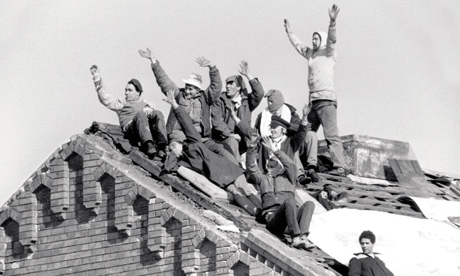
Sunday, 20 January 2008

Review - The Prison and the Factory (1981) by Dario Melossi and Massimo Pavarini

this is the version translated by Glynis Cousin and published by Macmillan

This book is a useful study in the development of the forms of punishment under capitalism. For marxist criminologists, how punishment and other methods of crime control cam into existence and developed is an important question, particularly given as marxists would theorise that the forms of the criminal justice system depend on the stages of economic development to an extent.
Others have studied the development of prisons as punishment too, and Melossi and Pavarini draw on both Rusche and Kircheimer as well as on Foucault in their analysis.

They start with asking why imprisonment is the dominant form of penalty under capitalism. pretty much every punishment under modern capitalism is either imprisonment, or non-compliance is backed up by it (which is the case for probation, home detention curfews, fines, community sentences etc.) The only major exception being the death penalty, but even this requires imprisonment to hold people on death row.

They also point out thatunder feudal regimes prisons were only used to hold debtors and not as punishments themselves which in those times, Foucault points out in Discipline and Punish, were corporal rather than carceral. This they link to life, physical condition and money being of more value to a person, than "human labour measured in time" (pg3)

Another theme running through this work is the influence of religion. The authors note the existence of a distinction between 'good poor' and 'bad poor'. Both were out of work, but the 'bad poor' were wicked because they'd been forced to resort to crime and had to be forced to work, whereas the 'good poor' hadn't and should be given assistance.

The work then goes on to argue that the development of prisons and workhouses were places "for the teaching the discipline of production" (pg 21) and thus are closely realted to the formation fo the proletariat from the landless, workless ex-peasant masses created by the enclosure of pastures. Indeed, they also speculate that the intensity of repression depended on the availability of labour during the period.

The development of the prison in Italy is then discussed, considering the specific economic development of that country. There is one question that they tunr to that deserves special mention, social banditry. This occurs becuase of the explusion of peasants from the land, some trun to banditry to survive. The authors view it as a form of class rebellion, and to them some sort of proto-revolutionary action. However, whilst I recognise the class nature of the banditry, their actions were incredibly destructive, either robbery or destruction of property, and thus it is a backwards looking, reactionary course of action. For me, it's like rioting, whilst we understand that social conditions have caused it, such acts will get the oppressed carrying them out nowhere.

Similarly, the development of prison in the early USA is examined. One of the interesting things that the authors note is the introduction of the 'Philadelphia model' of prisons (which was based on the strict isolation and observation of prisoners - like Bentham's panopticon) happened at a time when prison labour was uneconomical. When this changed due to a shortage of labour, gradually the 'Auburn model' was adopted which saw inmates working communally during the day.

The final chapter of the book is a sort of conclusion to the book. In it they state their central thesis - that when there is high unemployment prison takes on a destructive punitiveness, but when unemployment is low it takes on a re-educative, rehabilitative form, partially to lower wages. Personally, I think this simplifies things too much and certainly makes little sense when applied to Britain and other neo-liberal countries over the last 20 years or so. Furthermore I'd question what they mean by discipline - I could see prison having a physically controlling/coercive effect but they seem to mean some sort of mental effect to produce 'disciplined proletarians' or un-thinking slaves. the prisoners rights movements that developed around the 1960's and 1970's show this as being inaccurate. Moreover if prison is supposed to be this wonderful invention for creating 'disciplined proletarians' how come recidivism is so high (above 60%). Melossi and Pavarini's theory is an interesting one, but it's full of holes.