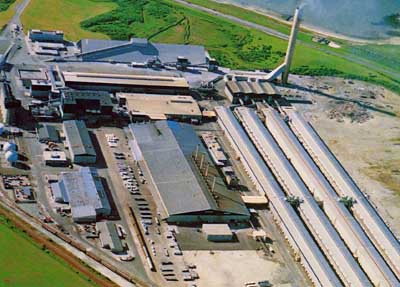
From Socialist Party Wales website -original with references can be read http://www.socialistpartywales.org.uk/front5.html. Photo is of Anglesey Aluminium.
Dylan Roberts (Socialist Party, North Wales)
Historically, the economy of the north west of Wales has been based upon agriculture and tourism; the economy of the north east of Wales upon heavy industry and manufacturing. However, over the past few decades, we have witnessed the death of heavy industry, and an agricultural sector decimated by the globalisation of food consumption. In both west and east we have watched as steelworks, collieries, quarries, and agricultural smallholdings have disappeared, to be replaced by unskilled manufacturing and service sector jobs which are inherently low paid and insecure.
The end result is that North Wales is one of the most highly skilled yet poorly paid regions of the UK, and which has witnessed rapidly increasing unemployment in recent times. According to the 2008 figures from the Annual Survey of Hours and Earnings (ASHE) report from the Office of National Statistics, the average annual wage in Wales is around 13% lower than the equivalent wage for across the UK, with the UK average wage sitting at £25,123 per annum in 2008, compared to £21,831 per annum for Wales. The reality in north Wales is likely to be even lower again. (1)
North Wales has been heavily hit by the capitalist crisis in 2009. We have already witnessed the loss of a vast number of jobs in the region, with major employers such as JCB, Indesit, Deep Stream Technologies, Corus, Marshalls Cement, and many others, either laying off staff or closing altogether. Many other employers have frozen pay, reduced working hours, terminated the contracts of temporary and fixed term workers, or are threatening to take such measures in the near future. In the past month we have seen a number of key employers undertake job cuts or site closures in both the west and the east of the region.
Air Products
On June 30th, Air Products, an American owned multinational, announced their site in Acrefair, Wrexham, would close, with the loss of around 200 jobs. Air Products are switching production to China. While the loss of 200 jobs in a relatively under populated area is reason enough to be concerned, the Air Products case is worthy of further comment for a number of reasons. Air Products’ Acrefair plant opened in 1950, at a time when the bulk of the workers of Wrexham were employed in heavy industry. However, in the modern day, Air Products was one of very few remaining employers of skilled manual labour in the area. The fact is that the skilled workers at Air Products will struggle to find similar work anywhere within this region. This means they will potentially face a long period of unemployment, and when they do find employment it is likely to be low paid and insecure work within unskilled manufacturing or the service sector. The alternative is, like many before them, to leave the region.
But why is Air Products closing their site? Well, naturally management blamed the recession, citing a drop in profits in the first quarter of 2009 and “on-going cost pressures and the changing demand for our products, which is shifting to other parts of the world, notably Asia". (2) Yet Air Products are not struggling, and neither was the Acrefair plant unprofitable, as management conceded at the beginning of the consultation period in April. Indeed, in 2008 they recorded a global turnover of £11 billion pounds, with profits of nearly £1 billion. Whilst they have seen a downturn in profits in comparison to previous years, it is nonetheless evident that they remain extremely profitable.Indeed, in the first quarter of this year they turned a profit of US $189 million, which equated to more than US $60 million a month, or in even starker terms, more than US $2 million a day. Less profit than they were used to perhaps but hardly a struggling company. (3)
What they are doing is using the cover of the recession to move production to where labour costs are lower, in order to squeeze the profit margin some more. Janet Ryder, Plaid Cymru AM for north Wales, described it as a "betrayal" of a workforce that had been "consistently profitable" for Air Products. (4)
Air Products had announced a consultation period in April, which of course meant that the decision had already been made. The workforce and Unite had put forward an alternative strategy that would have saved jobs and kept the plant alive, whilst conceding to some of Air Products' demands. Whilst offering concessions – job cuts – isn’t necessarily the right path to take, nonetheless this would have preserved some jobs and retained a much needed employer of skilled labour in the area. Air Products, however, were not interested.
As unpalatable as this is, it might not be quite so devastating if it was an isolated incident. Unfortunately, it is anything but.
Anglesey Aluminium
Anglesey Aluminium is, along with the Wylfa nuclear power plant, a major employer on the Isle of Anglesey, and in fact one of the largest employers in north Wales. It is estimated that the firm amounts to around a third of the entire economy of the isle of Anglesey. (5)
Anglesey Aluminium, a joint venture between Rio Tinto (who own 51% of shares) and Kaiser Aluminium (49%) announced in early July that they would be offering voluntary redundancy to 140 workers, with the remaining jobs almost certain to go in September when the plant ceases production. Anglesey Aluminium intends to retain only 80 workers from the 500+ strong workforce. The effect that the closure of Anglesey Aluminium will have on the island cannot be emphasised strongly enough. The north west of Wales is an overwhelmingly rural area with an over reliance on tourism, and the loss of such a significant employer will have long term consequences for many generations of workers on the island.
The plant is closing due to the end of a contract for cheap energy supply with Wylfa, with management citing this as the primary motivation for the closure. The only way the 400 jobs due to go in September could be preserved is if Anglesey Aluminium obtains another source of subsidised energy, which seems highly unlikely.
The closure of Anglesey Aluminium had been on the cards for some time. The closure of Wylfa was announced back in 2006, with the nuclear plant expected to close in 2010. However, earlier this year the Nuclear Decommissioning Authority (NDA) announced that they may extend the lifetime of the existing Wylfa plant (Wylfa A), with a second nuclear plant (Wylfa B) having been proposed back in 2006. One of the reasons given back in 2006 for the creation of Wylfa B was for the need to continue the supply of energy to Anglesey Aluminium, although this would no longer be at the reduced rate.
The proposal for the second generation nuclear plant, Wylfa B, was voted through by Anglesey County Council, following a propaganda drive by the council and local Labour MP Albert Owen, who heralded the proposal for Wylfa B as a boon for the island and claimed that 1,500 jobs would be at stake if Wylfa B didn’t go ahead.
Iain Dalton, of the Socialist Party Bangor branch, has written previously about Wylfa. On 6th February 2006, Iain noted that:
“They claim that without it, the island will lose 1,500 jobs. This figure has been inflated by Wylfa taking on temporary workers, and by including 400 jobs at Anglesey Aluminium, which the company has publicly stated will not be threatened by closure of Wylfa, although they may use it as a pretext to move production to a lower wage economy. However, a new nuclear station would employ far fewer people than the current station due to new technologies, and that is before cost-cutting practices of the new station's private owners (Wylfa is presently publicly run).” (6)
Indeed, Iain’s words have been borne out. Despite the claims of Albert Owen and Anglesey CC, the fact that the proposal for Wylfa B has been given the go ahead has not prevented Anglesey Aluminium from using the end of the discounted energy supply as an excuse to close the plant, with Rio Tinto and Kaiser Aluminium exploiting the situation in order to switch production to cheaper labour markets.
The Welsh Assembly Government (WAG), in conjunction with Westminster, offered a financial package of £59 million over four years to compensate for the loss of the discounted energy supply, which amounted to an astounding £1 million a month state subsidy. 7
However, management at Anglesey Aluminium, Rio Tinto, and Kaiser Aluminium rejected the deal, claiming that they would need at least double that figure in state subsidies to retain production on Anglesey. Yet Anglesey Aluminium has been extremely profitable in the 36 years it has been on the island. Furthermore, both Rio Tinto and Kaiser Aluminium are vast multinationals turning huge profits.
Rio Tinto, which owns the controlling stake, recorded record profits in 2008, delivering net profits in the first quarter of 2008 of an astronomical US $2.94 billion. They have not faired quite so well in the first quarter of 2009 but that still equates to US $1.6 billion in net profits between January 1st 2009 and March 31st 2009 – or US $177 million per day! 8
Yet again, we see private enterprise demanding that the losses are nationalised while the profits remain private.
As with Air Products, it is evident that the crisis of capitalism and rising production costs are being used as a scapegoat, for attacks on pay and conditions and the switching of production to non-unionised plants in low wage economies, in order to drive these obscene profit margins up yet further. In both cases, there is no pressing need to switch production; it is simply another case of profits coming before people.
As Iain pointed out, and as has been borne out by the impending closure of Anglesey Aluminium, the claim that a new second-generation nuclear facility on Anglesey would not only retain existing jobs but also create new jobs has been proven to be false. As Iain pointed out in the same article:
“Local campaign group Pawb (People Against Wylfa B – Pawb means ‘everybody’ in Welsh) are arguing for an alternative employment plan for the island. Much of this lies around the potential for harnessing renewable energy sources, as the island has near ideal conditions for several technologies including tidal, wind, solar and wave. Additionally, based on the experience of decommissioning Trawsfnydd in nearby Gwynedd, decommissioning the current Wylfa station will provide at least 500 jobs for at least fifteen years.”( 9)
Local politicians such as Albert Owen have argued that building a renewable energy plant on the island would not have been viable, as such a project would take many years, and would therefore leave the skilled workers of Wylfa and Anglesey Aluminium without employment. Yet as Iain points out above, decommissioning the existing Wylfa A plant would have provided significant employment for the next decade and a half, and a new renewable energy plant would have created both long term employment for the people of Anglesey, and shorter term employment as the plant would need to be built. Instead, it appears that Anglesey will retain a nuclear power plant, with all the inherent environmental dangers and impact that come with that, but will still suffer from mass job losses as Anglesey Aluminium ceases production and Wylfa inevitably cut jobs due to new technologies.
The ideal opportunity for a clean, green, environmentally sound mass source of renewable energy has been missed, in addition to the vast number of jobs in the beleaguered construction industry that could have been created by building such a plant.
We can also see further evidence of the short-termist attitude to the construction sector elsewhere in north Wales.
Hanson Cement
Hanson Cement – formerly Castle Cement – in Padeswood, near Buckley, Flintshire (north east Wales) announced on Tuesday 7th July that they had entered a 90-day consultation period, with a view to 96 redundancies. 56 production jobs and a further 37 in distribution are under threat, which would leave only a skeleton staff of 46 at the plant. This is despite promises made by Hanson that there would be secure work for 110 workers. The plant is home to the most modern cement kiln in Europe. (10) Job losses at the plant in Flintshire have been on the cards for some time, with Hanson prepping the turf back in 2008. (11) The threatened job losses have been blamed on the stagnant construction industry, with a spokesman stating that the plant was "reducing output to a minimum in light of the continuing downturn in the construction industry."
This follows the closure of Marshalls Cement, not far from Hanson Cement, in Llay, near Wrexham, which shut down in may with the loss of 55 jobs. (12)
This follows the closure of Marshalls Cement, not far from Hanson Cement, in Llay, near Wrexham, which shut down in may with the loss of 55 jobs. (12)
In both cases, management has cited the stagnation of the construction industry and the resultant drop off in demand for cement as the primary reason for the job cuts and closures.
Hanson Cement (and Marshalls) does differ from both Anglesey Aluminium and Air Products, in as much as the capitalist crisis has undoubtedly had a severe effect on construction. Hanson are not switching production; rather, they are ceasing production, at least at the Flintshire plant.
Hanson Cement (and Marshalls) does differ from both Anglesey Aluminium and Air Products, in as much as the capitalist crisis has undoubtedly had a severe effect on construction. Hanson are not switching production; rather, they are ceasing production, at least at the Flintshire plant.
It does, however, seem ridiculous that we are currently seeing massive job losses in the construction industry across the UK when housing remains such an issue, with the BNP in particular using pressure on limited social housing stock and an absence of affordable housing to gain political capital. Whilst the news that the New Labour government intends to undertake a programme to build 3,000 council houses and 20,000 affordable houses over the next two years is to be welcomed, in as much as it is better than nothing, it remains evident that this does not go far enough. (13) A programme could be adopted to build new social housing stock and affordable housing on a mass scale, which, combined with the termination of the right to buy programme, would serve to alleviate the huge pressure on limited existing stock, provide employment for the hundreds of thousands of threatened construction workers in the private sector, and cut off the BNP and the far right's main source of oxygen by providing employment and housing on a vast scale.
Likewise, a similar large scale construction project on Anglesey could have not only provided work for the beleaguered construction workers, but also delivered an environmentally beneficial source of renewable energy, which would have sounded the death knell of nuclear power in the UK.
In addition, key employers such as Air Products and Anglesey Aluminium (Rio Tinto) should have been prevented from switching production to non-unionised plants in low wage economies given that the levels of profits of both multinational companies, and the continued profitability of their north Wales plants, demonstrates their viability.
Both companies should be made to open their books, and if necessary both sites should be nationalised to ensure there are opportunities for skilled workers in the already decimated local economy of North Wales. However, it appears that while the government, and indeed the capitalist establishment as a whole, are more than happy to bail out the bosses and the bankers, there are no such plans to bail out the workers.


