Showing posts with label human rights. Show all posts

Friday, 23 January 2009

Will Israel's Leaders Be Put Before a War Crimes Tribunal?

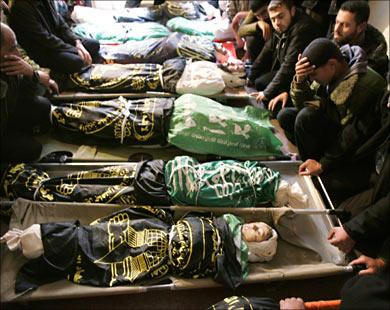
Details of what some suspected weeks ago are now beginning to emerge from Gaza. Yes, the Israeli regime has used 'illegal' weaponry in its war upon Gaza. James Caspell at La Lutte Continue! has reposted an al Jazeera article with the details of these, but i'll briefly summarise them here. Doctors are reporting that Israel has used Dense Inert Metal Explosives (Dime) weapons which explodes into tungsten dust - the metal in this may possibly be radioactive too. Amnesty International has also confirmed that it believes that the Israeli army has used white phosphorus weapons too, it basically causes really, really bad burns and is very difficult to put out.
Yet despite the clamouring of many around the world for the Israeli government/army to be tried for use of these inhumane weapons on civilians, will this actually happen?

Well Israel isn't a part of the treaty that created the International Criminal Court and Gaza isn't officialy classed as a state, so its unlikely that route would be used. Yet it could potentially be possible to create some sort of special tribunal like was done for the former Yugoslavia and Rwanda.
But the problem is Israel (and it's US backers) are hardly likely to let anyone be tried. In general, people only face war crimes tribunals if they have a) lost power and b) lost internal or international support. The current Israeli government hasn't done either at the present. And if it were to lose the upcoming Israeli elections, it would be to a party further to the right of it, who would hardly likely to give them up of their own accord.
That said, it is theoretically possible that a new government may give up other people if it is put under a lot of pressure - both internationally, but crucially within Israel itself. It may choose to scapegoat them for a crisis it gets itself into at a future point. But as it stands I would say it is highly unlikely at present.

Sunday, 7 December 2008

Judiciary challenged over the right to protest

I'm currently writing an essay for uni on preventive detention and saw this in this weeks issue of the Socialist. I'm goona put up a few more posts on this subject in the next week or so.

THE MAY Day Detainees went back to court last week. This time they appealed to the House of Lords against the judgement from the High Court, which said it was lawful for the Metropolitan Police to hold 3,000 anti-capitalist protesters for up to nine hours in Oxford Circus on May Day 2001.

Socialist Party reporters

Then, the detainees were contained and surrounded by rows of riot police and police on horseback and told they were not allowed to leave and were denied access to toilet facilities, food and water.
The May Day Detainees set up a campaign in defence of the right to protest which has involved court action, accusing the police of false imprisonment under the Human Rights Act.
The test case detainee is Lois Austin, Socialist Party member and campaigner. Lois was refused permission to leave the containment even though she had to collect her eleven month-old baby from a nursery.
The trial judge, Judge Tugendhat, proclaimed that the detainees were not aggrieved by their detainment but in actual fact quite enjoyed it! He also said that while there was a deprivation of liberty the police had no choice but to hold the crowd in this way because it was necessary to prevent a breach of the peace.
The findings of the original judgement are extremely dangerous for the right to protest in this country. It gives a green light to the police to ban any protest because one or two members of the crowd may be involved in, or about to commit, activity the police deem to be violent or threatening a breach of the peace.
The court of appeal took the view that there was no deprivation of liberty. They found that the detention in Oxford Circus was akin to holding away fans at a football match or holding car drivers up on a motorway after an accident.
They also said that the police action was justified under article 51b of the Human Rights Act because the crowd was being held to assist police officers in carrying out their duties, which were to arrest those threatening a breach of the peace. Apart from article 51b, the court of appeal said that the Human Rights Act did not come into it.
The detainees will get the verdict from the law lords in a couple of months but if the discussion in the court is anything to go by, it isn't looking good.
Human rights
The sometimes surreal discussion on issues relating to human rights was eye opening at times.
A discussion on rights that we all believed to be unqualified, like the right not to be tortured, or to be illegally imprisoned, was alarming. Some of the law lords at the trial seemed to be hinting that maybe torture only becomes torture once a certain threshold is reached!
The May Day detainees' QC had to remind the law lords that the right not to be tortured is, according to the Human Rights Act, an unqualified right and thresholds of what is acceptable do not come into it.
We have to wait and see what the Law Lords' judgement will be. There didn't seem to be much sympathy for the detainees during the hearing. Whatever the verdict, the right to protest is under attack and must be defended.

Sunday, 23 November 2008

Democratic republic of Congo: Civil war erupts once again

From this weeks issue of The Socialist (NB. an shortened version of this article is also appearing in Seren, the newspaper of Bangor Students Union)

RENEWED FIGHTING has broken out around the city of Goma in the east of the Democratic Republic of Congo (DRC) between armed forces led by the rebel general Laurent Nkunda and those of the Congolese president Joseph Kabila, deepening the region's humanitarian crisis. The fighting is taking place as talks are on-going between the two protagonists, brokered by the United Nations special envoy, the former Nigerian president, Olusegun Obasanjo.
Iain Dalton reports on the background to this conflict, particularly the role of the western powers, multinational companies, regional elites and UN troops in fermenting and perpetuating the civil war.

IN THE last few weeks over 250,000 refugees have fled from North Kivu province in the east of the Democratic Republic of Congo (DRC, formerly Zaire) near the border with Rwanda. This brings the total of internal refugees in the region to over one million.
Rebels in the National Congress for the Defence of the People (CNDP), under the control of ethnic Tutsi, Laurent Nkunda, have been advancing on government strongholds in the province - particularly the regional capital Gomu.
Although this conflict has only been major news headlines for the last few weeks it has been going on for years, since Nkunda rebelled against the DRC army in 2004.
The conflict has been a disaster for the people of the Congo. Since the civil war began in 1998 over five million people have been killed, life expectancy is only 45.8 years in the country as a whole, and in North Kivu it is 43.7 years; 73% of the population are in poverty.
Additionally the region has seen large usage of child soldiers and North Kivu province itself is the worst area for sexual violence in the world - according to United Nations (UN) 2007 figures there are around 350 rapes a month, although local figures suggest over 800 in April 2008 alone.

Unresolved conflict

Yet the civil war in the DRC was supposed to have ended in 2003. Then, a peace deal was signed to end six years of fighting after the deposition of the dictator Mobutu Sese-Seko. Laurent Kabila, who headed the Rwandan-backed forces Alliance des Forces Démocratiques pour la Libération du Congo-Zaïre (AFDL), tapped into the mass discontent with Mobuto's rule and declared himself president.
However, this coalition broke up almost as soon as Kabila took power and Rwanda in particular began backing a new rebellion, the Rassemblement Congolais pour la Democratie (RCD) to look after its own mineral interests in the country. Kabila was backed with arms and troops by the regimes of Angola, Zimbabwe and Namibia.
In reality, however, an on-off civil war has been going on ever since the deposition of the first prime minister of the DRC, the anti-imperialist Patrice Lumumba in 1960.
The Belgian colonial government and other western powers had wanted a compliant stooge post-independence government. Lumumba was deemed too much of a threat to the imperialist powers and the CIA-backed colonel Mobutu took power in 1966.
The western powers considered Mobutu as a bulwark against communism in the region. He crushed the remaining Lumumba supporters (Lumumba had been executed in 1961) but sporadic revolts continued thereafter and were fought with the aid of western powers. Some rebels, such as Kabila, even carved out their own statelets within the country and financed themselves through trafficking gold and other materials.
The collapse of the USSR at the beginning of the 1990s meant that Mobutu's bloody regime became unnecessary for maintaining US interests in the country.
Added to the political crisis was the backlash from the ethnic civil war in Rwanda when over one million ethnic Hutus fled from the country - including many members of the Interahamwe militia which Mobutu used against the Tutsis in Kivu to prop up his failing regime. It is these same ethnic Hutu forces that Nkunda alleges government troops have been supporting in attacks on Tutsis and he claims that his rebellion is in defence of Tutsis, particularly his own native group the Banyamulenge.

Resource rich

The country's rich mineral resources (particularly diamonds, copper, zinc and coltan - which is used in mobile phones and computers) have been fought over in the civil war with various companies backing warlords with arms to facilitate their plundering of the country. A UN report named 85 multinationals that it believed to be "violating ethical guidelines" - such as Anglo-American, Standard Chartered Bank, De Beers etc.
But it isn't just the companies themselves. It is no accident that when an anti-imperialist government under Lumumba was elected in 1960, Belgian imperialism sought to support the break away of resource rich Katanga province in a manner that parallels the moves to autonomy by the Media Luna provinces in Bolivia.
Regional powers are also in on the act. Zimbabwe, one of the backers of the Laurent Kabila regime, was granted concessions in the diamond industry for example, whilst Rwandan forces control some mines in the Kivu region that the country borders that are protected by the RCD it backs.

Socialist answers

Imperialism and capitalism have devastated the DRC and it is ordinary people that are suffering. However, many journalists, international human right groups and aid agencies are still calling for intervention by foreign troops. For example, Johann Hari in the Independent (30/10/08) suggests that UN peacekeepers will need to be kept in the region to 'stabilise' the country and that a coltan-tax should be created to fund this.
But Monuc, the current UN peacekeeping force, has over 16,000 troops in the country and is blatantly failing to stop the abuses. Indeed UN documents disclosed by Human Rights Watch demonstrate how UN peacekeepers in Congo took part in weapons trading with rebels and smuggling.
These forces are part of the problem because by their very nature they are subordinated not to the needs of ordinary Congolese but to the imperialist powers that dominate the UN security council.
Like in Iraq at present, what is needed to combat the abuses of militias, rebels, government troops and 'peacekeepers' alike are democratic, working class-based defence organisations that can cut across the ethnic divides and build up the mass resistance of workers and peasants to both militia-backed warlords, multinational companies and the major capitalist powers.
Capitalism has failed in the DRC.It is only socialist ideas, such as taking the mineral resources into public ownership to use for the common good of society and not to fatten the pockets of warlords and big business, that can provide a way out of the nightmare for the working class and poor in the DRC.

Wednesday, 23 July 2008

Rights and Their Necessary Material Conditions

This piece looks at a chapter by Hector Gros Espiell from the book The Poverty of Rights (eds. Van Genugten & Perez-Bustillo, 2001). This book was the only book in my university library which attempted to deal with human rights in Latin America.

The fundamental thesis of this piece is that human rights can only be secured when there is an economic basis sufficient to sustain them. The second point flowing from this is that although many countries proclaim support for the idea of human rights, this means nothing if the above condition is not met. The author of this piece cites a wealth of human rights legislation that shows the official support for political, legal, cultural and social rights, but he notes that the actual existence of these rights is patchy in many areas of the world.
The author’s belief of how to achieve this is that the necessary material conditions is through the development of the capitalist state, saying that “…we have to recognise that law, that is to say the law of a democratic state committed to social justice, is the necessary but perhaps insufficient condition to promote the economic and social change necessary for rights to be realised” (pg.139)
But is this self-same capitalist state, which is in existence to represent the interests of the capitalists profits rather than the needs of the working masses, that keeps the present disequilibrium in society that presents such needs from being realised. Of course, this comment is in all likelihood also directed towards indicting the bureaucratic, totalitarian, Stalinist states, and it is fair to say that the spread of workers democracy in those countries would have led to being able to put in place the guaranteed rights that human rights activists crave. But then this is basically the same programme that is needed in the rest of the world to give workers the ability to control their own societies and give the material basis for full universal rights for all.

Friday, 30 May 2008

The Socialist Crime Fiesta

This weeks socialist features a wealth of article of interest to the budding left/socialist criminologist. We have articles on youth crime, the exeter attempted terrorist attack, civil liberties, a review of a crime tv programme and a report of barbaric violence in South Africa. To read these go to http://www.socialistparty.org.uk/main/The_Socialist

Wednesday, 21 May 2008

Transitional and Failed Societies: What Are They?

This piece comments on some segments of Community Policing: National and International Models and Approaches by Mike Brogden & Preeti Nijar (2005).

States undergoing some kind of transformation are usually the sites of international criminal justice, which are supposed to settle scores with the past and provide a stable basis for the development of a (capitalist) democratic society. Although this is my starting point for this essay, it is worth pointing out that Brogden and Nijar are looking at similar states but more from the perspective of developing a critique of community policing models which are being ‘exported’ there by the advanced capitalist countries (particularly the USA and Britain).
Of the countries that Brogden and Nijar study, they seek to divide them into three groups those which developed community policing themselves (Mostly western advanced capitalist countries but some Asian countries are included in this category – namely Singapore, Japan and China), transitional states and failed states. I wish to examine these categories to determine their usefulness beyond this particular instance.

Transitional states are those which have usually gone through some international criminal justice ‘cleansing’ of the past (either a Truth Commission or International Criminal Court/Tribunal). They usually (but not always) have had some kind of dictatorial government and are in the process of attempting to build institutions of bourgeois democracy. Examples of these countries include such places as South Africa and Chile in the early 1990’s for example. For me a key ingredient of being a ‘transitional’ state rather than a ‘failed’ one is that the state remains intact – it is merely modified or purged of a few elements.

Brogden and Nijar state that “‘Failed’ societies… are essentially states in which the primary reason for transformation is due to the collapse of structures of political governance… (which) have been disappearing into a void.” (pg.189-190) However, they later go on to state “In this text, the term ‘failed society’ is intended to encompass those societies of the previous Soviet system which straddle a chasm between the disappearance of their command economies and the chaotic onrush of a free market system.”(pg.190)
There are two points I wish to make in relation to this, both related to each other. Firstly, that the term failed society is a poor one really – much better would be collapsed or even better disintegrated society. Secondly, surely societies where there has been a collapse of the ruling bodies into a void range further than just post-Stalinist countries. For example, what about Iraq and Afghanistan over the last few years – surely they are prime examples of power vacuums? I’m sure there are further examples that could be utilised here too.

But before I conclude, I wish to return to the notion of transitional states. In them there is a key question which I have asked in relation to them which is what are these states a transition from and to what. In there case they are transitions from a dictatorial/fascist regime to a capitalist democracy. But there are other types of transitions – in particular for us the question of dual power where the transition to a workers state is posed. The problem with the examples used in the book is they look at transformation from one form of capitalism to another or from non-capitalism to capitalism, but never with any state that is going into a non-capitalist form (whether from capitalism or not). How can such a schema be of use to us when it has such flaws?

Monday, 5 May 2008

Women Prisoners in Nothern Ireland

This piece takes a look at Phil Scraton and Linda Moore’s article in the Spring 2008 issue of Criminal Justice Matters on this issue.

One of the big problems with imprisoning women is that not that many get sentenced to imprisonment. By that statement I don’t mean that we should imprison more women, but that female prisoners are only a small proportion of the prison population and this has meant problems in terms of facilities for women prisoners.
The piece details the effects on women prisoners of being held in wings of male prisons. The truth about such imprisonment are shocking – there are limited facilities for recreational activities, education and workshops, prisoners in the two cases they discuss are locked up for a minimum of 17 and 18 hours a day. However, the most horrifying cass they cite refer to prisoners held in solitary and punishment cells, and I shall quote some of the examples they give:

“We found deeply disturbed young prisoners held with adult women and a child, flesh torn and cut from her ankles to her hips, hands to her shoulder, dressed in a canvas gown, no underwear, lying on a concrete plinth, no blanket, no pillow, in a punishment block strip cell… Also down the block was a grandmother, epileptic, diabetic, colostomy bag, weeping varicose veins, held in solitary for abusing officers. Prisoners stated that she was taunted by officers who openly refused to give her tea unless she complied. This was how self-harming and ill women were ‘managed’. During the research, a second woman, Roseanne Irvine, took her own life, having been held in the punishment block, deeply distressed and tearing her own hair out…”

Due to them being held within another prison facility, the women were escorted everywhere and were even forbidden to acknowledge other prisoners – which led to ridiculous instances where women were punished for speaking to their sons. Furthermore women were being humiliated by being strip searched when they were menstruating, for example. Prisons, and especially those for women, are, to paraphrase a former Home Secretary ‘not fit for purpose’. They don’t actually deal with the problems that offenders have and actually serve to aggravate prisoners problems. I agree with the line they take at the end of the article – arguing before for reform of the existing system to meet these needs, but also arguing against prison expansionism and for alternatives to sentencing altogether (although I suppose that would depend on the ‘content’ of these alternatives).

Wednesday, 30 April 2008

Sri Lanka - Twenty five years of war and conflict - Socialists fight in Eastern elections

Yes, another repost - this time from the CWI wesbite www.socialistworld.net - but yet again another story connected with human rights - regualr posting wil resume shortly.

Srinath Perera, United Socialist Party, CWI, Sri Lanka
The Sri Lankan government is engaged in a war against the Liberation Tigers of Tamil Eelam in the north of the country. This year marks its 25th anniversary. This war has cost more than 70,000 lives and billions of rupees of the country’s national wealth.

Both sides have had ups and downs in the conflict and no one has emerged victorious. In 2002 the then prime minister, Ranil Wickramasinghe, and the ‘Tigers’ entered into a ceasefire and the war was halted. Though negotiations were started to find a political solution to the problem they broke down amid accusations by both parties of violating the ceasefire. There was no progress towards negotiations to find a political solution to the Tamil national question. The present president, Mahinda Rajapakse, who came to power in November 2005 on a Sinhala nationalist platform, virtually went back on the ceasefire agreement and again started military attacks in late 2006.

The Sri Lankan military was able to capture Tiger-held areas in the East mainly due to the split in the ranks of the Tigers in that province last year. The president formally abrogated the ceasefire agreement in January this year.

Now the government has started a large-scale military offensive in the North to capture the Tiger stronghold in Wanni and Rajapakse has publicly stated that he wants to get Prabhakaran, the elusive leader of Tamil Tigers, “dead or alive”! This points to the thinking of government leaders that they can crush the Tigers by eliminating their leadership.

However, the present offensive which is in its fourth month now has not yielded any significant gains for the government. The president once spoke about a military victory in the North by the Sri Lankan New Year, which was in mid-April, and the military leaders now give deadlines of August and the end of the year, which indicate that the Sri Lankan military is still far away from capturing the Wanni

The government is hell bent on silencing any opposition to its strategy and programmes. Government and military leaders are labelling left party and trade union activists, human rights campaigners, journalists and media organisations and institutions as ‘traitors to the nation’. Physical attacks and threatening calls are carried out to intimidate such people.

Human rights are violated openly and armed groups closely working with the military are abducting people, mainly Tamils, for ransom. Disappearances, abductions and extra-judicial killings are reported almost everyday, however the government or the police have not taken any meaningful steps to alleviate the situation.

At the moment, the government’s main anger is directed towards the journalists who expose corruption involving top government politicians and military leaders. Twelve journalists, the majority of whom are Tamil, have been killed in the last two and a half years and several others physically attacked. The printing press of one newspaper which is critical of the government was set on fire inside a ‘high security zone’, indicating the military involvement therein. People very much suspect that these death squads operate with the connivance of the defence secretary, Gotabhaya Rajapaksa, a brother of the president who has vociferously denounced all those who utter even a word against the war or corruption involving the government and military leaders.

Economy
In the mean time, the economy is in dire straits. The war is eating into the state coffers and the government is very very lavish in spending for the war while the ordinary masses are left to fight a loosing battle for their day to day survival. Inflation was around 24% in the last two years and 23.8% in March of this year according to Sri Lanka’s Central Bank. The price of commodities such as rice and milk powder have sky-rocketed during the last six months and the government has not done anything proper to alleviate the suffering of the people.

While the crisis in the world economy and steep rise in the price of oil have contributed to this situation, people are very much angry about it. They blame the rulers as this is mainly due to the inefficiency and mismanagement on the part of the government, comprised of 108 cabinet ministers, probably the biggest in the world. Nevertheless, the main opposition parties and trade union leaders have done nothing against this situation apart from issuing statements. Most of the trade union leaders are allied with the ruling coalition and they do not want to do anything against the government which according to them is engaged in a war to save the country from “terrorism” (of the ‘Tigers’). The working and poor people have been lured to support the war and to believe that the government would make the situation better by ending the war in a very short time.

Bogged down
It is clear, however, that the things are not going to be that easy. At present the government has been able to muster some popular support especially among the majority Sinhalese for its war effort, mainly on the basis of capturing the East and on the promise of the eliminating the Tiger “menace” in the north and the rest of the country within a few months. The Sri Lankan forces seem to be bogged down in a long drawn out war despite their claims of a large number of Tiger casualties. The Air Force has now started bombings in the north even at night. A considerable number of civilians including children have been killed or injured in the past month alone. The LTTE has mounted heavy resistance to the Sri Lankan military offensive in the North and has been almost able to halt the advancing army. While the Tigers undoubtedly have been subjected to heavy attack, causing considerable loss to them, the military is trying in vain to hide the number of casualties among their own ranks, which are not a few by any means.

Unless the government forces are able to gain a significant result within the next two or three months, their support base in the South will begin to evaporate. As the economic burdens get to bear down more and more on them, they will begin to question the wisdom of military leaders hitherto unchallenged by anybody apart from the Left. And people will get war weary. If it were not for the Tigers’ attacks on innocent civilians in the South, such as what seems to have been their work in the bus bombing at Piliyandala on April 25, there would not be much support for the war which is mainly propped up by the ultra-nationalist party of the Buddhist monks (JHU) and the Sinhala nationalist radical petty bourgeois party, the JVP.

Socialist demands
The USP is calling for an immediate end to the war and the beginning of negotiations to find a political solution to the national question of the Tamil people - a vestige left behind by the British colonial rulers. We call upon the government and the Tamil Tigers to respect the human rights of all the people, especially the right to life and the right to freedom of expression. While we cannot have any hope in the Sinhalese ruling class, which is very backward and parasitic, we call for the active involvement of representatives of workers and poor in any negotiations. Only through such participation can the true aspirations of the ordinary masses can be taken into consideration.

United Socialist Party stands in Eastern elections

Elections for the Eastern Provincial Council are to be held on 10 May and the USP is the only left party standing in them. The ruling United People’s Freedom Alliance and the main capitalist opposition United National Party are trying to deceive the people in the East. The Area is comprised of all three communities - Sinhala, Tamil and Muslim – with roughly one third of each. The UPFA is contesting in alliance with the TMVP Tamil People’s L- the split away group from the Tamil Tigers which is still carrying arms and openly acting in collusion with the Army. The UNP is allied with the Sri Lanka Muslim Congress party, which has had the support of the majority of the Muslim people there.

The United Socialist Party is fighting on a platform of an end to oppression and discrimination against Tamil-speaking people, the recognition of a Tamil homeland in a merged North and East of the country with adequate safeguards for the Muslim community, a united struggle of all the people against war, poverty and exploitation and a socialist alternative.

Although the possibility for a free and fair election is very slim with the TMVP’s intimidatory power, the USP is providing the only alternative voice to a people hitherto subjugated by the barrel of the gun.

News Release
Just after this article was written, we received the following statement from the United Socialist Party (CWI in Sri Lanka):

Subramanian Nagularaj, leading candidate of the United Socialist Party for the Batticaloa District in the provincial council elections to be held an 10th May was attacked by alleged Pillayan group (TMVP) members in the heart of Batticoloa town at around 9.30 a.m. on Saturday, 26th April 2008.

Nagulraj and his supporters were distributing leaflets at the main city centre when two men who came on a motor bike assaulted him with their hands and snatched the bundle of leaflets from the candidate and rode away.

The Batticaloa Police was at first reluctant even to entertain the complaint of Nagulraj and only after information was given to the Colombo headquarters they recorded it. However no action has yet been taken to apprehend the suspects.

We are demanding a prompt and impartial inqury on this incident. This proves again this election is being conducted in a state of fear and intimidation by armed groups acting in collussion with the government authorities.
Friday, 4 April 2008

Counter-Terrorism Bill – Massive Expansion of Powers

Passing through parliament at the moment is the governments latest set of measures to tackle terrorism. This is yet another toughening up of existing powers and represents no new direction to anti-terrorist policy. And if the previous policies clearly weren’t working what’s the point in increasing the harshness of them. But this new legislation is not about protecting people, it’s much more about our capitalist government having the power to do what it wants.
The most talked about aspect of the bill is the planned extension to the time that ‘terrorist’ suspects can be detained without being charged from 28 to 42 days. But alongside that there are other elements such as a terrorism register, increased powers to take documents, DNA and fingerprints, allowing the use of phone tap evidence, and most worrying of all perhaps is the power to ban the public from inquests (ie. Into the death of Jean Charles de Menezes).
All these measures are attempts to circumvent accountability and remove more and more freedom from people. It’s an attempt to expand New Labour’s license to do what they want and move in a direction of a police state. These attacks will require action by the labour movement to defeat and further actions to return the other rights that have been stolen from us in the name of the ‘war on terror’.
Rather than removing even more civil liberties there are several ways that terrorism can be combated. Firstly ending the occupations of Iraq and Afghanistan that act as recruiting sergeants for right-wing political Islam. But more fundamentally, we need to put an end to the rule of profit and competition which led the US and UK to engage in these imperialist conquests and create a world in which we eradicate poverty and suffering.

Thursday, 3 April 2008

Immigration and Detention

This piece takes a look at the growing increase of the use of detention of immigrants and asylum seekers discussed in an article by Mary Bosworth titled ‘Immigration Detention’ in the Spring 2008 issue of Criminal Justice Matters.

As Bosworth notes, especially after 9/11, increasingly mandatory uses of detention are being made in the case of immigrants. Not only is this being used on all sorts of foreigners – from those who have overstayed their visas, to asylum seekers, to those who have completed a prison sentence.

As Bosworth points out, Britain leads the way in confining the greatest number of asylum seekers for the longest period of time. And of these immigrants which are held (this isn’t just including asylum seekers), 85 per cent are held in Immigration Removal Centre (of which 7 are contracted out to private security firms, whereas 3 are run by the prison service), 13 per cent are confined in prison and the remaining 2 per cent are in short-term holding facilities (whatever they are?).

However, immigrants detained as these are under the Immigration Acts are not being detained as criminals – yet as we have seen they are being held in the same or very similar institutions as those convicted of criminal offences. As Bosworth points out though, they are being held in places which were (or still are) penal establishments, being looked after by prison trained staff and being administered by former criminal justice system administrators.

Parallel to the crackdown on civil liberties is a crackdown on the rights of non-citizens of a country. But like terrorist legislation, it may find it’s way to affect the rest of the population – Bosworth reports that in Australia citizens of that country had been falsely deported.

So how, do I conclude such a piece as this? I think that for one thing, these actions can only fuel nationalistic and racist tensions in a country. Secondly, that this is to some extents making mountains out of molehills – what benefit is there to punishing immigrants and asylum seekers for being just that? Rather, as ever, we need to remove the social conditions that have led them to become these labels.

Saturday, 29 March 2008

Review – My Life by Leon Trotsky

Having read a year or two ago Issac Deutscher’s three-volume biography of Trotsky, I decided a few weeks ago to get myself a copy of My Life – Trotsky’s autobiography up to 1930.

There are several important differences between Deutscher’s biography and My Life. The first is obviously that My Life doesn’t cover the last ten years of Trotsky’s life. The second and much more important for myself is the different purposes to which they are being written – Deutscher is trying to understand Trotsky’s life from his own position many years later, whilst My Life is an exposition in opposition to the Stalinist slanders that had seen him expelled from Soviet Russia. There are several ways this shows through. Firstly is the constant reference that is made to Lenin at many points, as it was necessary for Trotsky to explain his relationship with Lenin in opposition to accusations about his ‘non-Bolshevik’ past. Secondly are comments on the background of the Stalinist caste at the time of Trotsky’s expulsion, this is not done for the purpose of point scoring, but to contrast them to Trotsky and allow readers to draw their own conclusions.

I don’t know how much point there is in going into the details of Trotsky’s life – most famously he was the chairman of the Petrograd Soviet at points in both the 1905 and 1917 Russian Revolution, the creator of the Red Army. This isn’t to mention the theoretical advances of the Permanent Revolution and the characterisation of the degeneration of Soviet Russia. It’s impossible to do justice to his life here, I’d much prefer to recommend people to read the book to understand for themselves.

But just one last point. In relation to the posts I’ve had on here in relation to human rights I think the last chapter of this book ‘A Planet Without a Visa’ is quite interesting. It tells us of how although the right to asylum formally existed in the countries of Western Europe, the chapter shows how every one of these countries found ways of denying him this ‘right’. I think this illustrates how although rights may exist on paper, the balance of class forces at any one time determines how ‘real’ these rights are.

Friday, 21 March 2008

The Question of Human Rights

Is there such a thing as inalienable universal human rights? Are they just a distraction of the capitalists from class struggle? These are questions I’ve been grappling with over the last few weeks whilst I’ve been trying to write an essay.

The most important human rights document is probably the UN Universal Declaration of Human Rights. Although this recognises such things as rights to medical care, asylum, and so on, it also includes the right to own private property. Although I agree if this were to be limited to personal property, I don’t this should extend to the right to own the means of production – not only because of being a Marxist and arguing for the nationalisation of the commanding heights of the economy, but also because without the aforementioned measure you can’t provide the facilities to guarantee the initial rights.

I think it’s a damning indictment of capitalism that 60 years after declaring ‘so-called’ inalienable human rights it hasn’t put them in place – indeed it seems to be threatening them ever more and more. Human rights as capitalism has presented them are just a fig-leaf to the oppressed masses around the world. Indeed, the UN is effectively a toothless body when it tries to act to curb the interests of the major capitalist powers. For them human rights are fine so long as they don’t interfere with their interests, and if they do then human rights get thrown out of the picture.

So should the working classes support the idea of human rights, or is it just a capitalist sham? As Marxist have always noted; the most advantageous capitalist regime for workers in the bourgeois democratic state – this of course is opposed to fascist or military-police bonapartist dictatorships which restrict civil liberties and human rights. So we should for my mind be fairly supportive. In the works of Marx and Trotsky, the idea of universal morality (to which the idea of human rights is derived from) is rejected, as it cannot exist in a class ridden society. To paraphrase Lenin (from State and Revolution) it is only possible to talk of real universal rights when class divisions exist no more.

In conclusion, answering my own questions I don’t think human rights are a tool of capitalists, I think they are in general an aspiration of the oppressed everywhere to live a decent life. To that extent they are actually in contradiction to the capitalist system that cannot sustain such rights – just take a look at the advanced capitalist countries where in theory they should be most obtainable but they aren’t. Thus the establishment of inalienable human rights is something Marxists should be fighting for, however, we need a system that can provide the necessary infrastructure to guarantee them, a socialist world.

Sunday, 16 March 2008

Security, Civil Liberties and Terrorism

This piece is some reflections on an article by Lucia Zedner entitled Securing Liberty in the Face of Terror: Reflections from Criminal Justice from the Journal of Law and Society. Although several of these recent posts have and will be discussions based on journal articles – this doesn’t mean that the issues are only intelligible to Criminologists – indeed that would be a very dangerous assumption.

In the so-called ‘war on terrorism’, governments have made many attacks on civil liberties in the name of increasing security. Often there is an assumption of a balance between the two that needs to be met, but that the ‘terrorist threat’ has upset the equilibrium and necessitates it swaying away from civil liberties towards security. Zedner’s article focuses particularly on critiquing this notion of balance as well as the relevance of criminal justice to terrorism legislation.

Zedner asks three questions on this notion of balance; What tips the balance? In whose interests? What lies in the scales? She argues that particularly when we have such an ill-defined threat such as terrorism, then any legislation can be extended fairly easily (she cites the example of legislation for Nothern Ireland being extended to Britain) – especially when you have defined someone where ‘the proof of guilt is a mere formality’. She is also critical of the culture which demands ‘that even the innocent individual must positively welcome surveillance, arrest, or interrogation as being in his or her own (as part of the collective) security interest’.(pg514)

Zedner also points out that such a balancing act is impossible to do in any kind of scientific way, as she notes ‘Precisely because it s unknowlable, prospective risk always threatens to outweigh present interest’.(pg.516) Indeed, with such a ‘threat’ the balance is never stable, as she notes ‘The deployment of security as a pursuit is potentially hazardous therefore because it presumes an endless quest, which must continually anticipate and forestall the next challenge by pre-emptive measures.’(pg.518)

However, there are points I would disagree with Zedner’s analysis. Firstly, she assumes that ‘cases of catastrophic risk, public officials may act extra-legally to engage in preventative interrogational torture (that intend to elicit information with which to avert a catastrophe).’(pg.521) actually exist. As one of the other students in my criminology lectures points out (he is doing his dissertation on the topic), these situations have never really existed – it is just an abstract moral question with no basis in reality. I also disagree with Zedner when she says that ‘These are not normal times…’(pg,522) because of the heightened threat of terrorism, but during the 70’s and 80’s wasn’t there the threat of IRA terrorism in Britain, what about Timothy McVey in the US for example? I must add, she does firmly advocate due process and human rights during all of this, but she should be critical of these assertations and the interests they serve.

Zedner as I have mentioned correctly defends due process and advocates that ‘Measures against terrorist suspects should, as far as possible, be taken within the mainstream criminal justice system’(pg.529), but I would go further and remove the ‘as far as possible’ from that sentence, after all terrorism is multiple acts of grevious bodily harm, murder etc. She also sees judges as the defendants of due process and civil liberties in general. However, she also points out that ‘Judges have a worrisome tendency to defer to the executive in matters of security, particularly in times of heightened threat’(pg.526). This however, is not something someone with a Marxist view of how the state operates should be surprised about at all. I have discussed the judiciary in more detail elsewhere however.

In her conclusion, Zedner notes ‘Instead of accepting security as an end in its own right, asking ‘security of what?’ obliges us to specify the goods to be secured. Liberty is one such good’(pg.532). I think a more pertinent question would be security for whom, for which group in society is this ‘war on terrorism’ being conducted? Although Zedner’s article raises some interesting questions, she is far from supplying the answers.

Thursday, 21 February 2008

Human Rights and International Justice

Yesterday I did a presentation on International Justice in relationship to the Pinochet Dictatorship in Chile, this piece is based on some of the material I discussed in that presentation. This area is, in my opinion, very poorly conceptualized and makes lots of unfounded assumptions, I apologise in advance if any of these have creeped into this piece, and would welcome anyone pointing out any if they spot them.

Putting an end to abuses of human rights is something that most people say they would strive for. The response to mass human rights violations in most cases (this is in most cases where there is one!) is some form of international justice. International justice in these cases can be split into two distinct camps in these cases. Firstly there are International Criminal Tribunals (or the now existing International Criminal Court) and secondly there are Truth Commissions. I’ll describe and discuss each in turn then criticise them both.

International Criminal Tribunals are based on the good old fashioned, cost-benefit, rational choice theories. Thus they aim to punish those who have offended against human rights to restore the universal balance. This is also supposed to deter other world elites from copying them too. However, for me this whole method is based on the idea that the tops of society have absolute control over those below them and manipulate them completely. Now of course, to a certain extent this could be the case, but it’s a far too simplistic understanding of society.
Furthermore, tribunals take an awful lot of time, and very few people end up getting tried by them. Similarly, a lot of the time the courts fail to hold people to account, Pinochet is a good example of this, but what about today’s great warmongers Bush and Blair.

Truth Commissions are all about healing and reconciliation through providing an accurate account of the human rights violations that happened over a period of time. They don’t have prosecutorial powers usually, unlike a the Tribunals, and have more recently been used in conjunction with prosecution of the leading figures in carrying out the human rights abuses. They are also often vested with producing suggestions of how such events can be prevented in future.
However, most Truth Commissions are set-up in a transitional period usually between the regime that carried out the abuses and an incoming ‘democratic’ government. This usually means some sort of compromise on the limits and extent of such a commission.

However, in my opinion there are two great flaws with these methods. Firstly, these methods look at these in a limited national conception, the only perpetrators according to these are those within the national country. Secondly, both methods don’t get to the root causes of these situations, the brutal conditions that people are forced to live in around most of the world.

This is just a short piece on this, but for myself one thing however is clear. In a globalised capitalist world, international justice is only possible if it doesn’t interfere seriously with imperialist aims.