Showing posts with label trade unions. Show all posts

Sunday, 2 August 2009

Review – Teamster Rebellion by Farrell Dobbs

I have to say, that when I recently read this book it was not for the first time, rather this book is one that I hold in great regard and wished to re-read it to clarify in my mind some of the issues that the 1934 Minneapolis Teamster strikes raises.
These strikes which the book covers marked the beginning of an upsurge in union activity in the United States that eventually led to the formation of the industrially based CIO. Moreover it was really the first serious labour dispute that the Communist League of America, part of the International Left Opposition, became involved in. The book depicts these strikes in a very easily readable format whilst pointing out the steps taken, tactics chosen that the union local took and why they were taken. To my mind this is a book that all militant trade unionists should read.
But one thing I want to focus on is the way that the defence of the pickets from police attacks and brutality during the strike was organised. Unlike some on the left who seem to cry for workers to be given arms at any occasion as if the main issue is some desire to beat up the police (or at least this is the impression that can often be given), Dobbs is rather more sane as he explains why the strike committee deemed it necessary to arm pickets against attacks from the police as well as from the employer-organised special deputies.

“Up to now the workers had gone about their activities bare-handed; but they found that attempts to exercise their right to peacefully picket were being repressed with police clubs and blackjacks. They decided to take steps to enforce their democratic right to prevent scabs from grabbing their jobs. It would have been a tactical blunder for members of an isolated vanguard to attempt measures such as the strikers were about to take; they would only get themselves clobbered by the police. In this case, however, the means used in self-defence had their origin in a spontaneous mass mood that had been generated by capitalist repression. Since these means were appropriately limited in the given situation to matching the police club for club, the tactics employed were completely valid.”(pg.81)

Later on in the book he deals with the run-up into the third strike, when workers were making preparations for this and the question was raised again.

“At the first strike committee meeting, chaired by Kelly Postal, the question of ‘picketing equipment’ was put on the agenda. For the first time since the truce at the end of the May strike, the bosses would be trying to operate trucks in defiance of the pickets. The last attempt had been stopped when the pickets won a pitched battle with the cops, fought club against club. At this new juncture many pickets were inclined to start where they left off in May, again arming themselves with clubs. In the changed circumstances, however, this would have been tactically inadvisable. It would have given the cops a pretext for immediate violence against strikers who were trying to peacefully picket; and the union would have lost the tactical advantage of reacting to police violence under defensive slogans.”

And finally he discusses the question again in the aftermath of the police shooting at the strikers and killing two whilst injuring several others.

“In the meantime Local 574’s pickets were reacting to the police assault in full keeping with their magnificent fighting spirit. After the shooting, many who had escaped injury dropped from sight briefly, only to return soon armed with various kinds of weapons. They now had shotguns, deer rifles, revolvers, hunting knives, and various types of souvenirs from World War I, which the veterans among them had brought back from France. Having bested the cops club-against-club in May, the strikers were now prepared to face them gun-against-gun. Although their cause was just and their courage admirable, it would have been a grave tactical mistake to attempt to go through with such an undertaking.
“The situation was now qualitatively different from what it had been during the earlier battle with clubs. Despite the fact that a club can kill, it is not usually classified as a deadly weapon. By virtue of that fact, self-defence of the kind used in May could be sustained tactically for several reasons: it was carried out by a massive body of pickets who had widespread sympathy within the city as a whole; for reasons described previously, Governor Olson found it difficult to use the state militia against the union; and due to the insular nature of the conflict and the local politics involved, President Roosevelt had little inclination and no ready pretext to intervene with federal troops. Consequently the fighting in May remained confined to a showdown between pickets and the local cops.
“As matters stood after Bloody Friday, however, the situation was entirely different. Being so deadly, their use in self-defence against the gun-toting cops could have been twisted around by capitalist propaganda into the appearance of an ‘insurrectionary offensive’ by the strikers. The bosses would have screamed bloody murder, claiming proof of their contention that our aim was not to build a union but to make a revolution. At the first armed skirmish between strikers and police a clamour would have been raised for Olson and Roosevelt to send in troops against the union…
“Local 574, against which such military repression would have been directed, was engaged in an isolated local action. Nationally, our struggle was paralleled only by two other similarly isolated conflicts… Hence, it could not have withstood the heavy military pressure; the strike would have been broken and the union crushed.
“This was a situation in which the central strike leadership had to act swiftly and decisively. Otherwise impulsive pickets, looking for a showdown with the cops, could have done irreparable damage to the union’s cause while the policy question was being debated. The pickets had to be disarmed forthwith, and the central leaders had to do it on their own responsibility…
“…Once again, Local 574’s incomparable soldiers went out barehanded to face cops with riot guns.
“Our action was promptly reported to a meeting of the strike committee, and the reasons were given for the policy we had followed. After considerable debate the committee approved the course taken, issuing picketing orders accordingly. The orders, which were published in The Organizer, contained a deliberately obscure formulation: “All pickets are hitherto instructed to continue tactics of peaceful picketing as hitherto. They are, however, to defend themselves against any attacks.” Since we hadn’t troubled to let the cops know whether or not the pickets were armed, they weren’t sure what permission to ‘defend themselves’ meant and being aware of the strikers’ anger, the cops weren’t in a hurry to find out.”

As these quotes amply demonstrate, at each stage the strike committee measured the objective situation facing the workers and prepared themselves accordingly. The task was not to repeat demands for arming of the workers but to act in a manner that sought to defend the interests of the workers at each stage in response to the course the struggle took. It is a lesson that some ultra-lefts who repeat demands blindly should do well to note.

Tuesday, 23 June 2009

Legality and the Lindsey Oil Refinery Dispute

There seems to be a trend in recent disputes of law-breaking. Of course the thing that has been highlighted in the media is that much of the action taken by workers in these dispute has been illegal. For example, Rob Williams sealing himself into his office after being sacked was technically trespassing, as was the occupations by the sacked Visteon workers. At Lindsey Oil Refinery (LOR) and other construction sites, the wildcat strikes are of course illegal under the anti-union laws.

Yet in most instances they have been proceeded by illegality on the part of management. The sacking of Rob Williams was illegal, all the proper procedures were simply ignored in their rush to get rid of a militant trade unionist. At Lindsey Oil Refinery the disputes have been over management breaking agreements with the trade unions (not sure whether thats technically illegal - but the principle is the same.

I think the recent disputes demonstrate the class bias within the law where it favours company management over the workers - anything illegal the management does they are able to cost out and work out whether its cheaper to break the law than to face militant resistance. Fortunately, where workers are in position to take action they can overcome some of this bias and acheive a form of justice for themselves as the case of Rob Williams shows.

I'm sure someone can probably do a better job with these thoughts!

Anyways, a few quick plugs:

Latest Socialist Party LOR leaflet http://www.socialistparty.org.uk/latest/7466
New blog based in Wrexham http://wrexhamsocialist.blogspot.com/

Sunday, 10 May 2009

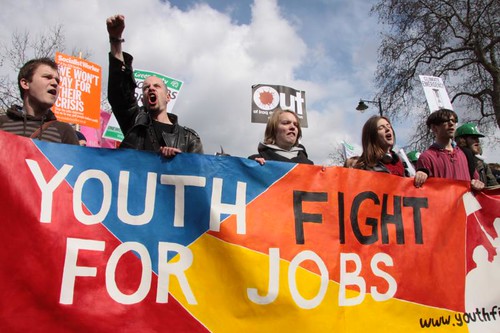
Youth Fight for Jobs Launch Conference

Somewhere between 100 and 150 (the room made it a bit awkward to tell, plus people who were there either only in the morning or afternoon) attended the launch conference of the Youth Fight for Jobs. After some good opening speeches by Alex Gordon from the RMT executive (speaking in place of Bob Crow), Tracy Edwards from the PCS, James Kerr and a Belgian CWI member, the timing of the rest of the opening session clearly went awry as they jammed in a few short contributions from a Tamil student, a member of the SP from South Wales speaking about the sacking of Linamar (ex-Visteon) convenor, Rob Williams and a hip-hop group At Risk of Offending. There simply was too much stuff attempted to be fitted in which meant that the plan of having contributions from the floor didn’t really work.
After a short lunch break the conference split up into workshops. I had been asked to chair the session on ‘What Is The Cause of Unemployment?’ Given it was only a small session (I think the debate on the European elections attracted the most attention), we were able to get into a bit of depth on Marxist economics and also able to discuss the working conditions of those who do have jobs too.
The next session took motions to the congress, all those submitted (which can be found on the Youth Fight for Jobs website) were passed, although a few of them were amended slightly, whilst the age limit for the campaign was remitted to the newly elected steering committee to discuss.
The Conference concluded with a closing rally with a speaker from the CWI in France, a Lindsey Oil Refinery worker and Sean Figg, the newly elected National Organiser for the campaign.
Speaking with comrades after the conference, we were a little disappointed with the attendance, but this is partially due to a number of reasons. In North Wales, it was a combination of lack of money to pay for people getting to London as well as several college students who have been grounded until their exams are over.
Yet the composition of the conference was fairly good. There were a sizeable number of young PCS members there, indeed the PCS Young Members Committee had submitted several motions to the conference as well as the East Midlands PCS NOMS branch and the Student organiser for UNITE was in attendance. In contrast to what a certain ex-member of the Socialist Party has been repeatedly stating online, whilst including university students in the campaign, it isn’t dominated by them as the presence of a substantial number of young workers at the conference showed. Indeed, the delegation from North Wales consisted of a college student and a shop steward.
The conference also received greetings from the workers who occupied the Prisme factory and featured sessions with speakers from the Lindsey Refinery dispute and one of the Visteon Conveners. From a shaky start with the morning session, the conference finished on a good note, despite me missing the last train back to Bangor.

Wednesday, 6 May 2009

Rob Williams sacked by brutal bosses - Step up the struggle

Rob Williams, trade union Convenor of Linamar Swansea, was sacked by the Linamar management last week, and then temporarily re-instated following militant action by the Linamar workforce.

Disgracefully, however, Rob today had his sacking confirmed. Negotiations between Linamar management and Tony Woodley took place all day in London, but Linamar did not shift.
Meanwhile at the Swansea plant Linamar revealed their brutality. Massive intimidation of the workforce took place - including foremen going around the shop floor threatening workers with the sack if they dared walk out in support of Rob. The bosses even went to the ludicrous lengths of removing the door from Rob’s trade union office.

This brutal action by Linamar is an attempt to return to the nineteenth century. What Linamar do not realise, however, is that all hell is going to break loose when workers, both in the Swansea and the wider labour movement, hear how Rob and his members have been treated.
The official reason for his sacking was “irretrievable breakdown of trust” - one of the most blatant excuses to behead a trade union organisation ever used in any factory. Rob’s record in standing up for his members, both inside and outside the factory, is second to none. However, what is at stake here is not the fate of one individual but the right for workers to be represented by the best militant fighters.

This sacking has to be totally opposed. The union has promised rapid action to organise a ballot for an official strike, but the anti-trade union laws mean this could still take up to a month between the ballot and the strike action actually taking place. That time, which must be kept a short as possible, needs to be used to pull out all the stops in support of Rob. Messages of support and donations should flood in.

If Linamar are allowed to get away with this, no convenor or shop steward, either in the already weakened car industry or in the wider trade union movement is safe. Allow the employers to inflict a defeat here and no trade unionist, shop steward, let alone a convenor, will be able to put their head above the parapet without the bosses seeking to cut it off.

Workers are facing the worst economic crisis since the 1930s. Big business is doing their utmost to make sure that it is the working class that pays for the crisis. Militant, fighting trade unionism – symbolised by Rob Williams and the union organisation in Linamar – must not only be preserved but strengthened in order to prepare the working class for the capitalist offensive that is under way in Britain and worldwide.

Continue to phone protests to:

Head of Swansea Linamar Brian Wade 01792 656339
Personnel Manager 01792 656238

Messages of protest to linda.hasenfratz@linamar.com
Messages of support to Rob Williams: robbo@redwills.freeserve.co.uk
and Socialist Party Wales: socialistpartywales@btinternet.com

Sunday, 25 May 2008

USDAW & Me

For the second time in my life I've rejoined USDAW. And certainly this time I joined the blurb from union officials about why you should joinwas much better. We were told tales about how the union defended people at disciplinaries and how that was why we should join the union - 6 out of 7 of us new recruits joined. This was much better than when I joined last time - when the rep was talking to a load of 17/18 year olds that they should join USDAW for the free will writing service! I only joined after I managed to get it out of the rep that the union negotiated wage increases.

But that is the key thing really, the person who came to speak to us the other day was boasting of the unions partnership with the bosses and boasted of getting a 4% wage increase - to £5.52 an hour - the minimum wage! With fuel, food and the prices of just about everything else going up - a decent minimum wage of at £6.50 an hour if not more which some of the main unions demand will become more and more necessary.

Friday, 18 April 2008

200 March Against the BNP in North Wales

I've been rather busy recently, hence the lack of posts. However, I have written stuff during this period which will shortly appear on this website

At least 200 people joined a demonstration against the BNP organised by Wrexham Trades Council last Saturday. The numbers came as a pleasant surprise to many people (including the organisers who had only expected 50 at the rally after the demo).

The demo consisted of members of PCS, UNITE, UCU, NASUWT and other trade unions, as well as anti-fascist campaigners, mostly from Wrexham, but also in other small towns across North Wales and a coach came up from Cardiff.
The BNP are threatening to win district and county council seats in Wales in the upcoming local elections. They are standing across North Wales where they won over 5% of the vote in last years assembly elections, but also in Mid Wales and Swansea. Already they have had several community councillors elected after they stood unopposed.
The demo consisted of members of PCS, UNITE, UCU, NASUWT and other trade unions, as well as anti-fascist campaigners, mostly from Wrexham, but also in other small towns across North Wales and a coach came up from Cardiff. On the march we passed straight past the BNP stall in Wrexham, showing that they are not welcome on our streets.
After the post-demonstration rally, many protesters decided to counter-leaflet against the BNP stall. Unfortunately I only saw one speaker from the platform of the rally join in this action, which is disappointing as it will not just take one-off marches to stop the growth of racist and fascist ideas. The cuts and privatisations that all the main parties favour need to be fought as these allow the BNP to scapegoat immigrants as being responsible for this. The trade unions have a vital role to play in doing this, but at the moment many of their leaderships are tied to the Labour government which is carrying through these attacks. Ultimately we need a party that is prepared to stand up against these attacks, building the Campaign for a New Workers Party in North Wales is an urgent priority.
Socialist Party members sold 16 copies of The Socialist on coaches to the demo and at the demo itself, as well as one copy of Socialism Today and one copy of the newly published France 1968 book by Clare Doyle.

Friday, 7 March 2008

A Brief Look at the Origins and History of Police Unionism in Britain – Pt1

This is part one of this post - partially becuase I haven't done the other half yet which will cover the period after the 1918-19 police strikes, but also becuase they are two fundamentally different periods in police unionism history. I also would like to do a piece or two on prison officer union, probation officer unions and also court staff as i think these are areas of interest

The formation of unions for police officers came as a result of dissatisfaction over pay and conditions prior to the First World War, although the first recorded instance of collective action dates back to 1872. Most grievances either related to conditions of service (in particular ruthless military discipline practiced within the force) as well as pay disparity between different regions. This led to the formation in 1913 of the Metropolitan Police Union, which soon expanded to have a branch for provincial members and in 1914 became The National Union of Police and Prison Officers (NUPPO).
It is worthwhile noting that the State has always been especially opposed to granting those working for the State the same trade union rights as other workers. NUPPO was no exception. As Rob Reiner notes in The Blue-Coated Worker, “Membership was secret and the Union met in a clandestine way. This was necessitated by the Union’s illegal status… Policemen discovered to be members were suspended.” (pg 20.)
NUPPO began forging links with the labour movement, whom its leaders were sympathetic to. This of course was made more complicated by the role of the police in repressing strikes, but the union became affiliated to the Labour Party, the TUC and many local trades councils.
The deteriorating position of police incomes during the First World War meant that they had gone from being relative to that of a skilled worker to just below that of an unskilled worker. This led to an increase in membership of the union, and importantly leadership of the union passing from ex-police officers to an executive of current police officers, several of whom were committed socialists.
In 1918, an event occurred that led to Sylvia Pankhurst describing it as “The Spirit of Petrograd”. This was the police strike in the late summer. The immediate stimulus for the strike was the dismissal of Constable Theil, a leading member of the union on August 27th 1918. This led to the union resubmitting its previous demands for recognition and a pay increase, as well as now demanding Thiel’s re-instatement, with an ultimatum that the union would strike if these conditions were not met. The deadline was ignored and the strike started on midnight August 29th and was almost total, by the August 31st approximately 12000 Metropolitan police officers were on strike. The government of Lloyd George was quickly forced to concede to the unions demands on pay, conditions and the re-instatement of Thiel. However, the question of union recognition was not completely answered by Lloyd George saying that he could not recognise a union in wartime.
Although not fully recognised, the concessions led to an ease of repression against union activists and also a massive expansion of the union itself. Moreover, both in recognition with it’s loyalty to the workers movement and realising its own strength the union publicly declared that its members would stop repressing workers, and not be used for strike-breaking. The union in London also fought for democratic control of the police force rather than the despotic control of the Home Office appointed Commissioner, General Macready.
A battle emerged over the newly created elected representative board which was to negotiate wages and conditions with Macready. The union made all the officers on the board ex-officio members of its executive and dominated it. It used this board to extend its control over police deployment and refused to pass on orders against the interests of police officers and workers alike.
However, on 24th February 1919, after the board refused to accept one of Macready’s orders he moved against the union and drew up plans for elected three different boards each representing a different ranks of the police force, constables, sergeants and inspectors individually. Union activists were dismissed and the Home Secretary in support of Macready that any policemen who retained membership of the Union would lose their jobs, and on 8th July 1919 starting bring forth a bill to ban police from being members of a trade union. Crucially, however, the government combined repression with concessions that vastly increased pay and used the new three-tier representative structure to establish the Police Federation, a kind of company union that still exists today.
The union had already balloted on strike action over recognition, improvements in pay and the reinstatement of a union activist, getting 44,599 in favour with only 4324 against. However, they blundered when they called off action after reports of Macready bringing in the military to strike-break against them. In fact the government had been planning against them ever since making the concessions the previous year. The union tried to lean on the rest of the labour movement for support, however, a combination of opposition to a strike from the tops of the movement as well as the difficulties of convincing workers who had previously had the police used against to come out in support of the police, meant that the supportive action that took place quickly dissolved away. Most of the police did not come out, when the last ditch strike action took place as the bill prohibiting union membership was read out in parliament. Indeed, only in Liverpool was the strike a success with over half the membership coming out, but it was eventually suppressed, with all strikers dismissed from the force.

Friday, 11 January 2008

Police ballot for industrial rights

Article from the Socialist 515

GORDON BROWN is trying to enforce below-inflation pay rises on public-sector workers, from the civil service to local government workers, teachers and nurses. Now the police are being forced into considering action. The Police Federation, representing rank and file police officers, has called on the Home Secretary to resign and is at loggerheads with the Metropolitan Police over a protest demonstration on 23 January.

Iain Dalton
The police were awarded a 2.5% pay rise by an independent tribunal from 1 September. But the government decided to implement it for the 140,000 police in England and Wales only from 1 December, saving £30 million.

Since the 1970s the police have been awarded pay increases by an index, which takes into account their lack of a right to strike. This year however, as part of their drive against public-sector pay increases, the government decided they wished to come out of this and impose a settlement.

The index was given to the police after discontent in the police force in the 1970s. A series of pay disputes, no doubt influenced by working-class struggles at the time, led to calls then for genuine trade union organisation and the right to strike.

To silence their demands they were given an immediate 10% pay increase, with a review into police pay after this. When the Tory government was returned in 1979, it announced the new generous pay index, no doubt partly to buy the support of police officers for the assault on trade unions during the 1980s.

Now the Police Federation is to ballot its members on whether it should lobby for full industrial rights. The Federation is also attempting to organise a demonstration in London, although archaic legislation may be used to block this from taking place - which would leave us with the odd sight of the Metropolitan Police banning police from demonstrating.

Socialists support police officers' right to a proper trade union and the right to strike. We should work towards bringing the ranks of the police closer to the labour movement, whilst also calling for local democratic control of the police and opposing their repressive use.

PS - I was wondering about whether anyone else would be interested in setting up a joint blog about the left & crime?

Thursday, 6 December 2007

PCS DWP Strike

Just got back from a very wet and windy picket line in Bangor, at the DWP call centre on parc menai. the strike there wasn't quite as solid there as elsewhere around the country (the other jobs are really crap here) but there was still a large number of people not going in. Below i've posted some stuff from the pcs website as background to the strike, and a press release of the days action so far. I'll try and do a follow-up post over the next week or so too, btu I sold one paper and gave out quite a few leaflets too despite th driving rain. (plus hopefully they'll be advertising our next public meeting too.)

PCS today announced a two day strike by members working for the Department for Work and Pensions (DWP) in Jobcentres, the Pension service and Child Support Agency (CSA) as the department walked away from last minute talks in a dispute over the threatened imposition of a below inflation pay offer.
The two day strike to be followed by an overtime ban will be held next week on Thursday 6 December and Friday 7 December and adds to the pressure on the government following rows over party funding and the loss of child benefit data. The two day strike comes as the DWP seek to impose a pay offer which would see approximately 40% of staff receive 0% pay increase next year.
Members are angry over the three year pay offer, which sees cost of living increases for longer serving staff members of 2% this year, 0% next year and 1% in the final year. The pay offer averages just 1% a year over the three years and sees the lowest paid receiving increases which take their wage to only 24 pence above the minimum wage.
The news comes as it emerged that the DWP would be closing three pension centres located in Birmingham, Blackpool and Dearne Valley at the cost of 650 jobs. The union warned that the closures would further damage the pension service which has been hit by delays and backlogs.
Commenting, Mark Serwotka, PCS general secretary, said: "The department has provoked conflict and the inevitable disruption that strike action brings by walking away from last minute talks. This insulting pay offer that will see low paid staff receive a pay cut in real terms has provoked anger amongst people who have borne the brunt of job cuts. Imposing a pay offer that averages out at 1% a year will do little for the morale of staff who have seen job cuts and services suffer.
"The government have got to start realising that its policies of cuts and driving down pay are not only damaging staff morale and services, but creating the conditions for systemic failure across the civil service. If the government and the department want to avoid damaging industrial action, then they need to re-start talks quickly on a fair pay deal for staff."


Fantastic Support for first strike day
6 Dec 2007
An estimated 70,000 PCS members supported the first day of the 2 day strike over the imposed below inflation pay offer.
Many reps reported better turn out than the excellent national action in May.
Hundreds of text messages have been received from reps on picket lines reporting solid support, good news coverage and high spirits.
Offices across the country were either closed or offering a very limited service with only a handful of senior managers covering the phones and turning claimants away.
The message to senior DWP management is clear. PCS members will not tolerate the imposition of an insulting, below inflation offer.
Turnout out tomorrow is expected to be even higher with more members on strike than any previous strike.

Monday, 19 November 2007

Socialism 2007

Two of us made the five hour trip from Bangor to London to participate in this annual event. The first session I went to, was the one added to the agenda only a few weeks ago on Burma, which indeed I'd been asked to chair. The session featured video footage of the recent protests and also a clip from john pilgers documentary on the 1988 uprising, as well as a brief introduction by Clare Doyle from the CWI. The discussion had some good input, but didn't really get going properly due to (i think) most of the people there coming to find out about burma, rather than knowing anything that much about it themselves (to be honest, I probably fell into that category too!).
Next on the agenda was the Socialism 2007 rally for socialism. The first speaker was Brian Caton, General Secretary of the POA (prison officers union), he hit back at the IBT (those who don't know a fairly insignificant left sect) who had been protesting against the us supporting the POA's recent strike, making some really good points about prison conditions, and admitting the existence of some reactionary prison officers, but saying they weren't welcome in his union. Next was Mel Mills, who if you go back on this blog to when I was in Huddersfield you might find mention of, she was the anti-cuts candidate who stood in a ward of Kirklees counil last election and reported of the advances made by the Save Our Services alliance in Huddersfield - anyone who says the CNWP is stillborn should take a look at this campaign. Next was a very short piece by a remploy shop steward, who my favourite line from was "I've got more socialism in my big toe than Gordon Brown". He was followed by Sadiq Abakar, a Socialist Party member facind deportation back to Darfur, where some of his family have been murdered and which he escaped from several years ago.
The Dave Nellist, who was hsoting the event read out some solidarity greetings from CWU NEC member Dave Warren (who seems to be leading the no campaign against the rotten deal with Royal Mail) and also from the striking NIPSA classroom assistants in Northern Ireland. Matt Wrack (FBU General Secretary) was the next to speak, starting with paying tribute to the firefighters who had recently died in Warwickshire and talking about the attacks on the fire service and the FBU. He was followed by a brief contribution from a Burslem Postal Worker who spoke about her branches struggle against trade unionist victimisation. Mark Serwotka was next, giving a lecture to an extent of left unity (more of which in a minute) and gave some example of the attacks on civil service workers including speaking of civil servants who were on maternity leave and expected to come in to do an IQ test two days after she was due to give birth, otherwise she would face the sack!
Peter Taaffe made the last major speech of the evening, in particular commenting on the need for a new workers party and drawing some conclusions from the split in RESPECT. Then followed the finance appeal rasing about £20,000, a short piece of film footage about the Russian Revolution and a very short contribution from a speaker from Socialismo Revolucianario (CWI in Brazil).
I failed to get much sleep that night, which meant i was quite knackered the f0llowing morning, but i managed to make it through the day nonetheless.
The first session I went to on Sunday was on the Shop Stewards Movement in the 1970's by Bill Mullins (SP industrial organiser). He started by giving an overview of that period of time, an era of revolutionary movements (france 68, chile 73, portugal 74 etc.), before commenting on the highly organised nature of the trade unions at that time, with 10 million workers in TUC affiliated unions and a period of mass action to defend and improve workers conditions. He talked briefly of the role of the CPGB in organising the Liason Committee for the Defence of Trade Unions, the main body through which the shop stewards organised, as well as many comments on his experience of being a shop steward at that time. The discussion focused on the mistakes of the CPGB and also on the existence of elements of workers control at that time. As well, Dave Chapple, co-convener of the National Shop Stewards Network (NSSN) suggested to Bill taht he should write a pamphlet of his experiences for discussion within the shop stewards movement today.
The next session was a debate on Venezuela between Karl Debbaut of the CWI and Jorge Martinez of Hands Off Venezuela and the IMT. (I've summarised this a little from my notes, no doubt there will be a write up fo thsi on the SP wesbite in a bit anyway)
Karl started off by pointing out the importance of Venezuela internationally, especially with Chavez talking about socialism, it had attracted the attention of many workers and young people (indeed I had a discussion with an otherwise unpolitical UCU rep the other day about Chavez). He pointed out that the CWI supports reforms that help workers, but we are critical of the IMT because they are fairly uncritical of Chavez and in Karl's opinion are more interested in having the ear of Chavez than in the politicla independence of the working class.
Jorge then outlined the IMT position on Venezuela, that there has been a revolutionary process since 1998, with massive participation by the masses but capitalism and the capitalist state still remains, even though the movement is a big threat to that. He concluded with three problems of the Venezuelan revolution, the first was that capitalism is still raking in big profits and that reforms cannot control capitalism. the second was that the state is only in a paralysis at the moment and that's why it could not cruch the movment for the time being. Finally he said there was a need for a revolutionary organisation there.
There were several contributions from the floor, the most interesting two in my mind were one from comrade PG who contrasted the building of the PSUV (Chavez's new Venezuelan socialist party) with the approach of the SP to the CNWP, pointing out that several things in PSUV are being imposed on the working class, the second interesting was on Chavez's foreign policy towards Iran, Russia, China and others, and the role he had played in breaking some strikes in the region (I think ecaudorian oil workers?).
Unfortunately Jorge dodged most of these questions prefering instead to concentrate on some queries that had been raised and points that he agreed on with the contributors from the floor. He did mention a document by the IMT on Venezuelan foreign policy on Iran, which i'm going to read though. Another annoyance for me was that despite their being other members of Hands off Venezuela in the room, none of them wanted to speak even after the chair asking several times that if they did they could be the next speaker.
Finally there was a closing rally on the russian revolution, but it wasn't as good as i had hoped, mainly because the russian comrade who had been expected their to speak had been denied a visa, which was a big shame.

Anyway, I've also been working on some ideas for future posts including one on Alienation and Crime, a review of the new publication Science, Marxism and the Big Bang and others for the blog over the next few weeks.

Friday, 7 September 2007

First Ever National Prison Officers Strike

This is taken from this weeks issue of the Socialist, i wrote most of the preamble.

Strike against public-sector pay cap

On 29 August, the Prison Officers' Association (POA) held its first ever national day of strike action, with over 20,000 staff walking out from all public prisons in England and Wales.
An earlier ballot showed 87% support for action up to and including striking.
The POA had its right to strike removed under the Tories in 1994. Labour repealed this but introduced a voluntary 'no-strike' agreement.
Earlier this year, the POA, angry after two years of below-inflation pay deals, told the government it was withdrawing from this agreement.
Under the agreement, the union was supposed to give the government 12 months notice of withdrawal, which is how the government got a court injunction and declared the strike illegal.
POA branch rep John Hancock spoke to Chris Newby and Keith Dickinson outside Wormwood Scrubs prison on the day of the strike.

"There was 93% of us locally in favour of taking industrial action. I think that's reflected in what's happened today across the country, the tremendous support for the strike.

The main issues are the fact that we're supposed to have an independent pay review body and the recommendation that they give is supposed to be binding on both sides. Over the last two or three years the government has accepted what the pay review body has said but phased the award in.

Last year the review body said 2.5% but then they phased it in, so effectively over the year it became 1.9%.

So we've had year-on-year cuts in our pay whilst we've been over-achieving on our targets. So we're now absolutely fed up with the fact that we're not getting paid for the job that we're doing.

Also there's been massive staff cuts. Ten years ago we had 400 officers here. We're now down to just over half of that. And yet the prison population has gone from 40,000 to 80,000.

In the Scrubs at the moment we have 1,300 inmates and 230 officers so it's five or six prisoners to one officer.

Most of us are outside here now and I'm very very proud of the branch for this turnout.

We're already worse off now than we were 10 years ago and there's a proposal for more staff cuts over the next three years. This will mean more escapes, less drug testing etc. Inmates will be locked up on Friday as well as Saturday and Sunday. What sort of problems is that going to cause us on a Monday morning?

The government said today that this dispute was wholly unlawful. I would say it's wholly unnecessary because had the government not reneged on the promise that they made while they were in opposition to reform trade union rights we probably would not have had action today.

We balloted according to the trade union laws but they are saying we have a no-strike commitment. But the prison service can break their side of this agreement whenever they feel like it. They don't like it when the prison officers have done exactly the same.

I attended the National Shop Stewards Network conference and I'm very much in favour of Bob Crow's stand. He has been exceptionally supportive towards us.

The general feeling here is upbeat and hopefully we'll get a settlement sooner rather than later."

Tuesday, 17 July 2007

Solidarity with the Gualberto Villarroel Contract workers union

Today, the leaders of the Sindicato Mixto de Trabajadores Petroleros Gualberto Villarroel, are beginning a hunger strike in La Paz in defence of their rights to organise and for a decent wage.
Their are roughly 300 contract workers at the Gualberto Villarroel oil refinery in Cochabamba, who have contracts for between 3 months and 2 years. With the contract workers being paid poverty wages of between 500-800 Bolivianos a month, permanent workers are paid much higher salaries ranging from 7,800-90,000 Bolivianos a month. To fight for higher wages, the contract workers formed their own trade union, the Sindicato Mixto de Trabajadores, but the leaders and most active members were fired, to date this is 32 members.
The sackings first started 8 months ago when the refinery was still owned by the Brazilian state-run transnational, Petrobras. When the refinery was nationalised on May 11th, workers expected a big change from the Evo Morales' MAS government, but nothing happened. The workers have been lobbying the governemnt but t no avail and are now going on the afoementioned hunger strike. They demand
  • All fired union leaders and workers must be immediately rehired.
  • The national labor laws prohibiting two-tiered working conditions must be respected.
  • All temporary contract workers must be signed to permanent contracts.
  • The right to unionize must be respected.
For details of how you can send solidarity messages and for more information check out the CWI article here:
http://www.socialistworld.net/eng/2007/07/13bolivia.html