Showing posts with label review. Show all posts

Wednesday, 30 September 2009

Review: The Everlasting Staircase: A History of the Prison Officers’ Association 1939-2009

From the September 2008 issue of Socialism 2008.

By David Evans with Sheila Cohen, Pluto Press, 2009, £15

Reviewed by Iain Dalton

WHEN PRISON officers went on their first ever nationwide strike two years ago, it propelled their organisation, the Prison Officers Association (POA), into the spotlight as, ironically, their leaders were threatened with imprisonment if they did not call off the action. Yet the history of trade unionism within the prison service goes back way further than this action or even the formation of the POA in 1939. Until now, it has been a relatively unwritten story, so the publication of a fairly comprehensive history is most welcome.
David Evans begins his narrative with the coming into being of the modern prison in the late 19th century and the attempts of the newly-created salaried gaolers to resolve their grievances. While a few attempts were made to form a trade union organisation in the early 20th century, it was not until the setting up of the National Union of Police and Prison Officers (NUPPO) in 1913 and the Prison Officers Federation (POF) in 1915, that this was achieved. Both unions were illegal, as a Home Office standing order was interpreted by then home secretary, Winston Churchill, as meaning that prison officers should be treated like the police, soldiers and sailors and banned from organising a union.
However, the NUPPO-organised walkout of the Metropolitan police in August 1918 over pay changed everything, with the government verbally backtracking over pay, conditions and the right to form a union. The apparent success of the action led to NUPPO and the POF merging. Yet, within a year of this apparent success, the government felt strong enough to pass the 1919 Police Act which once more took trade union rights away, at the same time attempting to buy off police officers with a substantial pay increase. NUPPO organised strike action in protest, but this was badly undermined with only a small number of police officers coming out as well as a few prison officers in Birmingham and 70 from Wormwood Scrubs. All those who took action were dismissed. The additional disillusionment following the failure of the 1924 Labour government to reinstate the strikers severely disappointed many who had been involved with NUPPO.
Instead of trade union rights, prison officers were left with an ineffectual representative board and, for the next 20 years, pay and conditions deteriorated, steeling the determination of prison officers to secure trade union rights once again. Despite the earlier association with police officers and the fact that the Police Act was used by the Home Office to designate prison officers as having police constable status and so banning them from forming a trade union, the struggle for union rights in the prison service has more in common with those of civil servants. Indeed, it was two leaders of the Civil Service Clerical Association who assisted in spearheading the POA’s right to exist and represented the fledgling POA in negotiations.
The newly-formed POA quickly reached a very high density of membership within the prison service, covering all prisons in England, Wales, Scotland and Northern Ireland. It quickly expanded in 1942 to win rights to represent staff at special hospitals such as Broadmoor. The period after the second world war saw a massive expansion of the prison population, almost doubling between 1945 and 1950. Prisons became overcrowded, with prison officer numbers failing to keep up with the increased population which, when combined with reforms improving prisoners’ conditions, began to breed resentment.
As Evans explains, it was not because prison officers were fundamentally reactionary, as some would claim, but that many of the improvements in conditions came without increasing staffing levels to ensure the safety of both prisoners and staff. This is not to say that the POA did not support improvements in prisoners’ conditions. For example, the POA was instrumental in ending ‘slopping-out’ and forcing the prison service to invest in integrated sanitation. But the overcrowding and extra duties imposed on officers led to the situation in the 1970s and 1980s where prison officers were required to do massive amounts of overtime just to keep prisons functioning.
The period from the late 1960s to the late 1980s was full of POA disputes and struggles which there is not the space to go into here. Importantly, however, this was when the POA discovered one of its most potent dispute tactics: refusing to admit prisoners above the Certified Normal Accommodation (CNA) limits, which highlighted both prison overcrowding and understaffing. There are also other interesting points that Evans raises, such as how prison officers treated the Pentonville Five dockers imprisoned for trade union activities, for instance, by leaving their cell doors open.
But it was the confrontation with the Tory government of John Major in the early 1990s that shaped the major concerns of the POA in recent years. Continued overcrowding of prisons led in 1993 to refusals to accept more prisoners at Hull and Preston, the latter already operating at 200% of the CNA. The Home Office went to court to seek an injunction against this action, and the judge, as well as ruling the action illegal, went further than the Tories in declaring that the POA was not a trade union. This was formalised by the Tories in the 1994 Criminal Justice and Public Order Act, which instituted the infamous section 127 which criminalised calling for prison officers to take industrial action.
Combined with this was the beginning of prison privatisation. Even the Thatcher government thought this was a step too far. But, in the early 1990s, starting with Wolds remand prison and court escort services, the Tories began opening up prisons and related areas to privatisation as well as privatising any new-build prisons. Not only did the privatised prisons attack the pay and conditions of staff, they also refused initially to recognise the POA. Instead, they recognised the scab Prison Service Union, which had been set up by disgruntled ex-POA officials, in ‘sweetheart’ deals. Faced with the market testing of public-sector prisons, the POA decided to organise within privatised prisons and fight for their return to the public sector. The POA’s campaign has been partially aided by some privatised prisons returning to the public sector after private mismanagement, as well as the embarrassing failure of any private-sector tenders to run Brixton prison when it was market tested.
Despite assurances from New Labour in opposition that it would fully reinstate prison officers’ trade union rights and reverse privatisation of the prison service, the POA has been let down on both counts. This led to the POA general secretary, Brian Caton, tearing up his Labour Party membership card at the 2009 POA annual conference. Trade union rights were partially restored on condition that the POA signed up to a no-strike agreement. However, such were the appallingly low pay offers that prison officers were receiving (even compared to other public-sector workers) that the POA pulled out of the agreement and undertook national strike action in 2007. The Ministry of Justice then reinstated the Tory legislation banning strikes by prison officers. This has led to the POA calling for the TUC to organise general strike action against the anti-union laws, as well as bracing itself for the possibility that the courts will be used against it if the POA is forced to take action to defend its membership.
Overall, the book is a very detailed history of the POA. However, there are several areas where more detail on particular issues would be welcome, as well as some areas which are not commented on, such as the alleged influence of the National Front in prisons and the POA in the 1970s. Also, on some points, the narrative is a little confused, jumping backwards and forwards in time rather abruptly. This is partially due to having to cover the specific intricacies of the issues the POA was dealing with in Northern Ireland and Scotland. But these criticisms should not put off anyone who is interested in the POA from reading this well-researched book.

Sunday, 23 August 2009

Review – Guilty and Proud of It by Janine Booth (2009)

There are certain struggles of the British working class that modern day socialists should make themselves aware of. Amongst those struggles are the 1984-5 Miners Strike, Chartism, 1926 General Strike, but there are also localised struggles that are worth our attention, and the struggle of the Poplar councillors is one of them. Booth, who writes for the blog Stroppyblog and is also a member of Workers Liberty, has done a service by bringing these events to a new audience including myself.
During the huge growth of the Labour Party in the aftermath of the first world war, Labour councillors began to be elected in ever larger numbers to local councils and even began to win control of some of them posing the question of what such councillors should do with their new found powers. After all, what local councils basically do is administer certain aspects of the capitalist system in a given area – should labour councils try and do this in a more humane manner or should they challenge the status quo by attempting to provide local services to meet the needs of the population?
As Booth demonstrates, the Poplar councillors chose the latter, demanding the money to be able to provide higher council wages (including equal pay for males and females!) and pay unemployment benefits without sending people to the dreaded workhouse. Their tactic in this campaign was to withhold the rates that they paid to all London bodies, demanding that rates should be equalised across London to pay for the larger welfare services needed in poorer boroughs, for this action they were imprisoned.
This section of the book is very well detailed, with a very good contrast between the actions of the Poplar councillors and the neighbouring councillors in Hackney which Labour also controlled who pursued the former policy mentioned above under the guidance of Herbert Morrison. One other important thing Booth notes is role of the paper, the Daily Herald, edited by the leading figure of the Poplar councillors, George Lansbury in terms of explaining the councils policy and actions.
Yet I feel the book has several points where I feel it falters. Firstly, whilst being excellent on the background to the struggle all the way up the imprisonment and release of the councillors, the book fails to portray a coherent reason for the eventual failure of the councillors struggle to spread further – certain points are raised, the role of the London Labour Party under the reformist Herbert Morrison, Lansbury being forced to sell the Daily Herald, the defeat of the 1926 General Strike etc. Yet the way these are discussed is like a list rather than explaining how these factors interlinked with each other. The role of different tendencies within the movement, apart from the divide between the councillors and the likes of Morrison, is also not explored with the detail needed to understand fully their roles in the struggle, although there is more detail in this respect within the movements of the unemployed.
A final gripe is in the final chapter dealing with the long-term aftermath of the struggle, whilst this chapter is brief in the events it deals with that is necessarily so, it is a book about Poplar and not everywhere else! Yet I feel it is to brief in dealing with the similar situation in Liverpool in the 1980s – this dispute is just lumped in with the others of that time, but Liverpool was significantly different, firstly it won concessions from the government in 1984 and secondly for the role of organised Marxists within the council. Whilst the author does refer to two books for further reference I do not feel that this does the comparisons between the two struggles enough justice.
In summary the book is well worth reading, despite the above mentioned drawbacks the depiction of the core of the struggle of the councillors around the non payment of London wide rates is excellent, and that after all is the main topic of the book.

Sunday, 2 August 2009

Review – Teamster Rebellion by Farrell Dobbs

I have to say, that when I recently read this book it was not for the first time, rather this book is one that I hold in great regard and wished to re-read it to clarify in my mind some of the issues that the 1934 Minneapolis Teamster strikes raises.
These strikes which the book covers marked the beginning of an upsurge in union activity in the United States that eventually led to the formation of the industrially based CIO. Moreover it was really the first serious labour dispute that the Communist League of America, part of the International Left Opposition, became involved in. The book depicts these strikes in a very easily readable format whilst pointing out the steps taken, tactics chosen that the union local took and why they were taken. To my mind this is a book that all militant trade unionists should read.
But one thing I want to focus on is the way that the defence of the pickets from police attacks and brutality during the strike was organised. Unlike some on the left who seem to cry for workers to be given arms at any occasion as if the main issue is some desire to beat up the police (or at least this is the impression that can often be given), Dobbs is rather more sane as he explains why the strike committee deemed it necessary to arm pickets against attacks from the police as well as from the employer-organised special deputies.

“Up to now the workers had gone about their activities bare-handed; but they found that attempts to exercise their right to peacefully picket were being repressed with police clubs and blackjacks. They decided to take steps to enforce their democratic right to prevent scabs from grabbing their jobs. It would have been a tactical blunder for members of an isolated vanguard to attempt measures such as the strikers were about to take; they would only get themselves clobbered by the police. In this case, however, the means used in self-defence had their origin in a spontaneous mass mood that had been generated by capitalist repression. Since these means were appropriately limited in the given situation to matching the police club for club, the tactics employed were completely valid.”(pg.81)

Later on in the book he deals with the run-up into the third strike, when workers were making preparations for this and the question was raised again.

“At the first strike committee meeting, chaired by Kelly Postal, the question of ‘picketing equipment’ was put on the agenda. For the first time since the truce at the end of the May strike, the bosses would be trying to operate trucks in defiance of the pickets. The last attempt had been stopped when the pickets won a pitched battle with the cops, fought club against club. At this new juncture many pickets were inclined to start where they left off in May, again arming themselves with clubs. In the changed circumstances, however, this would have been tactically inadvisable. It would have given the cops a pretext for immediate violence against strikers who were trying to peacefully picket; and the union would have lost the tactical advantage of reacting to police violence under defensive slogans.”

And finally he discusses the question again in the aftermath of the police shooting at the strikers and killing two whilst injuring several others.

“In the meantime Local 574’s pickets were reacting to the police assault in full keeping with their magnificent fighting spirit. After the shooting, many who had escaped injury dropped from sight briefly, only to return soon armed with various kinds of weapons. They now had shotguns, deer rifles, revolvers, hunting knives, and various types of souvenirs from World War I, which the veterans among them had brought back from France. Having bested the cops club-against-club in May, the strikers were now prepared to face them gun-against-gun. Although their cause was just and their courage admirable, it would have been a grave tactical mistake to attempt to go through with such an undertaking.
“The situation was now qualitatively different from what it had been during the earlier battle with clubs. Despite the fact that a club can kill, it is not usually classified as a deadly weapon. By virtue of that fact, self-defence of the kind used in May could be sustained tactically for several reasons: it was carried out by a massive body of pickets who had widespread sympathy within the city as a whole; for reasons described previously, Governor Olson found it difficult to use the state militia against the union; and due to the insular nature of the conflict and the local politics involved, President Roosevelt had little inclination and no ready pretext to intervene with federal troops. Consequently the fighting in May remained confined to a showdown between pickets and the local cops.
“As matters stood after Bloody Friday, however, the situation was entirely different. Being so deadly, their use in self-defence against the gun-toting cops could have been twisted around by capitalist propaganda into the appearance of an ‘insurrectionary offensive’ by the strikers. The bosses would have screamed bloody murder, claiming proof of their contention that our aim was not to build a union but to make a revolution. At the first armed skirmish between strikers and police a clamour would have been raised for Olson and Roosevelt to send in troops against the union…
“Local 574, against which such military repression would have been directed, was engaged in an isolated local action. Nationally, our struggle was paralleled only by two other similarly isolated conflicts… Hence, it could not have withstood the heavy military pressure; the strike would have been broken and the union crushed.
“This was a situation in which the central strike leadership had to act swiftly and decisively. Otherwise impulsive pickets, looking for a showdown with the cops, could have done irreparable damage to the union’s cause while the policy question was being debated. The pickets had to be disarmed forthwith, and the central leaders had to do it on their own responsibility…
“…Once again, Local 574’s incomparable soldiers went out barehanded to face cops with riot guns.
“Our action was promptly reported to a meeting of the strike committee, and the reasons were given for the policy we had followed. After considerable debate the committee approved the course taken, issuing picketing orders accordingly. The orders, which were published in The Organizer, contained a deliberately obscure formulation: “All pickets are hitherto instructed to continue tactics of peaceful picketing as hitherto. They are, however, to defend themselves against any attacks.” Since we hadn’t troubled to let the cops know whether or not the pickets were armed, they weren’t sure what permission to ‘defend themselves’ meant and being aware of the strikers’ anger, the cops weren’t in a hurry to find out.”

As these quotes amply demonstrate, at each stage the strike committee measured the objective situation facing the workers and prepared themselves accordingly. The task was not to repeat demands for arming of the workers but to act in a manner that sought to defend the interests of the workers at each stage in response to the course the struggle took. It is a lesson that some ultra-lefts who repeat demands blindly should do well to note.

Saturday, 4 July 2009

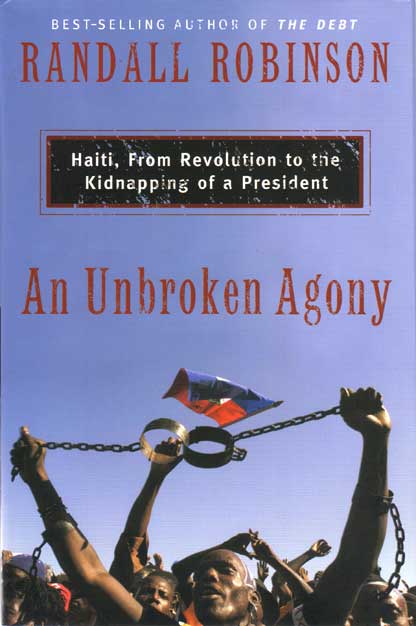
Review: An Unbroken Agony by Randall Robinson

This is the second, long overdue, post in my series on the 5th anniversary of the second overthrow and exile and Jean-Bertrand Aristide. The first can be found here and a posting dealing with current events in Haiti can be found here.

An Unbroken Agony is a much different kind of book to Damming the Flood, the book we had previously reviewed in this series. Damming the Flood is a highly detailed and well researched account of the rise and fall of Jean-Bertrand Aristide examining how and why he came to power as well as how and why he was overthrown.
Whilst An Unbroken Agony attempts to tell this story too as well as putting the events in a longer historical context than Damming the Flood, there is nowhere near the same amount of depth of research and explanation. Instead the main value of this book is in its insight into the life of Aristide through his friendship with the author.
Indeed, the book solves the question that Damming the Flood suggests an answer to but lacks the inside knowledge to conclude definitively on. That is the question of how Aristide ended up leaving Haiti for the second time on February 29th 2004 – did he flee or was he kidnapped?
Robinson is rather equivocal on the subject, he was kidnapped. In the book Robinson reproduces e-mail correspondence with Aristide and his wife and other information that make it blatantly clear that in the space of a few short hours the plans of the Aristide’s changed dramatically, they had made plans for a major interview on the 29th which was never cancelled. The change was precipitated by the arrival of US soldiers at Aristide’s house who escorted him to the airport.
Robinson points out that US TV news stations showed old footage of Aristide making a trip by himself abroad and attempted to pass this off as Aristide fleeing the country (as Robinson points out, his wife is nowhere to be seen in this footage. Moreover, why would Aristide flee to the dictatorship of the Central African Republic when neighbouring Jamaica had offered him asylum?
Although the book makes contributions on a few other points it is its utter demolition of the argument that Aristide fleed Haiti of his own free will, that is its strongest point.

Friday, 8 May 2009

Review – Appeal To Reason by Rise Against (2008)


A slightly edited version of this review was carried in this weeks issue of The Socialist

I’d guess that the name is perhaps the biggest clue to the fact that Rise Against are quite a left-leaning political band. Their angst-ridden punk rock/hardcore sound has driven them through several albums and has continued to propel them into their latest album, Appeal To Reason. Whilst the album is instantly recognisable as a Rise Against album to a fan, it doesn’t just repeat the style of previous albums, rather deepening it and finding new variations within that style, quite impressive for a four piece punk rock band.

The bands sense of timing combined with some great lyrics makes this a powerful album, for example within the song Re-Education (Through Labor) describing how events will wash away the mis-education people suffer as people “…won’t believe the lies that hide the truth.” Or the environmentalist anthem Collapse (Post-Amerika) with its lines describing the chaos global warming could potential wreak on the planet and asking how it is possible that some still seek to deny this is happening and stall the drastic measures needed. Or their self-deprication in Entertainment with the lyrics “All we are is pretty faces, Picture perfect bottled rage, Packaged synthesized versions of you.”

One of the best songs is Kotov Syndrome, named for a chess term for a move made where the player has spent to long deliberating and rushes a bad move before he runs out of time, focuses on the insecurity offered to ordinary people by capitalist society. The song also features a particularly good lyric “There, high on the watchtower, keeping the peace, whatever that means” is a biting critic of imperialist nations attempts to impose ‘peace’ on their own terms upon the world through the invasions in the Middle East.

But the song that steals the album, is the sole acoustic song, Hero of War. The song graphically depicts the life a young man who signs up to the armed forces and goes through a tour of Iraq. The song depicts the brutality of the occupation with the beating of prisoners and the murder of innocent civilians and how this changes the young man. If you like this genre of music then listening to this album is a must.

Sunday, 19 April 2009

Review - Damming The Flood: Haiti, Aristide and the Politics of Containment by Peter Hallward

Is is the first of three posts about Haiti - the 5th anniversary of the second coup against Jean-Bertrand Aristide would have been on February 29th this year (had there been one) and this article comes from the March 2009 issue of Socialism Today.

DAMMING THE FLOOD tells the tale of Haiti over the past two decades. This Caribbean nation had been the scene of the successful slave revolt which threw off French rule way back in 1804, but it had suffered economic isolation and ‘underdevelopment’ from the vengeful imperialist powers ever since. It was only in 1987 that it began to emerge from the dictatorships of Papa Doc and Jean Claude Duvalier.
The book begins with the period leading up to Haiti’s first democratic election in 1990 when a Catholic priest from a liberation theology background, Jean-Bertrand Aristide, won a large majority in the presidential elections at the head of the Lavalas (the flood) movement. He was elected on a pro-poor platform with his regime lowering food prices and increasing the minimum wage. He also attempted to reign in the army which had acted with impunity during the dictatorship and the few years after, and it was this that precipitated his overthrow in 1991, which unleashed a torrent of repression on the Lavalas movement.
In exile in the US, Aristide tried to negotiate for his return to the country and the removal of the coup dictatorship. He was eventually restored to power by the US in 1994, for which he made many concessions towards neo-liberal imperialism. He introduced World Bank and IMF sponsored ‘structural adjustment plans’ and the privatisation of some state enterprises, although he also dismantled the armed forces.
His successor as president, Rene Preval, Aristide’s first prime minister, continued these policies. Yet support for Aristide remained very high, and he again won an overwhelming majority in the 2000 presidential elections (now as the candidate of his own party Fanmi Lavalas). But yet again, despite many pro-poor policies (such as again increasing the minimum wage), he made concessions to imperialism in order to restore international aid they were withholding to strangle his regime.
Former soldiers, backed by the ‘democratic opposition’ (local capitalists and politicians that had fallen out with Aristide) launched a wave of guerrilla operations from the Dominican Republic that overwhelmed Northern Haiti and eventually led to Aristide being forced into exile in the Central African Republic by the US. Yet this overthrow, in February 2004, was not without opposition from the people who took to the streets to demand Aristide’s return, in a manner reminiscent of the mobilisation of the Venezuelan masses to demand Chavez’s return after the 2003 coup attempt in Venezuela.
The despicable role of the imperialist powers is nowhere more clearly shown than in its ‘humanitarian intervention’ forces which, rather than trying to prevent abuses of human rights, actively perpetrated them, in particular repressing the remnants of Fanmi Lavalas with many deaths and its leading activists thrown into prison. This clearly shows how the imperialist powers will intervene in a country, not to protect ordinary people, but to defend their own economic and strategic interests.
Peter Hallward’s book has several strengths. Firstly it is clearly very well researched and he is able to quote from a variety of sources to refute several myths that have been promoted by various groups (including some well-known human rights organisation) about the period. These include a dispute over a technicality in the 2000 elections, how Aristide left the country in 2004, and the links between the armed forces and various oppositional groups. He also explains how such myths originated from the biased opposition press which, after being repeated without verification in the US, became unchallengeable ‘facts’ for much of the rest of the worldwide media.
Hallward also interviewed many of the participants in the Lavalas movement and the Fanmi Lavalas party and thus provides a clear view of the amount of support that Aristide still holds to this day, despite his exile. Hallward actually compares him to Chavez (however, Chavez is clear on the need for socialism and Aristide is not in the slightest) as both movements in Venezuela and Haiti clearly depend on their leading figures to a large extent. Yet there are similarities with the social organisation basis of Evo Morales in Bolivia too, as Fanmi Lavalas still continues to operate with well-established leaders and is not wholly dependent on the figurehead leader. This is clearly evidenced by the actions of the Latortue regime (the dictatorship that replaced Aristide) in imprisoning these leaders so they could not contest elections.
However, there are a few obvious weaknesses in the book too. One is the continual insistence by Hallward that there was no other route that Aristide could have taken apart from compromise with the major imperialist powers (in this case the US and France). He gives two reasons for this. The first is that Haiti was dependent on foreign aid and that as Haiti ground to a halt without these funds Aristide could not carry out his pro-poor initiatives. Yet a resolute programme to nationalise the major parts of the Haitian economy (especially the assets of those funding the armed opposition) would have countered this. It is true that, as Hallward notes, large sections of the economy are geared towards export. But an appeal for further assistance from Cuba and, during his second term, Venezuela – who both before and since Aristide’s presidency have had significant trading agreements with Haiti – could have overcome economic dependence on foreign aid. Of course, due to the nature of those regimes it would not be guaranteed that they would have come to Aristide’s aid, but such an appeal would certainly have been supported by the workers and poor of those countries, and would also have pointed towards the need for a socialist confederation of those countries with Haiti.
The second reason Hallward gives is related to the first. He argues that because Aristide had no armed forces he could rely upon he was therefore at the mercy of foreign armies if they chose to invade, and also the armed opposition. Yet at the same time Hallward praises Aristide’s pacifist stance, which meant that Aristide ended up demobilising the spontaneous attempts of Haitian workers and poor to defend themselves against the opposition forces.
This is linked to another issue that Hallward is weak on, the existence of pro-Aristide gangs (referred to by the opposition as chimeres). As he states the gangs, led by some Lavalas supporters, formed in the wake of the first coup to defend themselves and the communities they were based in from paramilitary violence. However, the gangs also relied on criminal and thuggish activities to support themselves. But such gangs would not have existed if Aristide and other Lavalas supporters had mobilised a movement aimed at stopping either of the coups in their tracks. Such examples can be found from history, such as the mobilisations that stopped the attempted coups of Kornilov in Russia in 1917, of General Spinola in Portugal in 1975, or even the ‘tancazo’ plot to overthrow Allende in Chile in June 1973. Such mobilisations could also have formed the basis for opposition to foreign military intervention. Although around 200 years ago, the slave revolts in Haiti show that technically superior foreign armies intervening into a social revolution can be successfully defeated, especially as at this time the US was already tied up in Afghanistan and Iraq.
One certainly can see another resemblance between the events in Haiti in recent years and the Haitian slave revolution. Like the brave, but continually compromising Toussaint L’Overture, Aristide made concessions where he should have been decisive. The main ingredient that has been missing from Haiti over this period is a revolutionary party that will take decisive measures – more in the manner of another slave leader, Jean-Jacques Dessalines – which could bring about the necessary conditions for the real freedom and liberation of the Haitian masses, a socialist Haiti and socialist world. This conclusion is not presented in the book, but it is the task that Marxists will have to take up in the country. Despite these criticisms, however, this is an excellent book and deserves attention.

Monday, 13 April 2009

Review: Red Dwarf: Back To Earth

Where to be begin? I think I can safely say that they weren't the best Red Dwarf episodes ever.

For me the first episode wasn't that good at all. It just wasn't funny. The most amusing part was the Cat's diving costume. Instead we had what appeared to be quite high end special effects which just looked completely out of place. At times the odd thing looked good, like the rememberance garden, but for the most part it just made everything look too shiny and clean and just not Red Dwarf. I think I'm amongst a number of people who hate the overuse of CGI in programmes - usually cos it attempts to cover up a poor plot.

And thats before we get into them re-using gags from old series too. And I also wonder whether the lack of a studio audience (all but series 7 had one) had any impact on it, I feel that the actors timing might have been better with it and they might have come up with some funny bits too. I felt that the episode wasn't horrible, but I can't think of anything good to say about it.

Fortunately the next two episodes were better. I guess the whole TV characters realising that they are TV characters has been done before, but I thought it wasn't done too badly. More to the point I actually laughed during those episodes. They still weren't as good as classic Red Dwarf shows though, one of the main problems was that everything just seemed a little overdone, amusing things went on so long that they weren't as funny as they would have been if they had ended sooner, either that or they appeared to obviously have been borrowed from earlier series (the main exception I can think of is where Sophia Winklemans character explains how it is ethical to kill holograms like she plans to do to Rimmer and he promptly pushes her in front of a moving vehicle). The episodes weren't like you could hate them, but someone could and should have done something better with them.

But what I do want to address is some of the comments made by Phil at A Very Public Sociologist made in his review (see http://averypublicsociologist.blogspot.com/2009/04/red-dwarf-back-to-earth.html)

Firstly I want to take up the division between the series that he creates, which are

1) Series 1 and 2 (early Red Dwarf)

2) Series 3 to 6 (mid-aged Red Dwarf)

3) Series 7 and 8 (Red Dwarf post Rob Grant)

I think this division is wrong, we need to be more exact about the changes in location for the series, change in writers and change in cast. Instead I think it should be split up as follows,

1) Series 1 and 2 (On Red Dwarf, Grant and Naylor writing, crew-Lister, Rimmer, Cat, Holly)

2) Series 3 to 5 (On Red Dwarf, Grant and Naylor writing, crew-Lister, Rimmer, Cat, Kryten, female Holly)

3) Series 6 (On Starbug, Grant and Naylor writing, crew-Lister, Rimmer, Cat, Kryten, Female-Holly)

4) Series 7 (On an enlraged Starbug, Naylor by himself, crew-Lister, Rimmer(for part of the series), Kochanski(for part of the series), Kryten, Cat)

5) Series 8 (On Red Dwarf (in the tank), Naylor by himself, crew-Lister, Rimmer (alive), Kochanski, Kryten, Cat, Holly, Hollister and others)

The shift from series two to three with two different charcters (one new) changed the shape of the show, but not as much as happened in later series with the set changing each time as well as the cast and also shifting from having a studio audience to a film-like version then back to a studio audience again. Every time you change things it means the programme is going to turn out differently.

Basically, my problem with Phil's version of the development of Red Dwarf is that for him series 1-6 are great and 7-8 (as well as Back to Earth) are bad and it's all Doug Naylor's fault. This is way too simple for my liking and I don't think its completely accurate either.

I think there are good things about series 7 and 8 for a start, for example I really like Tikka To Ride, the first episode of series 7 (the recap at the beginning of that episode from series 6 is excellent, as is the recap at the beginning of series 6 - miles better than Back to Earth). And the bunk scenes in series 8 are rather good (perhaps if Doug Naylor had had at least one of these in Back to Earth the first episode might have been better, I think he writes those really well). But most importantly they are a different kind of Red Dwarf to the earlier series. (and by the way there are some crap bits in some of the earlier series too - using Rhyl as a location for an exotic resort, for example!)

But there is a point to Phil's comments about Doug Naylor writing stuff by himself. When writing comedy its generally advisable to have a partner writing with you. It's almost a necessity as you need to bounce your ideas of someone else to make sure other people find them funny and tease out any humour to it's full potential. If they plan on making further Red Dwarf episodes then the issues I've raised simply have to be addressed.

Sunday, 5 April 2009

Review – The Ragged Trousered Philanthropists by Robert Tressell

After having this book recommended to me several times I finally got around to reading it over the last few months. And the reasons that it was recommended to me, for its exposition of the capitalist system and a vague explanation of how Socialism could work are very good. The chapters which feature the debates the workmen have about socialist ideas are excellent parts of the book.
Yet, for me there were several things I disliked about the book too. Firstly, at 700 or so pages, I felt that the book was overly long for the story it was telling. Secondly, I found the story quite depressing. Not that that is a reason necessarily to dislike it, but what was most depressing was the fact that the Socialists were just abstractly arguing for their ideas without trying to engage in struggles alongside other workers. There is one bit towards the end when the main character, Frank Owen, finally stands up to his employer to defend an apprentice at the company, and I found myself thinking ‘at last!’.
The Ragged Trousered Philanthropists depicts the brutality of capitalism for the working classes excellently, and despite the gap since when it was published those same conditions apply in similar form today. But whilst you’ll find an exposition of Socialist ideas in the book, what you won’t find is how to bring these ideas to the working class.

Sunday, 15 February 2009

Book Review – Cuba: A New History by Richard Gott

With this January being the 50th anniversary of the 1959 Cuban Revolution, I thought it was about time I delved a little more into the history of the island in preparation for the very successful public meeting Bangor Socialist Party held last week.

The real strength of the book is Gott’s presentation of the pre-revolutionary history of the island. Apart from knowing the island had been invaded by the United States during its struggle for liberation from Spain, I knew relatively little about the country in this period. Gott’s presentation of this period is very illuminating.

Yet the part that most people would be interested in is his account of the 1959 revolution and the regime led by Castro afterwards. However, for me this is the weaker part of the book. I felt that Gott covered it fairly superficially, you are reading it waiting for him to go into further detail. There are some exceptions such as Castro’s relationship with the Soviet Union and the support given by Cuba to anti-imperialist conflicts in the third world.

I suppose this is somewhat clichéd, but I just get the feeling that Gott is approaching Cuba from a different direction to me. Gott seems to approach it from middle-class intellectual’s point of view and various trials, middle class opposition groupings etc. take up the focal point of his narrative and you are left wondering what the ordinary peasants and workers thought of what was going on. He also takes the view that all that Cuba had to do with socialism was just words whilst they had Soviet support, and that element of Cuba is now gone due to the collapse of the Soviet Union. He also, mistakenly, seems to believe that Cuba had returned to Capitalism with the reforms instituted in the 90’s that led to the creation of the dual dollar-peso economy.

As I said at the beginning, the early parts of Cuba’s history are really interesting reading. The latter part, although still interesting, leaves the impression on you of events that are only half-analysed. It is a book of two halves, but the latter doesn’t undermine too much the strengths of the former part.

Monday, 12 January 2009

DVD Review- In The Name of Justice by John Pilger


This DVD is the second set of John Pilger documentaries released over the last few years as a ‘sequel’ to Documentaries That Changed the World. It follows the same layout of 12 documentaries on an array of different topics.

The Mexicans

Despite being somewhat dated, this film conveys the hardship ordinary Mexicans face, in particular those related to the influence of the USA and the reasons that so many Mexicans migrate their illegally each year.

Street of Joy

This documentary looks at the US advertising industry and asks whether it can influence politics? Pilger examines how advertising techniques have been used in presidential elections to boost the ‘image’ of candidates whilst saying nothing about their policies.

Pyramid Lake is Dying

This film takes up the case of American Indians who after being robbed of thbe majority of their land, now face discriminatory policies that are destroying their culture and the environment that it was created in, including the aforementioned Pyramid Lake.

A Faraway Country

Pilger investigates Czechoslovakia almost ten years after the 1968 Prague Spring. Contrary to what many wished to convey then and now, most of the people Pilger speaks to argue for socialism with democracy, rather than the capitalist restoration that eventually occurred

Do You Remember Vietnam & Vietnam: The Last Battle

These two documentaries both look at Vietnam after the war, the first examines the causes of the war, the horrendous conditions endured by those who fought there and how, although under Stalinist rule, it is in much better condition than when it was under thinly-veiled imperialist rule. The second is 20 years after the war and examines in particular the so-called Market Socialism, which Pilger shows is but a stepping stone to full-blown capitalist restoration.

The Truth Game

Pilger looks behind the development of nuclear weapons. Especially interesting is his discussion of the cover-ups surrounding the dropping of nuclear bombs on Japan at the end of World War 2. He also deals with the nuclear weapon build up during the cold war.

Japan Behind the Mask

Made during the 1980’s, Pilger examines the economic ‘miracle’ of Japan’s post-war reconstruction and exposes how the super profits of Japanese corporations are based on the unseen super-exploitation of workers, especially women.

Apartheid Did Not Die

In this film Pilger takes a critical look at post-Apartheid South Africa and analyses the betrayal of the hopes of blacks by the now pro-capitalist ANC government. Rather interestingly for myself, it showed some footage inside the South African Truth and Reconciliation Commission proceedings, which gives you a better idea of what one looks like than just sinmply reading about them.

The Last Dream: Heroes Unsung, Secrets & Other People’s Wars

These last three documentaries are a series made for the 1988 Australian centenary. They take a look at the hidden and unmentioned history of Australia, from the untold tales of how Australia was colonised with the forced labour of exiles and natives alike to Australia’s participation in wars at the behest of the major imperialist powers. As well as a critique of the then ‘Labor’ Hawke government, he reflects of the often untold struggles of ordinary people in the country.

All in all, although some of the documentaries are a little out of date today, they are still very watchable. I would recommend that people buy Documentaries That Changed the World before this as it covers a wider array of topics, but this is still worth buying, if only for Apartheid Did Not Die, which I think is one of Pilger’s best documentaries.

Friday, 9 January 2009

Review – The Kings Depart by Richard M. Watt


What with last November being the anniversary of the beginning of the 1918-19 German Revolution, I was recommended this book as a good introduction to the events of that period.

What this book really is, though, is a book about the treaty of Versailles, that has to spend a considerable portion of its contents explaining the revolution in Germany and also other events, particularly in Poland and Hungary around this time. To be honest though, I actually found the bits on the creation of the treaty interesting too as things which are relevant to my dissertation on Truth Commissions and War Tribunals cropped up here too.

The book is not a complete history of the German Revolution, but rather describes the main events and discusses some of the fundamental driving forces which does serve very well as an introduction to the topic. However, Watt is not a Marxist and there really isn’t a serious discussion of the tactics, and the mistakes of the German Communist Party and its allies.

Nevertheless I would recommend the book as an introduction to the events of the German Revolution, but also for anyone interested in studying the creation of the Versailles peace treaty.

Wednesday, 7 January 2009

TV Review – Jonathan Creek, BBC 1, 1st Jan ’09, 9pm


It’s been years since they made the last episode of Jonathan Creek, and as a fan of the series I was quite excited by the fact that another had been made. For those who have never seen the programme before, Alan Davies plays the title character – a man who devises tricks for a magician who gets roped in to use his skills to solve seemingly impossible mysteries.

In this latest episode he is brought in to solve a series of disappearances in a room in a house. The room is an attic room in a house where someone had, in attempt to disprove a superstition, locked themselves in overnight and had disappeared in the morning. So it’s a classic locked room mystery, and therefore the solution shouldn’t be too hard – as if a room is completely sealed the body should still be in the room. Yet there is in my opinion a brilliant piece of mis-direction in the episode as there is something that grabs you as unnecessary the first time you see it, yet story distracts you from it and focuses your attention on both the bed and a painting on the wall. Whilst it’s not an entirely original mystery, it is a rather good one.

Yet the rest of the episode lets it down. There is just too many things going on that seem unnecessary, the magician Creek works for is up to his usual womanising shenanigans, Creek is once more unlucky in love and there’s a whole side mystery to do with a kidnapping that feels somewhat unnecessary. Its like they’ve had to do lots more to fill-up the episode. But also there are some parallels with the previous Christmas special episode, a big house with a deadly secret, a hidden romance between possible suspects. It all just takes the edge off what would have been a decent mystery.

Monday, 29 December 2008

Socialism 2008: Review of China Seatshop of the World (2008)

Yes, the final Socialism 2008 post at last - only a matter of a month and a half after the event. But this wasn't a session at the event I'm reporting on (although as I said before it was pretty impressive seeing and hearing a Chinese Trotskyist speak at the main rally), it rather is a book I managed to get a hold of at the event.

The book is a collection of articles by two of the writers for Chinaworker.org, the CWI website for China. The majority of the articles are ones that have already appeared on the site over the last two years - however, they are some of the most interesting ones such as the one on Xinjiang province, the one on the Hong Kong Legco elections or the one on the Chinese coal industry. However, three of the articles were written especially for the book - one of which is on the Bejing olympics and it's green credentials and has also appeared on the site too, but the introductory chapter and closing chapters are both new for the book. The first examining low-paid sweatshop labour which seems to be the backbone of China's huge growth and the second examining all the points where struggle could erupt in China over the next few years.

I have to say, the more I read about China, the more interested I get. It is a huge country with a large portion of the world's population living there and what happens in China will be significant for people everywhere. And hence I recommend this book to people as a series of articles that will help you get a deeper understanding of the events in that country written by Chinese socialists. But it isn't all the material on China the CWI has been producing recently, for a start there is the excellent chinaworker.info website with in depth analyses of events in China and the region as well as reports of workers struggles (the most recent one as I write this being a strike of airport workers in Hng Kong). Over the past year or two both the Socialist and especially Socialism Today have carried some really good articles on China too. It is worth getting much more interested in the issues in China and this book will certainly help with that.

(You can order the book from Socialist Books, http://www.socialistbooks.org.uk/ - although it doesn't come up on the online bookshop)

Sunday, 28 December 2008

Film Review: Yes Man (2008)

I didnt think i'd do a 'serious' post today. So there's no real analysis of this film - just a few thoughts on something I went to see to relax.

I went to the cinema for the first time in ages yesterday. Given I'd read the book this was based on a long time ago I thought I'd give it a shout. And I have to say that the fact that I'd read Danny Wallace's Yes Man (supposedly a true story of what happened to him) coloured how I viewed the film. Mostly cos it's almost nothing like the book.

Instead the film has Jim Carrey star as the main character Carl, set in America instead of London and with a whole host of other characters not in the book. It was like they'd stripped the story down to its bare bones and then given it a whole new flesh. There was the odd bit of occasional bit that popped up from the book and a cameo appearance by Wallace but apart from that you would barely know it was the same person.

That said the story they've constructed around it wasn't that bad - it was an okay film with some quite good new quirks replacing Danny Wallace's own ones. However, it is only very loosely based on the book and to me having read the book it was a shame that some of the really quirky and funny parts of the book had been gotten rid of. It isn't a disaster, but I think I would rather of them make something that had actually based on the book.

Friday, 28 November 2008

Socialism 2008 – Review – Socialism and Left Unity by Peter Taaffe (2008)

Whilst this isn’t really a session at Socialism 2008, this book was launched there and is a critique of the ideas and methods of the Socialist Workers Party (SWP). It does take up some of the points that were debated in the session at Socialism 2008 on Building a Revolutionary Party (of which there is a video of on the Socialist Party website - http://www.socialistparty.org.uk/articles/6614).

The book begins with some general points about why the Socialist Party (SP) thinks debates on the methods and ideas of organisations are important for serious attempts at left unity. The first section proper discusses the origins of the SWP and the Socialist Party and their ideas in relation to Stalinism – particularly criticising their idea of the USSR and other states as being state capitalism and the problems with this definition. The next chapter begins with focussing on how these ideas led to problems after the collapse of Stalinism in the early 1990’s and their idea of this decade being “the 1930’s in slow motion”.

It then moves on to discuss the approach of the SWP towards the anti-capitalist movement – in particular their use of the slogan – another world is possible - compared to the SPs – a socialist world is possible. It also takes up Trotsky’s transitional programme, what the SP believes to be the misapplication of the idea of transitional demands.

Next up is the attitude of the SWP to the rest of the left – its role in relation to the Socialist Alliances and also the role of its sister organisation in Germany. To this the approach of the SP is contrasted with that of the SWP, particularly how the SP argued for a federal approach in that organisation with the SWPs ‘rule or ruin’ approach. It then deals with the RESPECT saga too. This area is then dealt with again later in the book in a section entitled “United Front Today and the Left in Germany”.

The book then goes discusses a few incidents in the trade unions in the 90’s before taking up disagreements in the PCS and NUT between the SP and the SWP. The section after this discusses the SWP’s anti-fascism work – after discussing the successes of the Anti-Nazi League – it critiques what the SP believes were some of its failures – it’s “Don’t vote Nazi” slogan which leaves open the possibility of voting for other capitalist parties and the lack of democracy within that organisation and then deals with the role of Unite Against Fascism in recent years.

The final section deals with the internal regime of the SWP, in particular the use of top-down bureaucratic methods when dealing with serious disagreements inside the organisation giving examples of the expulsion of their US sister organisation and in relation to break up of RESPECT and then contrasts this with the SP and the CWI.

Although the book is a critique of the SWP and many of the arguments may be familiar to people already, the book touches on many other points which are of interest to anyone on the left in terms of history, theory and various movements. The debate on revolutionary ideas, organisation and methods will become increasingly important and this book is worth reading for anyone who agrees with the necessity of this, especially current members of the SWP.

Saturday, 15 November 2008

Review – What’s Going On? By Mark Steel (2008)

I wrote this review quite a while back, but given that Mark Steel was a speaker at the sunday rally at Socialism 2008 and some of the points he raised were also raised in this book it think it is apt to publish it now.

Mark Steel’s latest book is a tale of his very own personnel mid-life crisis. As his personal life breaks down seeing him sleeping on the couch at home, he also goes through a political divorce with the organisation he’s belonged to since he was a teenager, the Socialist Workers Party (SWP).
But both these personal episodes illustrate the bigger issue that Steel discusses throughout the book, the question of how we can take the anger that exists at the capitalist system and do something about it.
On of the main things Steel disputes throughout the book is the notion that the working class no longer exists. Although the large factories of traditional industrial working class are slowly being transferred abroad, Steel notes how layers such as civil servants and teachers now form parts of the working class. More importantly he notes how the supermarkets and other large retail stores have in effect become the factories of the 21st century with customers being the object the workforce there are processing – Steel picks out a good comparison of how in Subway customers order their sandwiches in a manner that is effectively a conveyer belt system.
Steel notes how events such as the movement against the Iraq war have drawn large numbers of people into opposition to the government , yet the potential for building a new party to represent workers has been squandered on several occasions, particularly by the leadership of the SWP.
Steel focuses on the ruins of Respect, noting how the SWP leadership were willing to overlook various factors ie. George Galloway’s lack of accountability to Respect etc. (of which the Socialist Party has been critical of Respect), but for George Galloway to issues a document mildly criticising John Rees, the National Secretary of Respect (and SWP Central Committee member) – this was a step too far.
The rest is history as they say. Steel gives plenty of examples of the control-freakery of the SWP leadership in the downfall of Respect. But given he also cites examples prior to this, including the inflation of membership numbers, the reader wonders why it took him so long to break politically from such people.
The book however, is well worth the read. Steel writes in a manner that is easy to understand and in a very humourous manner (as is to be expected being a comedian), but he also helps even those very politically aware understand things in new and insightful ways at the same time.

Wednesday, 1 October 2008

Review - McMafia: Crime Without Frontiers by Misha Glenny

This review of this recently published book was written by myself and featured in this weeks The Socialist.

As the title indicates, this book is a penetrating insight into the close co-existence of big business and organised crime throughout the world.
Glenny, a former BBC correspondent during the break-up of Yugoslavia, starts his journey through worldwide organised crime with where he knows best, the Balkans. He interviews law enforcement agencies and current and ex-criminals and describes the web of corruption in these newly capitalist states that have allowed smuggling to establish itself so strongly. He goes on to trace the explosion of organised crime worldwide.
Unlike other authors discussing the relation between organised crime and the break-up of the USSR, he doesn't see the rise of the mafiya in Russia as an aberration on its path to transforming into a full-blown free market economy. He demonstrates that the rise of the mafiya and the gangster capitalist society it brought with it were linked.
Mafiya bosses transformed themselves into 'legitimate' businessmen who would then cut and run with their new money and status to the west.
Glenny then examines the effect this transformation of the former Stalinist states had on other countries. He demonstrates how globalisation, in particular the deregulation of financial markets, has led to a bonanza for organised crime as the boundaries between legality and illegality have blurred.
He points out that the main recruiting sergeant for organised crime gangs and syndicates is capitalism's inability to provide even the hope of a decent future for many people, whether it be the street gangs in Mumbai, the Yakuza in Japan, drug mules in South Africa or coca growers in Colombia.

Maintaining 'order'

He also notes the role that organised crime plays in helping to maintain capitalist society in many countries - not just by occasionally doing big business' dirty work but also in maintaining 'order' through their own rule of terror that law enforcement agencies co-exist with rather than tackle.
An extreme example was when the boom in the Japanese economy ended, leaving several financial institutions with bad debts owed to the yakuza. To reclaim these debts the yakuza made an example of one leading banker by murdering him. To stop a crime wave setting off, instead of punishing the yakuza for this act, the government underwrote all the financial institution's bad debts, effectively buying the yakuza off.
The book offers no serious way forward. Instead Glenny is rather despondent, understanding that the financial and other loopholes that organised crime exploit are the same that benefit big business.
He says in the conclusion that: "The need for strong, well-equipped law-enforcement agencies to combat organised crime is axiomatic. But appeals like this, which offer solutions based on the greater engagement of the police or military alone, betray a profound abdication of political responsibility."
Getting halfway there, he then adds that these appeals "are the product of unimaginative politicians who lack either the vision or the interest to address the great structural inequalities in the global economy upon which crime and instability thrive."
Glenny explains that it is not in the interests of the major capitalist countries to do this but at this point he reaches his limits.
It is socialists who have both the vision and interest to tackle inequality and really begin a fight to eradicate crime.

Thursday, 11 September 2008

Review – The Red Book by Leon Sedov

There are few serious books that can make you laugh, and this one did which sort of makes me ashamed given the seriousness of the topic it discusses. But Sedov’s ridiculing of the ineptitude of those preparing the Moscow show trials and the glaring contradictions he reveals in the case the accusers are trying prove had me laughing in disbelief.

But the topic is deadly serious, Sedov writes about the first Moscow show trial which saw Zinoviev and Kamenev, two long-standing Bolsheviks shot for a crime they didn’t commit (the Kirov assassination) and the prosecutors trying to make some sort of case to argue that the assassination had been ordered by Trotsky (who was in exile) and Sedov, his son.

Dates are made up, people and places invented and the ‘terrorist network’ that Trotsky supposedly led appears to be the most incompetent in history, calling off all the assassinations they were supposed to be attempting at the last minute. The book leads one very well through the contradictions in the arguments and is well worth a read even today.

But it also got me thinking about whether show trials are not just limited to this period or whether you could group such trials together where the trial is really just a symbolic denunciation of someone done for mostly political reasons with the verdict fixed in advance. Despite Saddam Hussein being guilty of what he was tried for, I think his trial could fit into this category, due to all the things he could have been, but wasn’t, tried for.

Sunday, 7 September 2008

Review – Comrades in Conscience by Cyril Pearce (2001)

I couldn’t help but pick up this book when I saw. The book covers Huddersfield, where I lived for a few years, during World War One. In particular it deals with working class resistance to the war.
It is a well researched book, examining not only academic reports but examining both the local and national press reports (including the Huddersfield weekly workers paper simply called ‘The Worker’). Indeed it is able to discuss academic work and put forward his own views without boring the casual reader (which is something I which I could say for many other books).
Pearce starts by giving the background to the opposition to the war, covering the state of the two working class parties (the Independent Labour Party (ILP) and the British Socialist Party (BSP)) in Huddersfield as well as the remnants of radical Liberalism and also other organisations in Huddersfield (such as Adult Schools, Socialist Sunday Schools, Huddersfield Trade Council, the local press etc.)
At the time the workers parties were in a bit of disarray but, ironically, the war fused them together and saw them organising jointly against the war, in particular, through the Trades Council. Such a no-go area for pro-war views was Huddersfield that it was labelled ‘a hotbed of pacifism’ (of course people were still recruited for the war from Huddersfield, just fewer than some other areas).
Pearce details the different stages of the war, the governments initiatives to supply themselves with troops for the front and the various tactics used by the workers parties and their sometime radical Liberal allies. In particular he focuses on conscientious objectors (COs and hence the title), not only refuting other academics work in this area, but explaining how support for working class COs was mobilised and how although leaders of the working class parties becoming imprisoned for their resistance for the war affected them, they were able to gather more support and replace them.

There are some problems with the book however. Firstly, it is £15 which I think is a bit steep for a book whose actual content covers only 210 pages (it has over a hundred pages of appendixes and notes however). Secondly, it ends rather abruptly at about mid 1917, although it does mention a few events after much more detail of the after effects of their struggle would have been interesting. And thirdly, for me the book lacks much analysis of the tactics of the various parties and organisations – it is more concerned with presenting the facts of how successful the tactics are, perhaps this a task for another writer though.
Despite these criticisms, the book is a very good read about a topic that contains lessons for all socialists and is worth reading if only to acquaint oneself with the history of this period in England.

Wednesday, 3 September 2008

Review - Kevin McCloud and the Big Town Plan

Over the last few weeks Channel 4 has been showing a series of documentaries about a project they set up with the local council (Wakefield) to renovate various areas around Castleford chosen by the local population. Being from the area, this immediately caught my attention when it was advertised on TV and only being busy has stopped me writing about it before now.

Now there are probably issues about how this scheme was devised, how it has been funded etc. But I want to deal what is billed as the central question, can ‘good design’ re-invigorate a run-down town. The idea of designing out social problems is not one that I haven’t come across before, in criminology the idea of designing out crime exists for example. The project is conceived as follows; the funding from various bodies for 8 initial schemes will create a boost that will lead to the regeneration of the whole town.

That the design of things can make a difference I personally am of no doubt of. Just the physical dimensions of any object affect how it can be used. A good design that fulfils the needs of local people will be of more use than a bad one. But no matter how good a design you have it is not isolated from the conditions around it.

The programme also suggests that it is innovative in involving the local community. In each programme there are some sort of community representatives, which although I am unsure how they are selected, I would think that any re-design of public space should include, indeed be the dominant group involved. Generally speaking though, in all the schemes covered, where the architects have listened to and taken up the ideas and needs of the people who are going to use it this has resulted in the best outcomes. Wherever the council takes direct responsibility for anything or tries to push its own agenda it ends up in creating something mediocre or worse. One programme has farce of a town square of benches, trees and paving being replaced by different benches, trees and paving.

Generally speaking it is the minor projects that have a large amount of local involvement that are big successes, and the ones where this involvement is either lacking or taken over by the council or a private company the result is less than satisfactory. But has good design reinvigorated the town economically. I think the answer is no – other factors such as the relocation of the market and a private investment plan are doing that for the town as a whole which are somewhat independent of the programme. But on a local basis around some of the smaller projects (particularly the parks) it has brought a community spirit back through a communal working together and ownership of these projects.