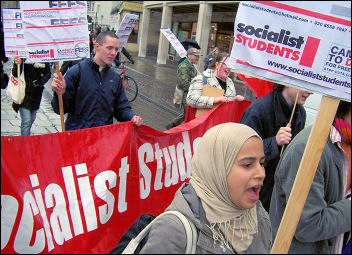
Showing posts with label socialist students. Show all posts

Thursday, 2 April 2009

3 Days of Purgatory: NUS Conference 2009

Whilst radicalism in Britain was seeing a revival around the G20 protests, some poor sods on the left drew the short straw and had to make the annual trek up to Blackpool for the NUS Annual Conference.


However, the conference started off with a pleasant surprise for me – it only took us 3 hours from Bangor to get there - it usually takes me that long to get to Manchester if I’m lucky!
The conference reflected the situation that NUS finds itself in at present – the vast majority of the motions were fairly pointless and without substance. Most of the motions with any substance had been proposed by groups and students unions on the left which tried to bring into conference the voice of the energetic movements that had developed. Unsuprisingly, amendments of free education, supporting the gaza occupations, recognising the success of those occupations etc. all got voted down. The only motion that did get passed was an amendment by Sussex against Ultra-vires that saw Wes Streeting speak for it (we believe he was deliberately baiting the Organised Independents).
Conference also featured some of the worst chairing I’ve ever seen with some NEC members blatantly deciding to ignore delegates wishes. We also saw a motion of censure being passed against Hind Hassan and Rob Owen.

The left was noticeably weaker than the last time I had gone to NUS conference. Another Education is Possible (SWP) were a lot smaller than the last time I’d seen them they maybe around 40 delegates. Education Not For Sale were also smaller – with around 10-12 delegates. Our delegation was very small – however, we’d have been around the same size as ENS if we hadn’t sent people down to the G20 protests instead of NUS Conference – our delegation of 5 was holding the ‘fort’.

Another presence at the conference was Communist Students – but it wasn’t Communist Students that’s associated with the CPGB – instead it was the CPB attempting to reclaim the name. Whilst they didn’t have any delegates they did run a stall and put on a fringe meeting which they asked us to speak at about the No2EU campaign. Indeed they were very friendly to us through the whole conference – allowing us to put copies of my election leaflet on their stall.

The CPB fringe meeting was small but very interesting – due to the smallness of it I was able to quiz the guest speaker, a consul from the Venezuelan Ambassy, about crime and criminal justice in Venezuela (post coming shortly!). We also had a brief discussion on how the No2EU election campaign was developing. I also went to two fringe meeting organised by the SWP – the first was a debate between Rob Owen and Wes Streeting which went over most of the same old ground. The second was the SWSS fringe on ‘How Can Palestine Be Free?’ There were two speakers – a SWSS student who talked about Zionism – unfortunately most of his contribution was stuff to do with the guy who came up with it rather than an actual analysis of its development and influence today. The second contribution was that of Michael Lavalatte who spoke about how we can solve the conflict there – a contribution which was good in some ways – stressing the need for socialism and opposing the Hamas tactic of firing rockets into Israel – but was still vague. Unlike the SWP fringe I went to three years ago, this time they allowed a handful of contributions from the floor (although they ignored Dan Randall of ENS who had his hand up first) and another Socialist Students member came into the discussion pointing out the inverse relation of the strength of Zionist ideas to the strength of the working class in relation to Russia and Germany before commenting further on the working class being the force for socialist change in the Middle East, including in Israel. The SWP seemed to have clearly prepared for us to come in on this point as they began attacking the very idea that the Israeli working class could be a force for change saying that the official labour movement is tied to Zionism and excludes Arabs (but that doesn’t stop Israeli workers organising outside that, like we are doing with NUS). The SWSS speaker then also started replying to stuff we’d never said – one memorable point he tried to make was that the Palestinian working class (which we hadn’t mentioned) is very small – he said around 20% of the population (but the working class were only 5% of the population when the Bolsheviks took power in Russia!)

For me, the struggles of students mostly lay outside that conference. But compared to the expected weakness of our intervention we made a good intervention into the conference, making several good speeches (including mine for the block of 15 – I didn’t get elected by the way). We also did a mildly successful stall in Blackpool on the Wednesday lunchtime. But I guess the best moment for the left in the conference was when Dan Randall (ENS) got elected onto the new trustee board with the highest number of first preference votes running on a anti-trustee board platform. (the appointees to the board include the Sheffield Uni vice-chancellor who threatened his own student with court action and a director of Lloyds TSB bank – which says it all about the board). James Haywood (AEP) was elected to the block of 15 and Dan Swain (AEP) was elected to the democratic procedures committee.

Sunday, 22 February 2009

Stop fees, No to cuts, Save education

Article from the back page of this weeks The Socialist.

FOR YEARS the government, echoed by the National Union of Students (NUS) leadership, has told students they would get a fantastic job at the end of their course to pay off their student debt. But as the economy went on the slide last year, so did many final-year students' employment prospects.

Iain Dalton, Bangor Socialist Students

Now students increasingly question the current system of funding university education. And it's not just job opportunities in jeopardy. As The Socialist previously reported, several universities face big cuts in funding which threaten them with potential bankruptcy.
The government's director-general for research and science, Professor Adrian Smith, blames these crises on the government taking too long over the question of raising the cap on tuition fees. He says neither Labour nor Tories want to touch the question, afraid of the backlash that they might face.
The government and university vice-chancellors are looking at three options, increasing fees, raising interest on student loans or making cuts to courses. None of these options are acceptable to students.
Despite the recession, all the main parties still support the capitalist free market and this is reflected in their plans for education. Ideally, they want a US-style system where student debt can run over £100,000. The next step for them is to further lift the cap on tuition fees, probably to around £7,000 a year, although many university vice-chancellors are pushing for more.
As the bailouts to the banks show, the government can find plenty of money when it wants to. But it wants to give it all to its fat-cat friends in the banks and other industries while we bear the costs of the crisis they caused.
Figures released by the PCS civil service union revealed £21.5 billion in uncollected corporation tax as well as £25 billion lost through tax evasion. Why not spend this money on education and other public services instead of letting it slide into the back pockets of the rich?
Socialist Students has been at the forefront of campaigning against fees and cuts, organising protests around the country. In Bangor, Socialist Students has won the support of Bangor Students' Union for the Campaign to Defeat Fees.
But where has the national voice of the student movement, the NUS, been in all this?
The pro-New Labour NUS leadership are celebrating their victory in getting a 'governance review' passed that will transform the NUS into little more than a charity for students rather than a national union. Students though have been increasingly by-passing them.
Such is the case with the demonstration against fees on Wednesday 25 February in London. This is organised by various left/campaigning groups including Socialist Students and the Campaign to Defeat Fees.
We encourage all students to join our contingent on the demonstration and discuss with us how to build the fight-back for free education across the country.


Protest Against Fees

Wednesday 25 February. Assemble 12 noon
SOAS, Malet Street, London WC1

Fight for your future!

Tuesday, 10 February 2009

Assembly learning grant ‘reorganisation’

From the Socialist Party wales website.

by Glyn Matthews

The Welsh Assembly plans to reorganise the way in which the funding of the Welsh assembly grant (WAG) is to be administered. The proposal is that from 2010 the top-up grant for fees will be scrapped and instead the WAG will simply constitute a larger maintenance grant. On the surface, this simply sounds like a bureaucratic and unnecessary change to the system without any damaging effects. If we analyse the proposals in more detail it is quite clearly an attack on education. Currently only a thirdof students in Wales are eligible to the maintenance grant but many more are eligible for the top-up fees grant. When this is gone they will not receive any part of the WAG as the are not changing the eligibility of the maintenance grant, leaving many students having to take out larger and larger loans to cover the cost of their loans.

The other side of this is those students who will lose the fees grant but will receive a higher maintenance grant. Once again on the surface this sounds fine. However, Jane Hutt the Welsh education minister said: “much of the £61m used currently to fund the tuition fee grants should be added to Assembly Learning Grants. These are means-tested grants available to help pay for students’ living costs.” This shows clearly two things, firstly this will mean a further extension of means testing in education which all socialists should oppose. Secondly without stating the amount of money involved is this new ‘scheme’ Jane Hutt does omit that not all £61m used now will then be used by using the word ‘much’ rather than ‘all’

Despite this, both the assembly government and Welsh universities have welcomed the proposal with all the Orwellian language they can muster by presenting this as an improvement. At this stage we can only speculate why, but clearly if the fees are not being paid for by the assembly any longer then it would open the door for Welsh universities to charge higher and higher top-up fees as this will no longer be a drain on the assembly budget. This clearly shows the need to take action now before it is too late!

The role of the NUS in all off this seems to be silence. There is absolutely no mention of this on the NUS website. Once again the NUS leadership has shown their inability to be a campaigning organisation leaving Socialist Students to take up issues without their backing.

Socialists demand

  • A fighting campaign led by NUS Wales to defeat these proposals.
  • For an NUS organised demonstration in Cardiff with all Welsh universities students unions’ to provide transport to the demonstration.
  • For the NUS nationally to back to campaign and extend the campaign to the rest of Britain by supporting the Campaign to defeat fees and the national demonstration on February 25th

Thursday, 22 January 2009

NUS leadership severs links with students

Socialist Students statement on the passing of the NUS Governance Review. I've been writing an essay for the last week so it'll be business as usual once that's finished.

Build a mass movement for free education

The NUS extraordinary conference on January 20 in Wolverhampton saw the culmination of a campaign by the NUS (National Union of Students) right wing leadership, many of whom are Labour party members, to remove democratic structures in the national student body. This is taking place at a time when students are being threatened with a big increase in tuition fees, but the priority of the NUS leadership is to destroy their own union's democracy, rather than to fight in students' interests.
In order to force through these changes, the student union bureaucracy was mobilised to ensure debate was kept to an absolute minimum. Officers against the removal of democracy were locked out of emails, whilst the NUS leadership 'accidentally' sent emails to all the delegates. Without going through annual conference, these changes have been put through by two extraordinary conferences, one called at such short notice that many delegates were not elected, the most recent in the university and college exam period.
The new NUS constitution will mean that it is virtually impossible for students to propose motions to conference that will then get discussed on conference floor, that the final say on all national campaigns is in the hands of self-selecting bureaucrats, and the obligation to elect delegates to conferences is open to removal for some students unions. NUS is now far more akin to a charity that lobbies for students interests than a trade union, a body that has the potential to carry out mass action through the involvement of its members.
As Socialist Students have pointed out many times, this process has happened above the heads of the vast majority of students. The NUS leadership has rendered itself increasingly irrelevant to students' lives by refusing to take any large-scale action for over two years, and downplaying action that has taken place in order to misrepresent the real feelings of students over issues like university fees and student debt.
But the British government is in the midst of an economic crisis, and is imposing draconian attacks on people claiming benefits; it will also seek to make big attacks on students and young people in the future in order to cover the costs of bailing out the rich bankers and the capitalist system. Already graduates are being asked to work below the minimum wage for wealthy multinationals, as part of the governments National Internship Scheme (see here). A report for the government, quietly published over the Christmas holiday period, recommends big increases in the amount universities can charge students. These attacks will provoke huge opposition and mass movements from young people and students. The NUS will not be in a position to effectively lead these struggles, with new generations of activists looking mostly elsewhere. It will be out of these struggles, and mass action, that a genuine new student movement will be built.
Socialist Students has initiated the Campaign to Defeat Fees, which has won broad support from those beyond Socialist Students ranks. It has led the way in terms of national action against fees, organising days of action over the course of the last two academic years which have involved hundreds of students in over 50 universities and colleges around the country. It has also won support from students in Bangor University in a referendum, against the arguments of the leadership of NUS. In addition to campaigning on fees and debt, Socialist Students have also organised many protests over the recent destruction in Gaza in places like Keele and Bangor, campaigned against privatisation in Sussex, Exeter and Northumbria, and much more. Socialist Students, and the Campaign to Defeat Fees, have an important role to play in building campaigns against raising the cap on university fees and in building a national fightback against attacks.
Unfortunately, there is currently no mass force amongst students that is capable of giving effective leadership to the student struggle and of starting a discussion about building a new national body with serious weight behind it. Socialist Students argues for a broad left to bring together all genuine activists to be built in the coming period.
In the absence of such a broad left the NUS will remain, in the eyes of the government, the media etc, the established voice of students for now. Many students unions view their relationship with the national body as a means of getting discounted beer and other goods, through NUSSL, rather than primarily as a political one. Large numbers of College and FE students unions, largely without the same resources for full time staff as university HE students unions, will not have been aware of the undemocratic changes to NUS. Changes in voting for NUS conference delegates will happen on a student's union-by-students union basis, and will be a gradual process. Without mass developments outside NUS, it is possible that a layer of activists could still even be attracted to the NUS, only to be sorely disappointed once reaching national events. Although extremely unlikely, it is also not impossible that the NUS could still play a role in campaigning for student rights, even organising demonstrations if it feels under pressure and is worried about losing its dominant position as 'the' voice for students. Therefore it is unlikely that these fundamental changes to the NUS will be fully felt immediately. Only as a result of mass action led by activists outside the NUS will the domination of NUS be undermined.
This will not necessarily be a lengthy process however. A march has been called through London on February 25, actively involving a modest number of students unions and campaigning student groups, including Socialist Students. This has been organised outside of the NUS structures, in opposition to the NUS leadership's inactive strategy, although supported by NUS-affiliated students unions. Socialist Students put a motion to the body that is organising this action, calling for it to take on more flesh and become the embryo of a new national campaigning centre. This is opposed by Socialist Workers Student Societies (SWSS) and the Alliance for Workers Liberty (AWL) because of fears they will not be able to dominate it. The AWL state, in a document they distributed at a Socialist Students national council,

"We should use Sussex [Students Union] as a starting base of the new centre [to replace NUS] – Sussex could provide a fraction of its current NUS affiliation fee...
"The Open Planning Meetings for the demonstration should continue after the demonstration... but it is unlikely that they will 'morph' into a new organising centre. They are too loose to form a nucleus or a base, and an attempt to 'firm them up' would be fraught with difficulty. Separate meetings and conferences should be held to create the new body – and when Sussex constitutes it, the new organising centre should be presented to the Open Planning Meetings as a fait accompli"

Amongst student activists, Sussex has an important reputation as a campaigning students union. Activists within the union, who have been involved in organising the march on February 25, will have an important part to play in building a new body. But we do not agree that one union can substitute itself for the whole student body, much less establish a new centre and present itself as a fait accompli to other groups of students entering activity. Because of the methods of the SWP and the AWL, the march on February 25 has been organised in a nebulous manner, one that is open to undemocratic manoeuvres and does not carry as much weight as it could do. A march, even a smaller one, will be a positive step forwards, and a national body that has led this and organised this could be in a significant position. Unfortunately, it is unlikely that the open planning meetings will be transformed in order to take full advantage of this. Any steps towards forming new national bodies need to be based on mass action, on a genuinely democratic approach involving new layers of activists as well as bringing together student activist groups and students unions. That may come through local students unions, but many of these bodies have also attacked internal democracy.
New bodies may also develop around and without these local structures as well.
If the loose grouping that has called the February 25 march does not take on flesh, it will be a missed opportunity. Socialist Students will strive to ensure that that does not happen, but it is clear that the end of NUS has opened up a period where there may well be a series of false starts and missed opportunities. We will attempt to ensure that we discuss the situation regularly within our ranks, whilst prioritising campaigning against attacks on students and workers conditions and rights.
We will continue to play a role in the NUS structures, and not abandon any activists that are attracted to it by false hopes, or any possibility of gaining a wider audience of students for our ideas of struggle and socialism. Whilst there is no new national body, we do not call for students unions to disaffiliate from the NUS. But as part of our campaigning, we will raise the idea of building genuinely representative bodies for students, that fight against attacks and for improvements, and endeavour to build the fight back alongside students with the strategy of building mass movements.

Tuesday, 20 January 2009

Students occupy at Kings College


This report was just e-mailed to me from the Socialist Students national organiser, and I post it here to share the news.

Despite the ceasefire, a number of students are still protesting on campuses against the war and against universities links to the arms trade. Occupations of lecture halls involving 40-50 students have taken place over the last week at Kings, Birmingham, SOAS, Essex and LSE making similar demands to the occupation at Kings below. Socialist Students has also played a key role in organising protests of hundreds in Bangor and Keele.

Today from 10 am, 40 students have occupied a lecture hall at Kings College in London. Socialist Students society members are present.

The students have made various demands on the university management relating to the recent onslaught by the IDF on Gaza.

These include

  • Immediate withdrawal of the honorary doctorate awarded to Shimon Peres the President of Israel who has led military campaigns in the occupied territories and Lebanon
  • That Kings College disinvests from arms companies supplying the IDF and the arms trade in general
  • That Kings College fully funds the studies of 5 students from Gaza
  • That Kings College makes a donation to organisations carrying out medical aid in Gaza
  • That students involved in the occupation are not victimised and suffer no repercussions
Various lecturers have been invited to speak to the occupying students. Socialist Students is arguing for a student led debate and discussion over the political issues involved in conflicts in the Middle East and for links to be made with campus trade unions in pressuring the university to disinvest in arms companies.


Socialist Students
020 8558 7947
PO Box 858 London E11 1YG
socialiststudents@hotmail.com
http://www.socialiststudents.org.uk/

Sunday, 18 January 2009

Bangor Socialists and local residents stand up and say “NO” to Israel’s attack on Gaza


On the 17th of January, Bangor University Socialist Students, Bangor Socialist Party members and other local residents, trade unionists and college students braved the cold winter wind to take part in a protest against the continued attacks by the Israeli military on the Gaza strip. Socialist Students had been canvassing University Halls of Residence, and doing stalls outside the local college and in the city centre in the days leading up to the protest with vast amounts of support shown towards the demands for an end to the conflict.

Sean Homan, Bangor University Socialist Students

Starting at 11am a stall was erected upon Bangor high street and petitions were signed by many approached by volunteers. At noon, the high street rang with the sounds of “ one, two, three four, stop the bombing stop the war” along with other such chants. The protest was later joined by a march into town from the local mosque by an estimated group of around 70 people, with a further and thus larger rally on the high street. Both rallies were addressed by Iain Dalton, Bangor Branch Secretary of the Socialist Party who called for and end to the blockade of Gaza and united working class struggle in the region and worldwide The turn out throughout the day was over 100, with people from all generations young and old taking part.
Over 30 copies of the Socialist were sold in addition to 20 sold during the previous week and £30 was collected for the fighting fund. 3 people asked about joining the Socialist Party and many others expressed an interest in attending our public meeting on the crisis the following day.


Monday, 12 January 2009

50 Protest in Caenarfon Against Gaza Carnage

A report by members of Bangor University Socialist Students on the vigil in Caenarfon this evening.
On Monday 12th January, members of Bangor Uni Socialist Students braved the cold to attend a 50 strong vigil in Caenarfon protesting against the inhuman slaughter occurring in Gaza. This follows a 100 strong demonstration around Bangor on the 3rd of January. We talked to other organisations there to discuss plans for further protests and demonstrations in the Gwynedd area along with advertising our upcoming public meeting about this humanitarian disaster. 4 copies of the Socialist were sold to people wanting to read about our alternative to the capitalist system which has led to this catastrophe.

Sunday, 21 December 2008

Wales - The True Extent of Student Debt Exposed

From the most recent issue of the Socialist.

On Thursday 4 December, members of Bangor Socialist Students organised a 'Wall of Debt'.

Laurence Winch-Furness

Students could estimate how much debt they would be in by the end of their course. Around sixty students participated and the estimates were written on colour coded stickers, with the lowest estimate (0-£5000) being pale pink, whilst the highest (over £20,000) were dark green. Over half of all estimates were green, whilst only a handful were pink.
The highest estimate, at $128,000 (£78,000), came from an American overseas student. Joint second were two law students at £64,000. Only two students were in no debt at all, and one of these was a visitor from Finland, where education is free. Many students in the lower debt bands informed us they had had to save large sums of money before coming to university.
This is an indication of the problems facing students in Wales before top-up fees have been introduced. There is an urgent need for a mass campaign for free education and against all attacks on education in Britain.

Monday, 15 December 2008

National Free Education Demo Planning Meeting Report

On Sunday I was in Manchester for the second Open Planning meeting for this demo (provisionally the 25th February in London). I reckon there were between 40-45 people in the meeting, with quite a few from ENS, about 7 from Socialist Students, 5 or so SWP and then some people from Manchester's Reclaim the Uni (RTU) and some other. I of course was there delegated by Bangor Socialist Students Society.

Before I discuss the actual content, I want to talk a little about the way the meeting was run. RTU decided they wanted the meeting to use concensus decision making and after a short debate and vote it was decided to use it. I found it incredibly confusing as there were various different gestures and stuff we had to do and i found you couldn't tell if a decision had been made or not. Also, i found it potentially undemocratic as the facilitators have an awful lot of power to shape discussions and put forward their own proposals (or accept others without real debate such as changing the order of the agenda). As it was I felt the system began to break down towards the end under the size of the meeting and i think some people's growing frustrations with it.

The meeting started off with the organisation of the demo itself. I have to say i thought it was very clear that the SWP/Another Education is Possible(AEP) were very clear about their own plans for what they want to happen - they want their own rally at the end of the demo. (although they were less blunt than their leaflet in the meeting)
The meeting agreed a short rally before we set off (with speakers from various groups - my impression was at a minimum one person from AEP, one from ENS and one from Socialist Students)
There were suggestions of organising Direct Action heavily pushed by RTU. Personally I think direct action has its place as part of a wider, mass struggle as a tactic - not a stunt or an end in itself. What seemed to be discussed was a sort of conspiratorial thing with a keyword and the reason to do it would be to get lots of press. I think however, this would be press for the stunt and not the mass movement and would detract from it. There was also later on talk about 'creating a confrontation' as a way of 'energising' the movement (speakers from ENS and SWP suggested this). I think such talk is a little childish. Whilst we ought to be aware that the police have attacked demos in the past and could attack this one, we shouldn't try and create a provocation. That said we should organise proper stewarding to defend ourselves (this wasn't discussed - i think it was postponed to the next meeting)
Finally the preferred route of the march was discussed from Malet Street to Parliament Square which needed negotiating withe the police (to get a SOCPA permit etc.) and a committee was elected to do that.

The next thing discused was how to mobilise for the demo. There seemed to be an assumption that SU's who have declared their support for the demo will actively mobilise for it - however, from talking to some people at those Uni's this won't be the case with quite a few of them - as ever it will probably be up to the activists to mobilise for it (i guess thats why we're called activitis though!)
There was some discussion about publicity - most groups will produce their own leaflets, but there will be a very basic centrally produced leaflet with the just the three main demands (not to marketisation of education, no to fees, living grants for all students - perhaps the wording is slightly off but you get the gist) and the details of the demo, mostly for the use of any smaller groups who want to use it locally and add to it.
There was also some discussion of building for it outside of universities (i think everyone there was a university student (or left student group organiser)). There was mentioned the support the demo had received from the UK Youth Parliament. Then came the contentious bit.
EMA!
During the discussion Matt Dobson raised how the fact that many FE students hadn't been paid EMA on time was a source of much anger their and would be something that FE students would be more than willing to campaign on. I backed this up with my experience in Bangor (see september posts on this blog) and suggested it be added to the demo's aims/slogans. This was opposed both by ENS and SWP. Their argument was that by adding it it would mean potentially adding an avalanche of other demands reagrding sections of students. However, in countering that I argued that EMA affects a huge proportion of all FE students and thus cannot be compared to International Students, Postgraduate Students, Part-Time Students etc. (which aren't small groups either). Also they said that it was covered under the slogan of a living grant (which is technically true, but saying EMA makes it a lot clearer to FE students I have found) Needless to say, that addition was blocked. I think that was a big mistake and I actually wish I'd been a bit sharper and forceful on this question as I think it is something that could have mobilised more FE students to join in the demo and link the questions of FE and HE funding and living costs together. (especially because it would show up NUS a bit that we do care about FE students, seeing how they always bang on about FE students).

And on that note the meeting, sort of ended, but actually carried on for another five minutes discussing the NUS extraordinary conference in January. Points were made about how the timing of it will exclude ordinary students who will be doing exams, and also how the turnout could probably be lower than the last one. What response we should have to it was discussed briefly but was still open at the end, so wait and see.

And then I had a 2 1/2 hour journey back to Bangor turn into a 5 hour one. Thanks privatised railway network!

Wednesday, 3 December 2008

For a genuine fightback against fees, cuts and privatisation

Socialist Students statement on national protest on February 25. Anyways, must dash as i'm off to speak at a meeting in Manchester later on.

With the review of funding for higher education taking place next year, it is urgent that a campaign is built mobilising students to defend their rights. Already Tony Blair and Gordon Brown have introduced university tuition and top-up fees, and they currently stand at up to £3,000 a year. University vice-chancellors, through their organisation Universities UK (UUK), are keen to see this raised in the 2009 review, and are attempting to push the government to allow universities to charge up to £6,000 or maybe even more. Students need to build a fightback against this possibility, which would have devastating effects for tens of thousands of young people. But we also need to fight against the idea that education is a commodity and should be paid for. Socialist Students has initiated the Campaign to Defeat Fees, which has organised the most successful action on campuses against fees recently, coordinating action in over 50 universities and colleges in highly successful days of action. The Campaign to Defeat Fees has a wide range of support, including leading figures from the trade union movement including John McDonnell and Tommy Sheridan, students unions and over 5,000 individuals.

Unfortunately, the National Union of Students (NUS) leadership has so far not been prepared to launch a serious challenge to the demands of UUK. The leadership of the NUS are politically at one with the government of Brown, and in reality wish to allow the New Labour government free reign, with as little trouble from angry students as possible. They have had a conscious policy of constantly downplaying any action, and of promoting the idea that students cannot win against fees, but should restrain themselves to asking for slight improvements. Instead of battling against fees and for students, the policy of the NUS leadership has been to concentrate on destroying democracy in the NUS in order to insulate themselves from the demands of students.

This raises the question of how can a fight against fees be built on a national level. Socialist Students, as well as being involved in the Campaign to Defeat Fees, has argued for an organisation that brings together those who are opposed to the attacks of the government and the strategy of defeat from the NUS leadership. This should aim to involve as many students as possible, and bring together those students unions involved in fighting back and campaigning, alongside activist groups and individuals. This organisation would have to be based on building coordinated action, of aiming to involve and convince as many students as possible to get involved in campaigning, and on general demands of opposition to fees, cuts and closures and for a better education system for all.

To ensure that this works, it would also have to be organised along democratic lines, guaranteeing representation for those involved and allowing individuals and groups to put forwards different ideas and different strategies. No group should be allowed to dominate and there must be democratic accountability of the steering committee.

Socialist Students is in favour of a serious strategy in the campaign against fees, which should definitely involve national mobilisations and demonstrations. However, a serious strategy should be based on an assessment of a number of factors at every stage. What is the mood amongst students? What level of support could be gained for a national demonstration? What forces are involved in building for the demonstration? What is students' perception and awareness of those forces? How widely can we publicise our action? How many do we estimate that we will be able to mobilise? Will it be seen to represent a step forwards for students in our battles?

Socialist Students has called for and raised the idea with thousands of students of a national demonstration against fees called by the National Union of Students. Given the wide recognition of the NUS, the huge resources that are available to it, the big potential for media coverage etc, this would be the best situation. It would also open the door for genuine anti-fees activists to campaign and build as big a mobilisation as possible. This is comparable, although on a smaller scale, to the NUS 'students in the red' day of action earlier this term, which although organised around very limited slogans, presented an opportunity for activists to build action and gain broader support for those protests. This was an opportunity seized by Socialist Students, although unfortunately ignored by the Socialist Worker Student Societies (SWSS).

However, given the failure of NUS to call action and the urgency of the issues, it is correct that activists do not just give up, and that we take initiatives of our own. The Campaign to Defeat Fees has organised several days of action to mobilise students, building from below rather than waiting for the 'official' structures. However, where we have called protests and initiatives we have ensured that they are properly planned and built for. SWSS has so far called three national demonstrations this term, none of which have had more than a few hundred in attendance. To call a 'national' initiative without the means to mobilise on a national scale can give the impression that there is less of a mood to fight than is the case. Such unilateral action does not strengthen the movement.

Socialist Students want the event on 25 February to be as strong and positive as possible. We think that the best way for this to happen is for activists and activist groups to build support and to mobilise for this protest. But with the limited resources of those involved so far, this protest may not fully show the extent of students' opposition to the raising of the cap and education commercialisation. Nevertheless, it could be a step towards the national mobilisation necessary for a truly national demonstration. Therefore Socialist Students proposes that the main slogan of the protest should be 'for a national demonstration against fees, cuts and privatisation'.

This protest should also be organised along democratic lines. The most democratic way to do this is to allow everyone to have their say and to contribute to discussions, but to prevent any one group taking over. The planning meeting that has been called on 14 December should elect a committee to organise the protest, based on guaranteeing representation for students unions, strands of opinion and campaigning groups relative to their size and weight in the student movement. Unfortunately so far this has not been the case, primarily through the approach of SWSS who have attempted to impose their will on others, firstly at the Another Education is Possible conference, and now more recently in unilaterally naming a date for a national demonstration against fees, on the 25 February. In fact, there is an argument that a date later in the spring may give more time to mobilise support. But debates and discussions like this show precisely why there needs to be a more democratic structure than is in operation at present. A more democratic structure would also aid the protest in ensuring the best balance of speakers at the protest and different views and ideas being heard and ensure that the follow up to a spring protest is properly prepared.

For this campaign to be successful, it cannot just be limited to one action. The best way to ensure that effective opposition to fees is built for an alliance to be built that offers a fighting strategy that will bring together student activists, and inspire others that they can play a role in the fight for free education.

Wednesday, 19 November 2008

Why say NO to disaffiliation?

This is an article written for the weekly paper of Sussex Students Union, the Badger, by Lee Vernon, Finance Officer at that Student Union and also a member of Socialist Students. I think it raises some interesting questions as to how to approach NUS if the governance review passes.

November 17, 2008 by Lee Vernon

I just wish to start by saying how much I hate NUS. Words can hardly do my bitterness justice, but saying I despise it with every ounce of my being is a pretty good description. I’m kinda the NUS expert around the Union and I challenge anyone to take that honour (god, please do).I attend just about any NUS event going only to sidelined, write numerous policy submissions that get ignored and speak at conferences only to be shouted down. Yep, I really hate NUS and yet, I say no to disaffiliation.
Yes the NUS is run by a bunch of bureaucrats and New Labour stooges who are hell bent on wrecking democracy and stand opposed to a lot of what Sussex stands for.
As a committed socialist and a member of Socialist Students, the NUS leadership is the evil doppelganger of all my beliefs. But this isn’t enough to warrant disaffiliation. Why? Because us leaving it would only disadvantage and isolate us whilst the NUS leadership would be overjoyed and the left wing weakened. Sussex remains one of the NUS’s biggest critics, and you can guarantee at every meeting, conference and event we’re there pushing for a strong democratic NUS that fights against marketisation and for free education.
Thanks to Sussex’s role in Save NUS Democracy, the first constitution got voted down, embarrassing the NUS leadership and forcing them to back down on and give us concessions.
We raise the political debate and show that a Union that engages it students and fights for them goes out and wins. We inspire other smaller Unions to campaign in the same way and are one of the few that hold the NUS to account at every corner.
Without us, I guarantee the NUS bureaucrats will sleep safer at night, knowing that it will be twice as easy to get its motions rubber stamped without so much as a peep. But we’ll be making a political statement I hear you say, I mean, really?
Sussex, with its reputation as the most left wing union in the country, leaving will hardly cause a ripple as one Union leaves and NUS continues as usual. And what happens to us? We become one Union against the world, with no national or regional representation.
Though we will save the £36,000 we give in affiliation fees. And then lose between £50,000-60,000 in savings in beer and shop goods we get through NUSSL (the NUS’s purchasing consortium). Not to mention all the training, connections, networking and resources we also get from NUS, along with the 10% student discount.
So to conclude disaffiliation gives us :
  • A 30k budget deficit
  • No representation nationally
  • No say in policy debates
  • No arena for networking
  • And of course, no discount card….

It is vital that Sussex stays in NUS, not just for the resources it gives us, but to continue to fight and hold it to account, networking and uniting with other activist unions and showing them that the way forward is genuine democracy, engagement and resistance.
The student movement needs an organisation to bring together all the Unions to fight nationally whilst supporting locally, and the NUS for all its faults is that organisation. Say No to disaffiliation, so we can continue to both fight and inspire on a national level .

Friday, 17 October 2008

Socialist Students beat NUS leadership!!!

In Bangor Student Union referendum!

After a hard week of campaigning by Socialist Students and other supporters of the Camapign to Defeat Fees, our hard work clearly paid off when 271 students voted YES to supporting the Campaign to Defeat Fees, whilst the no campaign only received a 104 votes, a clear majority supporting our clear policies of opposing ever increasing stduent debt and fees as well as our strategy of the need for a mass camapign to be built. A longer report will follow...

So if anyone's wondered why i've not posted not for the last week, as you can see I was otherwise occupied - and I certainly think I spent my time profitably.

Sunday, 28 September 2008

Kicking Off The New Term

Below are two reports from Bangor from campaigning amongst students in the last two weeks. For reports from the rest of wales see http://www.socialistpartywales.org.uk/front2.html

Coleg Menai

Last Tuesday, members of Bangor University Socialist Students ran a stall outside the FE college, Coleg Menai against EMA payment delays.
We received a lot of support from students who, in particular, agreed with our demand that FE students deserve an EMA they can actually live off, that does not leave them reliant on their parents.
One student came back after reading our leaflet and said we should organise a protest. We invited her to join our Campaign to Defeat Fees day of action on 16 October and our upcoming meetings. Others came back later with friends to sign the petition and buy copies of The Socialist and the new Student Socialist magazine. We now aim to build links between college and university students in Bangor.
It looks like a busy autumn as we also prepare to campaign for the student union to support the Campaign to Defeat Fees, despite opposition from the national leadership of NUS.

A Bangor Socialist Students member

Bangor - Success at Serendipity

With the undertaking of a new academic term around the corner, Bangor was buzzing with fresh faces and an encouraging sense of avidity.

Lizz Evans. Bangor Socialist students.

‘Serendipity’ or ‘Freshers Fair’ took place on the 24th and 25th. The response to the two Socialist Student stalls that were set up on both days was very encouraging to say the least: twelve Socialist Student magazines and 12 copies of the socialist were sold in total, also nine people paid membership fees on the actual days of Serendipity. In addition to this, the response to the hard hitting posters that blazed the slogans of ‘Fight for Free Education’ and ‘Solidarity with Venezuela and Bolivia’ was promising; thirty people altogether approached the stand in order to sign up for further information, with many more signing our petition and taking away leaflets. With all this said, the Bangor Socialist Student society looks forward to another year.

Saturday, 20 September 2008

Fresher's Week

Next week is Freshers week at Bangor University so I will be incredibly busy printing leaflets, petitions etc. Doing stalls, holding meeting etc. and generally trying to win as many people as possible to Marxist ideas. That said I'll be taking a break from blogging for the next week and a few days as I'm doing all this as well as working.

To keep you entertained, why not check out these old posts

Charities and Private Companies Getting Cosy in a Prison Bed?

On Arbitrary Laws and Punishments

Nid oes bradwr yn y ty hwn (No traitor in this house) - The Great North Wales Quarry Strikes

Tuesday, 16 September 2008

Scrap This Broken Fees System

A discussion document for Bangor University Socialist Students.

At the beginning of September NUS launched their latest report into higher education funding, entitled ‘Broke and Broken’. Inside it sets out a quite damning critique of the top-up fees system that was created by the 2004 Higher Education Act and of the governments plans to lift the cap they set on top-up fees.

The document starts out by noting that by lifting the cap would raise student debts to unprecedented levels – a student paying £7000 a year in fees and claiming maximum living expenses in London would owe about £37,000 by the time they graduated (and some universities are pushing for the new cap to be higher than that!). They also point out that students would need to be earning over £25,000 to begin paying off just the annual interest of a debt of £25,000 – they note that an Association of Graduate Recruiters survey found that £24,500 was the average starting salary for a graduate position, but the report points out “many graduates do not take jobs designated as ‘graduate’ jobs, so the true average of all post-graduation salaries is likely to lower than this figure.”(pg.6)

Top-up fees were also supposed to widen access to universities, but the report shows that students going to the prestigious Russell Group universities are more likely to be from higher socio-economic groups and have gone to private schools. Furthermore, there is also an inequality in the bursaries that universities can provide to poorer students (another key plank of the 2004 reforms). As the report points out, “institutions at the top end of the market of prestige are able to give large needs-based bursaries to their relatively sparse population of students from low income backgrounds…The low end of the market of prestige has far more students from low income backgrounds, and these institutions cannot afford to provide as much support to individuals.”(pg.4)

The report in conclusion comes out with no clear recommendations, with instead NUS President, Wes Streeting’s introduction to the report saying “our next duty is to produce a rigorous alternative policy, and we will do so in the coming months.”(pg.1) and also uses his introduction to take a swipe at campaigning for free education, arguing “…I know the debate has moved on and we won’t tin by dredging up the old arguments.”(pg1)

In truth, Streeting and the NUS leadership have already made up their minds as to what they want. As Streeting details in the debate between himself and Matt Dobson in the latest issue of the Student Socialist, NUS are arguing for a graduate tax to fund higher education. But such a tax will mean a similar drain on graduate students resources as paying off a student debt, with the added problem that it won’t be written off after 25 years. How will low paid graduates (for example those who go into some public or voluntary sector work) be able to buy a house and afford increased living costs as the coming recession hits? It doesn’t really solve the problem at all.

The Broke and Broken document also makes a big play of the fact that the businesses that benefit from the education students get hardly contribute anything to it, they simply reap the rewards. But a graduate tax proposal doesn’t change any of this, instead, as Socialist Students argue, the cuts in corporation tax should be reversed, tax loopholes should be closed to bring in more revenue and fundamentally the biggest companies in the economy should be taken into public ownership so their wealth can be used for public need rather than private profit.
NUS also has announced that they will be holding local days of action on student debt. About time too! Socialist Students organised the first Campaign to Defeat Fees (CDF) day of action over a year and a half ago and have been calling on NUS to organise action even before then. Whilst we will support NUS’s ‘Students in the Red’ day on November 5th, we will use that and the CDF day of action on the 16th October to call for the NUS to also organise National Action that goes further than the mere lobbying of parliament NUS proposes. Socialist Students will also continue calling for local Students Unions to back the CDF, including at the referendum being held in October at Bangor University.

Saturday, 7 June 2008

Socialist Students supports London wide FE staff strike - Monday June 9

For a united struggle of workers and young people for a decent education system for all

If your college lecturers are on strike and you want to support them get in touch!

Members of the University and College Union (UCU) who work in London FE colleges are taking strike action on Monday 9. They are not coming into work in protest at the government’ attacks on the education system, and against wage cuts in real terms. Socialist Students supports this action, sends our solidarity, and gives our active support to all workers taking industrial action.

The New Labour government has attacked our right to a decent education with fees, cuts and privatisation. While college students are suffering huge cuts in courses, unaffordable privatised college services and the prospect if they choose to go to university of fees and debt, college lecturers are being forced to work longer hours, on lower pay and on more insecure contracts. College lecturers are taking action to fight against this neo liberal model for education and attacks on their pay and conditions which also results in worse conditions for students.

Their fight with the government is our fight, students need to unite in struggle with workers for a decent education system for all.


The government is demanding that public sector workers including college lecturers have only a 2.5% increase in wages this year.

This is despite public sector workers bearing the brunt of rising inflation mortgage interest payments are up 8%, food costs are up 6% and transport costs are up by 7%. Why, when big business fat cats are making huge profits, splashing cash on yachts and gulf stream jets for their summer holidays and MP’s are allowed to get away with fiddling expenses, should public sector workers have to accept a drop in living standards?


College lecturers have had below inflation pay increases every year since 2004 and have suffered a sustained loss in income. This has gone hand in hand with redundancies due to the slashing of college funding and massive cuts in areas like ESOL and Adult Education, increased workload and for new starter’s attacks on conditions with “term time only” contracts.

The employers, the Association of Colleges have made an insulting offer of a 2.5% pay increase for 2008-9. The trade unions in FE colleges have rejected this offer and have jointly demanded a catch-up pay claim for 6% or £1,500, whichever is the greater. This would establish a minimum wage level of £7.38 for workers in FE and would go some way to meet the actual cost of living. The employers have refused to back down and so college lecturers have been forced to take strike action.

On the 24 April , UCU members were part of the 400,000 public sector workers including teachers and civil servants who took strike action against the below inflation pay freeze. The UCU has continued its campaign with lunchtime protests on June 4 which took place in colleges across England with other trade unions and students participating. If the employers and the government refuse to come back with a better pay offer the UCU and other unions may take further strike action in the summer and into the autumn. You can find out more about the UCU’s campaign here http://www.ucu.org.uk/index.cfm?articleid=3032 .


Socialist Students calls for the college lecturers reasonable demands to be met by the government and the employers and supports all public sector workers taking strike action against the government’s attacks. Socialist Students activists will be attending the picket lines across London offering our support and building links with education workers so we can fight back together against fees, cuts and privatisation.

Unfortunately this is not the attitude of the National Union of Students leadership. The two NUS vice presidents of FE and HE, Beth Walker and Wes Streeting have made a statement calling on the government to increase funding for colleges and to end the pay disparity between college lecturers and school teachers. However disgracefully, nowhere in the statement is there explicit support for this specific strike action calling for active support from students and student unions for this strike. The only action that this statement advocates is that students complain to college management about the effects of the strike. This will only play into the hands of management and will not help the situation of lecturers or students. The emphasis of this statement is that this industrial action will have negative consequences for students. You can read the statement here www.nusonline.co.uk.

Socialist Students condemns this statement. The NUS leadership have a responsibility to explain clearly to students and student unions why this strike is taking place and have deliberately failed to do so. The NUS leadership because of its links to the New Labour government is worried about more instability and a fight back against Brown’s government that will affect their future careers not the conditions of college students and the future of education.

Why doesn’t the NUS statement make the following points?

College lecturers have democratically taken the decision (through a unanimous vote at the UCU conference) to take this action after trying many other options.

The government and the employers have refused to listen to public sector workers despite many discussions, lobbying of MP’s and public rallies.

This strike will mean the closure of many colleges and courses not being run for one day, students may have genuine concerns about their exams and coursework. However if the government are not forced by workers to stop these attacks it will affect our ability to access free , good quality , publicly funded education.

By taking this action, college lecturers are losing a days pay, but they have decided its worth it in the struggle against the governments attacks.


The NUS leadership should also have taken the following steps to support the lecturers.

Released press releases in support of the strike action, produced posters and leaflets in support of the action and distributed them to students.

Produced posters and leaflets in support of the action and distributed them to students, emailed all students and students unions encouraging them to visit local picket lines and organise demonstrations in support of the lecturers.

Through local students unions organised meetings on campuses with speakers from the UCU, NUS and local activists groups to explain why the strike should be supported.

The NUS needs to link up with the trade unions to build a mass campaign against attacks on education. This means actively supporting workers taking strike action and mobilising students and student unions to co-ordinate action on the same day. When the UCU and other unions take action in the autumn the NUS should organise a national demonstration against fees, cuts and privatisation and use its resources to mobilise the mass of students.

Sunday, 18 May 2008

More Student Protests

This is taken from the Socialist Students website. After the recent occupations in protest, this is a sign that there is increasing militancy from students. However, it is only at a small stage at the moment, and significantly these are places where left student groups were already existant (the same goes for Sussex which has been quite active over the last few years).

Southampton students blockade university
Protest at student's union's exclusion from university court
4.30 pm 15/05/08

100 Southampton University students have marched through campus and are blockading a university court meeting.

The university has taken the decision to remove the Union President vote from the Vice Chancellor appointment panel.

Today the university court is meeting - the highest decision making body in the university with VC chancellors from other universities, local politicians and councillors and representatives from the University's investors including BAE systems and HSBC, in attendance.

The action started with a march across campus towards the meeting. Students have obstructed the meeting by holding a silent sit in which is blocking building entrances they are wearing gags saying "student's voice silenced".

Clare Blackwell from Southampton Socialist Students says "the occupation a few weeks ago at Manchester has boosted morale about what is possible if decisive action is taken. We are taking similar action today. We are asking why is it that fat cat multinationals like BAE systems, and HSBC, the bank that makes record profits from ripping off students, are allowed a voice in how the university is run but student representatives are not?

It is clear that the right wing management and their big business friends want to get away with cuts and privatisation in the university and are trying to remove the students union as a potential obstacle."

Southampton Socialist Students has a record of fighting fees, cuts and privatisation and standing up for students in Southampton. We organised a protest in February at the constituency office of John Denham the Universities and Skills minister on that drew students from across the south coast. Socialist Students is raising the need to mobilise students to defend the student's union voice but also to raise the need for the students union to build a fight back linking up with campus trade unions and students unions across the country in a mass campaign against fees, cuts and privatisation.

Friday, 25 April 2008

Protest Against Fees in Bangor


Bangor Socialist Students held a protest on the 23rd April encouraging the Student Union to support the campaign to defeat fees, which follows several weeks of gathering support for the cause.

Following the rejection of the Student Union to support the motion submitted by Socialist Students, calling on it to support the campaign to defeat fees, the group has been campaigning to change the attitude of the union. Members of the student society have held stalls and canvassed student accommodation to collect a petition that will force the union to hold a referendum regarding their position on campaigning against tuition fees. A total of 250 signatures were needed, but over 300 were collected. People who signed were also encouraged to attend a protest at the union to demonstrate their attitudes towards tuition fees. The campaigning contributed to the sale of over twenty copies of The Socialist in two weeks.

Unfortunately the turnout at the protest was low in comparison to the amount of signatures collected, with a total of ten students attending over the half hour the protest was held, possibly due to it coinciding with dissertation deadlines. Despite this, the protest went well with press coverage from local newspapers, and the addition of a few more signatures, as well as several people passing by expressing an interest in joining Socialist Students. The protest consisted of chants, such as ‘no to war and occupation, spend the money on education’; and a stall providing further information on the campaign and the activities of Socialist Students. At the end of the protest, everybody went to hand in the petition, and a response is expected soon. The petition means that every student at Bangor should get the opportunity to vote in a referendum regarding whether or not the union should support the campaign to defeat fees.

The campaign has revealed the attitude of a large amount of students, who are against tuition fees and has shown that there needs to be more opportunity for students to voice their opinions to an increasingly ignorant government. It is hoped that the Students Union will recognise this and support the campaign to defeat fees.

James Nock

Students also agreed the following message of support, which was signed and shown to workers taking industrial action yesterday

Statement of Support for Striking Teachers and Civil Servants

We here today declare our solidarity with teachers and civil servants taking industrial action against the governments below inflation pay offers. The current government is responsible for the biggest gap between the rich and the poor in this country, and moves to increase tuition fees and hold back the incomes of public sector workers will increase this gap. Student debt will only be compounded even further if pay is held back even further. Therefore this protest wishes to send greetings and its support to teachers and civil servants in Bangor and the surrounding area, taking strike action on Thursday 24th April 2008 and hope for a speedy victory in your struggle.

Wednesday, 23 April 2008

The Local Elections

This piece is from my column in the latest issue of Seren (our SU newspaper) - after writing it I realise I didn't discuss the BNP which I maybe should have - but I am writing an article for the next issue on them. People may also be interested to know that the Student Union passed a motion submitted by Socialist Students (well, me directly) which responded to recent stuff in the local press blaming students for housing problems around Bangor and also opposing cuts to local public services.

In case people haven’t noticed, it’s going to be local election time very soon. So I would suppose the question of the day is who to vote for? In Wales there are four main parties represented in the Assembly Government – Labour, Conservatives, Liberal Democrats and Plaid Cymru.
As for their records – successive Labour and Conservative governments scrapped student grants and introduced tuition fees – so if you have to work whilst you’re at university to support yourself or if you’re worrying about the huge amount of debt you’re going to get into by the end of university here’s who’s to blame.
As for the Liberal Democrats and Plaid Cymru, although both have not governed from Westminster, both have been involved in coalition governments in the Assembly and have run several local councils. Both have been involved in making cuts to public services – which if students aren’t using at the moment – they certainly will be in the future. In Gwynedd where Plaid Cymru are in control of the council, they have, on the back of some funding cuts from the Assembly, drawn up plans to close 29 schools and merge or federalise many others – similar plans are being attempted to be put into effect by the Liberal Democrat controlled Cardiff Council. In Gwynedd, as well as withdrawing funding from Gwynedd Museum and Art Gallery, the Plaid Cymru-led council are cutting 300 jobs and closing various other facilities.
So what have we? Four parties with very similar policies. I’m sure people have heard of voter apathy – surely if you’ve got four choices and you don’t want any of them you’re not going to vote. Indeed, this seems to be increasing, especially amongst younger people.
For the majority of the population, including many students, there is no party that represents them. Thus a new one needs to be created, resting on policies that the majority of the population want. Fundamentally for most students, the demand for free quality education is a must, with the provision of a living grant for all students to live off, rather than many students being forced into part-time work which research by NUS and the TUC (Trades Union Congress) has shown can lower grades by a whole classification. But alongside this should be the right to a decent job at the end of university, or as an alternative to university (obviously these probably wouldn’t be the same types of jobs), but they should have a guaranteed minimum wage that is above the poverty pay that the level is set at at the moment.
Linked to that needs to be opposition to the policies of privatisation which have devastated the National Health Service (NHS), particularly the Private Finance Initiative (PFI). What happens under PFI is that to keep public borrowing down, private companies are invited to raise the finance for new building projects and then lease the buildings back to the NHS. Not only do these companies reap huge profits by doing this, but they can also re-finance their original loan, as once the building is built because they have a guarantee from a government institution they are going to get the money back, they can borrow at a much reduced interest rate, making even more money. Add in that the NHS is locked into these deals for periods of upto 25 to 30 years when in some cases they may not need the buildings even 5 years into their life, and you have an NHS which is saddled with massive debts which means that other services have to be cut – the most common recently have been mental health and maternity services. And it isn’t just restricted to the NHS: schools, museums, courts, and other public facilities (even police stations) have been built under PFI.
Another issue that many young people and students are interested in is in opposing the occupations of Iraq and Afghanistan. These actions were justified as being part of a war on terrorism – but all they’ve been is attempts at plundering the resources of these countries – if anything they’ve destabilised these countries and increased terrorism in the world – both in these countries and abroad. Additionally, draconian legislation reducing civil liberties and various other measures have seen an increase in state terrorism. Removing civil liberties and invasions of other countries must be opposed. If they were really concerned, then the US and Britain wouldn’t have armed Saddam Hussein and Osama Bin Laden in the first place.
I’m involved in a group that aims to create a party like this the Campaign for a New Workers Party (CNWP – see www.cnwp.org.uk). However, such a party needs to be created still and this doesn’t exactly tell you which party to vote for. I’d look at the election materials of candidates in these elections and see if any match up to what I’ve outlined above. If, as they probably will, they don’t match up then I’d argue that rather than ignore the elections, you should show your disapproval by spoiling your ballot paper. But more importantly get involved with campaigns that argue for things your in favour of, and help create the kind of party that is worth you voting for.

Saturday, 12 April 2008

NUS conference report: Struggle still essential

This is a full report of NUS conference taken from this weeks The Socialist and a piece about the activist academy happening at Portsmouth Uni today.

Newly elected National Union of Students (NUS) president Wes Streeting, claims students will lose influence on the government if they protest and demand free education. Apparently students only have to ask for the £3,000 cap on fees to be maintained and the government will listen.

Disgracefully Labour Students and the rest of the right wing leadership opposed a call for a national demonstration to put pressure on the government and spoke against organising a mass campaign against fees and for free education in the run up to the review of the cap on top-up fees in 2009.

But Wes's tactic is not having much 'influence' as vice chancellors and universities are already budgeting for the increased income from higher fees.

This ludicrous argument was answered during the conference debate by Mia Hollsing from Cardiff Socialist Students. Mia argued that the most effective way of defeating fees and forcing the government to properly fund education is by "mobilising students into action and linking up with workers who are fighting attacks on their pay and conditions in a mass campaign".

Arran Cottam, from University of the West of England Socialist Students, received enthusiastic applause when he proposed NUS support for the teachers' industrial action on 24 April. He called on students to support picket lines and demonstrations but the NUS bureaucracy would not allow Socialist Students to propose an emergency motion.

But students also won a victory at the NUS conference. A proposed new constitution, which would have removed any potential for the NUS to represent and fight for ordinary students, was defeated.

The New Labour-backed NUS leadership attempted to force through undemocratic structural changes such as allowing student unions to opt out of mandatory cross-campus elections for delegates to NUS conference and replacing the current national executive (NEC) with a senate and board that would have allowed unelected 'experts' to veto any campaigns or actions proposed by elected student representatives.

The constitution was rejected on the basis of a higher turnout of students to NUS conference than in previous years. Despite attempts to pressurise delegates to vote in favour, Labour Students and others on the right narrowly failed to get the two-thirds majority they constitutionally needed to push through the attacks.

Socialist Students members contributed to the defeat of the right wing by organising opposition to the review in many student unions and mobilising ordinary students (ie those who are not seeking to carve out a career in politics seeing NUS as the first step!) to the conference.

The NUS leadership are already contemplating organising undemocratic extraordinary conferences (possibly in the summer when students are not on campus!) to push through their unwanted constitution.

Socialist Students explained that a democratic and campaigning NUS can only be defended by involving the mass of students in campaigning against fees, cuts, privatisation and other New Labour attacks.

There was a significant minority of activists at the conference, particularly from Further Education colleges who responded positively towards Socialist Students with many delegates buying copies of The Socialist and signing up to find out more.

However, because of the grip of the New Labour right-wing clique that runs NUS conference, the majority of ordinary students on campuses across the country are not involved in the structures and events of the NUS. This means that the majority of delegates to conference are not fighters or campaigners, but people looking to build political careers.

Fightback needed
Arran Cottam, Socialist Students candidate for the NEC, put forward a socialist fighting strategy for building links with workers and fighting back against New Labour during the hustings but missed out on a position on the NEC.

The right wing have a majority on the NEC (as well as New Labour, Conservatives and Liberal Democrats were elected) and will continue to use the bureaucratic structures against campaigns.

The left are in a minority on the NEC with Student Respect having two representatives on the part time 'block of 12'. The most effective use of their positions will be to go out to ordinary students and other activists and campaigners to democratically build effective mass action against fees.

Socialist Students and the Campaign to Defeat Fees has shown what is possible by organising a wide range of action against university fees, including days of action with over 50 coordinated protests around the UK.

This gives a glimpse of the anger that exists on campuses and in the colleges, and shows the potential for campaigning against fees and privatisation. It also shows the potential support for a genuine left campaigning alternative to the current NUS leadership.


Portsmouth Activists Academy - Get active and fight back!

This academic year has seen students protesting against fees around the country on 21 February, against anti-democratic attacks on students in Nottingham and Sussex, against privatisation of services in Exeter, saying no to military recruitment in universities in UCL.

Students are also involved in wider campaigning on national and international issues, such as climate change, the war in Iraq and Afghanistan, and other issues. The Portsmouth Activists Academy aims to involve these activists in discussions around how to campaign, what is possible through campaigning and discussions on the different issues that face student activists.

There will be speakers on events in Venezuela, recent youth struggles in France and Greece, issues that students face such as the fight for free education, the future of the NUS, as well as workshops to share campaigning ideas. Virginie Prégny, French activist and trade unionist and member of the Committee for a Workers' International, will speak on May 1968, and whether it can happen again.

The Academy takes place on Saturday 12 April, starting at 10am.

If you are interested in coming along or building a fight back against fees, cuts, closures and privatisation, contact Socialist Students at www.socialiststudents.org.uk, socialiststudents@hotmail.com, 020 8558 7947 or at Socialist Students PO Box 858 London E11 1YG or visit http://www.upsu.net/diary/event/714.htm for Portsmouth Students Union.