Showing posts with label wales. Show all posts

Monday, 17 August 2009

Anglesey in crisis

Taken from Proper Tidy (http://wrexhamsocialist.blogspot.com/2009/08/anglesey-in-crisis.html) - I hope to do a post about the trials and tribulations of Anglesey County Council at some point soon

You may recall that I have written previously about Anglesey Aluminium, here.

On Thursday of this week, it was inevitably confirmed that a further 250 jobs would go as of September 30th, leaving a workforce of just eighty at the plant. At the turn of the year, Anglesey Aluminium employed 540 workers.

I could, at this stage, point out that Anglesey Aluminium are owned by a hugely profitable parent company; that Anglesey will be left decimated by the closure of one of the largest employers in the region; that Rio Tinto declined a public money grant of nearly £50 million in compensation for the loss of cheap energy from Wylfa; that consent was granted for the new Wylfa B nuclear power plant on the basis that it would preserve jobs at Anglesey Aluminium; and that this is a clear strategy of Rio Tinto’s to use the cover of recession to switch production to low wage economies, irrespective of the vast profits their existing plant has created for them and the devastating effect the closure will have on the island. But I have already covered this, previously, and there seems little point in going over old ground.

I should, perhaps, point out that the closure of Anglesey Aluminium will also have a significant knock on effect for what little industry is left on Anglesey; that many more workers are indirectly reliant upon Anglesey Aluminium.

David Hughes, operations manager at hauliers LE Jones in Ruthin, told the Daily Post: “A loss of a major factory like this is a major blow for the haulage industry in North Wales and it will impact on our company.

“They were one of our biggest customers and this will affect us. We don’t know how badly yet but it will impact.”

Another firm affected by the impending closure is Grays Engineering, which carries out welding work for the company. They employ 17 people.

Spokeswoman Karen Lewis said: “Workers are already on short time and this will put jobs under threat. We are very low here today and very concerned.

“They are our biggest customer and we have worked for them for 20 years.”

Graham Rogers, North West Wales regional organiser for Unite, said there was great anger at the plant.

“There is dismay, disappointment and anger at the decision. There is a feeling from workers they have been strung along through this and then let down at the end.

“The impact on the community is massive. It will impact on all types of businesses from shops to garages. In the long term you could quadruple the jobs that will be lost.”

Former Anglesey Aluminium worker Jeff Evans, now manager at the JE O’Toole Centre for the unemployed in Holyhead, said: “The impact on the Holyhead and Anglesey is devastating, it is a huge blow. The workers and the whole community has been left in the mire by the company. They have made vast profits over 40 years from this loyal workforce, they could have accepted some temporary losses over this recession but have showed that profits come before people.”

I’ve not got much more to add to the above, other than to say that this is a clear example of the callousness and greed not only tolerated but encouraged by neo-liberal capitalism. The workers of Anglesey Aluminium and the people of Anglesey have been let down; by big business; by the Welsh Assembly Government; by local New Labour mouthpiece Albert Owen; by the system. This is an island with a highly skilled workforce but with one of the lowest average wages in the UK. Unemployment is well above the national average, and those lucky enough to be in work are often employed in seasonal trades, such as agriculture and tourism, or in unskilled and poorly paid sectors such as retail and low-end production. That the people of Anglesey will now have to cope with the loss of such a key employer is nothing short of a tragedy, and the self-serving greed of Rio Tinto and Kaiser Aluminium, combined with the ineptitude, incompetence, and indifference of the WAG and Albert Owen MP is an insult to the workers of West Wales and beyond.

Friday, 24 July 2009

North Wales suffers in Race to the Bottom

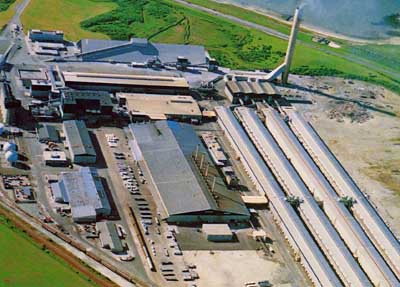
From Socialist Party Wales website -original with references can be read http://www.socialistpartywales.org.uk/front5.html. Photo is of Anglesey Aluminium.

Dylan Roberts (Socialist Party, North Wales)

Historically, the economy of the north west of Wales has been based upon agriculture and tourism; the economy of the north east of Wales upon heavy industry and manufacturing. However, over the past few decades, we have witnessed the death of heavy industry, and an agricultural sector decimated by the globalisation of food consumption. In both west and east we have watched as steelworks, collieries, quarries, and agricultural smallholdings have disappeared, to be replaced by unskilled manufacturing and service sector jobs which are inherently low paid and insecure.
The end result is that North Wales is one of the most highly skilled yet poorly paid regions of the UK, and which has witnessed rapidly increasing unemployment in recent times. According to the 2008 figures from the Annual Survey of Hours and Earnings (ASHE) report from the Office of National Statistics, the average annual wage in Wales is around 13% lower than the equivalent wage for across the UK, with the UK average wage sitting at £25,123 per annum in 2008, compared to £21,831 per annum for Wales. The reality in north Wales is likely to be even lower again. (1)
North Wales has been heavily hit by the capitalist crisis in 2009. We have already witnessed the loss of a vast number of jobs in the region, with major employers such as JCB, Indesit, Deep Stream Technologies, Corus, Marshalls Cement, and many others, either laying off staff or closing altogether. Many other employers have frozen pay, reduced working hours, terminated the contracts of temporary and fixed term workers, or are threatening to take such measures in the near future. In the past month we have seen a number of key employers undertake job cuts or site closures in both the west and the east of the region.
Air Products
On June 30th, Air Products, an American owned multinational, announced their site in Acrefair, Wrexham, would close, with the loss of around 200 jobs. Air Products are switching production to China. While the loss of 200 jobs in a relatively under populated area is reason enough to be concerned, the Air Products case is worthy of further comment for a number of reasons. Air Products’ Acrefair plant opened in 1950, at a time when the bulk of the workers of Wrexham were employed in heavy industry. However, in the modern day, Air Products was one of very few remaining employers of skilled manual labour in the area. The fact is that the skilled workers at Air Products will struggle to find similar work anywhere within this region. This means they will potentially face a long period of unemployment, and when they do find employment it is likely to be low paid and insecure work within unskilled manufacturing or the service sector. The alternative is, like many before them, to leave the region.
But why is Air Products closing their site? Well, naturally management blamed the recession, citing a drop in profits in the first quarter of 2009 and “on-going cost pressures and the changing demand for our products, which is shifting to other parts of the world, notably Asia". (2) Yet Air Products are not struggling, and neither was the Acrefair plant unprofitable, as management conceded at the beginning of the consultation period in April. Indeed, in 2008 they recorded a global turnover of £11 billion pounds, with profits of nearly £1 billion. Whilst they have seen a downturn in profits in comparison to previous years, it is nonetheless evident that they remain extremely profitable.Indeed, in the first quarter of this year they turned a profit of US $189 million, which equated to more than US $60 million a month, or in even starker terms, more than US $2 million a day. Less profit than they were used to perhaps but hardly a struggling company. (3)
What they are doing is using the cover of the recession to move production to where labour costs are lower, in order to squeeze the profit margin some more. Janet Ryder, Plaid Cymru AM for north Wales, described it as a "betrayal" of a workforce that had been "consistently profitable" for Air Products. (4)
Air Products had announced a consultation period in April, which of course meant that the decision had already been made. The workforce and Unite had put forward an alternative strategy that would have saved jobs and kept the plant alive, whilst conceding to some of Air Products' demands. Whilst offering concessions – job cuts – isn’t necessarily the right path to take, nonetheless this would have preserved some jobs and retained a much needed employer of skilled labour in the area. Air Products, however, were not interested.
As unpalatable as this is, it might not be quite so devastating if it was an isolated incident. Unfortunately, it is anything but.
Anglesey Aluminium

Anglesey Aluminium is, along with the Wylfa nuclear power plant, a major employer on the Isle of Anglesey, and in fact one of the largest employers in north Wales. It is estimated that the firm amounts to around a third of the entire economy of the isle of Anglesey. (5)

Anglesey Aluminium, a joint venture between Rio Tinto (who own 51% of shares) and Kaiser Aluminium (49%) announced in early July that they would be offering voluntary redundancy to 140 workers, with the remaining jobs almost certain to go in September when the plant ceases production. Anglesey Aluminium intends to retain only 80 workers from the 500+ strong workforce. The effect that the closure of Anglesey Aluminium will have on the island cannot be emphasised strongly enough. The north west of Wales is an overwhelmingly rural area with an over reliance on tourism, and the loss of such a significant employer will have long term consequences for many generations of workers on the island.
The plant is closing due to the end of a contract for cheap energy supply with Wylfa, with management citing this as the primary motivation for the closure. The only way the 400 jobs due to go in September could be preserved is if Anglesey Aluminium obtains another source of subsidised energy, which seems highly unlikely.
The closure of Anglesey Aluminium had been on the cards for some time. The closure of Wylfa was announced back in 2006, with the nuclear plant expected to close in 2010. However, earlier this year the Nuclear Decommissioning Authority (NDA) announced that they may extend the lifetime of the existing Wylfa plant (Wylfa A), with a second nuclear plant (Wylfa B) having been proposed back in 2006. One of the reasons given back in 2006 for the creation of Wylfa B was for the need to continue the supply of energy to Anglesey Aluminium, although this would no longer be at the reduced rate.
The proposal for the second generation nuclear plant, Wylfa B, was voted through by Anglesey County Council, following a propaganda drive by the council and local Labour MP Albert Owen, who heralded the proposal for Wylfa B as a boon for the island and claimed that 1,500 jobs would be at stake if Wylfa B didn’t go ahead.
Iain Dalton, of the Socialist Party Bangor branch, has written previously about Wylfa. On 6th February 2006, Iain noted that:
“They claim that without it, the island will lose 1,500 jobs. This figure has been inflated by Wylfa taking on temporary workers, and by including 400 jobs at Anglesey Aluminium, which the company has publicly stated will not be threatened by closure of Wylfa, although they may use it as a pretext to move production to a lower wage economy. However, a new nuclear station would employ far fewer people than the current station due to new technologies, and that is before cost-cutting practices of the new station's private owners (Wylfa is presently publicly run).” (6)
Indeed, Iain’s words have been borne out. Despite the claims of Albert Owen and Anglesey CC, the fact that the proposal for Wylfa B has been given the go ahead has not prevented Anglesey Aluminium from using the end of the discounted energy supply as an excuse to close the plant, with Rio Tinto and Kaiser Aluminium exploiting the situation in order to switch production to cheaper labour markets.
The Welsh Assembly Government (WAG), in conjunction with Westminster, offered a financial package of £59 million over four years to compensate for the loss of the discounted energy supply, which amounted to an astounding £1 million a month state subsidy. 7
However, management at Anglesey Aluminium, Rio Tinto, and Kaiser Aluminium rejected the deal, claiming that they would need at least double that figure in state subsidies to retain production on Anglesey. Yet Anglesey Aluminium has been extremely profitable in the 36 years it has been on the island. Furthermore, both Rio Tinto and Kaiser Aluminium are vast multinationals turning huge profits.
Rio Tinto, which owns the controlling stake, recorded record profits in 2008, delivering net profits in the first quarter of 2008 of an astronomical US $2.94 billion. They have not faired quite so well in the first quarter of 2009 but that still equates to US $1.6 billion in net profits between January 1st 2009 and March 31st 2009 – or US $177 million per day! 8
Yet again, we see private enterprise demanding that the losses are nationalised while the profits remain private.
As with Air Products, it is evident that the crisis of capitalism and rising production costs are being used as a scapegoat, for attacks on pay and conditions and the switching of production to non-unionised plants in low wage economies, in order to drive these obscene profit margins up yet further. In both cases, there is no pressing need to switch production; it is simply another case of profits coming before people.
As Iain pointed out, and as has been borne out by the impending closure of Anglesey Aluminium, the claim that a new second-generation nuclear facility on Anglesey would not only retain existing jobs but also create new jobs has been proven to be false. As Iain pointed out in the same article:
“Local campaign group Pawb (People Against Wylfa B – Pawb means ‘everybody’ in Welsh) are arguing for an alternative employment plan for the island. Much of this lies around the potential for harnessing renewable energy sources, as the island has near ideal conditions for several technologies including tidal, wind, solar and wave. Additionally, based on the experience of decommissioning Trawsfnydd in nearby Gwynedd, decommissioning the current Wylfa station will provide at least 500 jobs for at least fifteen years.”( 9)
Local politicians such as Albert Owen have argued that building a renewable energy plant on the island would not have been viable, as such a project would take many years, and would therefore leave the skilled workers of Wylfa and Anglesey Aluminium without employment. Yet as Iain points out above, decommissioning the existing Wylfa A plant would have provided significant employment for the next decade and a half, and a new renewable energy plant would have created both long term employment for the people of Anglesey, and shorter term employment as the plant would need to be built. Instead, it appears that Anglesey will retain a nuclear power plant, with all the inherent environmental dangers and impact that come with that, but will still suffer from mass job losses as Anglesey Aluminium ceases production and Wylfa inevitably cut jobs due to new technologies.
The ideal opportunity for a clean, green, environmentally sound mass source of renewable energy has been missed, in addition to the vast number of jobs in the beleaguered construction industry that could have been created by building such a plant.
We can also see further evidence of the short-termist attitude to the construction sector elsewhere in north Wales.
Hanson Cement
Hanson Cement – formerly Castle Cement – in Padeswood, near Buckley, Flintshire (north east Wales) announced on Tuesday 7th July that they had entered a 90-day consultation period, with a view to 96 redundancies. 56 production jobs and a further 37 in distribution are under threat, which would leave only a skeleton staff of 46 at the plant. This is despite promises made by Hanson that there would be secure work for 110 workers. The plant is home to the most modern cement kiln in Europe. (10) Job losses at the plant in Flintshire have been on the cards for some time, with Hanson prepping the turf back in 2008. (11) The threatened job losses have been blamed on the stagnant construction industry, with a spokesman stating that the plant was "reducing output to a minimum in light of the continuing downturn in the construction industry."
This follows the closure of Marshalls Cement, not far from Hanson Cement, in Llay, near Wrexham, which shut down in may with the loss of 55 jobs. (12)
In both cases, management has cited the stagnation of the construction industry and the resultant drop off in demand for cement as the primary reason for the job cuts and closures.
Hanson Cement (and Marshalls) does differ from both Anglesey Aluminium and Air Products, in as much as the capitalist crisis has undoubtedly had a severe effect on construction. Hanson are not switching production; rather, they are ceasing production, at least at the Flintshire plant.
It does, however, seem ridiculous that we are currently seeing massive job losses in the construction industry across the UK when housing remains such an issue, with the BNP in particular using pressure on limited social housing stock and an absence of affordable housing to gain political capital. Whilst the news that the New Labour government intends to undertake a programme to build 3,000 council houses and 20,000 affordable houses over the next two years is to be welcomed, in as much as it is better than nothing, it remains evident that this does not go far enough. (13) A programme could be adopted to build new social housing stock and affordable housing on a mass scale, which, combined with the termination of the right to buy programme, would serve to alleviate the huge pressure on limited existing stock, provide employment for the hundreds of thousands of threatened construction workers in the private sector, and cut off the BNP and the far right's main source of oxygen by providing employment and housing on a vast scale.
Likewise, a similar large scale construction project on Anglesey could have not only provided work for the beleaguered construction workers, but also delivered an environmentally beneficial source of renewable energy, which would have sounded the death knell of nuclear power in the UK.
In addition, key employers such as Air Products and Anglesey Aluminium (Rio Tinto) should have been prevented from switching production to non-unionised plants in low wage economies given that the levels of profits of both multinational companies, and the continued profitability of their north Wales plants, demonstrates their viability.
Both companies should be made to open their books, and if necessary both sites should be nationalised to ensure there are opportunities for skilled workers in the already decimated local economy of North Wales. However, it appears that while the government, and indeed the capitalist establishment as a whole, are more than happy to bail out the bosses and the bankers, there are no such plans to bail out the workers.

Monday, 18 May 2009

Celyn – The Welsh Green Left Review

Anyone who regularly checks out the Socialist Unity blog will probably have seen a few posts announcing the publication of a new left magazine in Wales, Celyn along the lines of the Scottish Left Review which aims to be a discussion journal between lefties in several parties and others, (The editorial statement says the editorial board consists of ‘people from Labour, Plaid Cymru and the Communist Party as well as trade unions, the peace movement and other campaigning organisations’.) although I do believe the two main people behind it are Marc Jones (former Cymru Goch member and current Plaid Cymru councillor) and Leanne Wood (Plaid Cymru AM).
When I was in Wrexham a few weekends back I picked up a copy and I have to say I have mixed feelings about it. To my mind its not like a journal that allowed debate between different trends on the left wouldn’t be useful. But the nearest that Celyn gets to this is a page about the European Elections which features statements on the European elections from Plaid Cymru, Labour, the Greens and No2EU (and the layout is such that the Plaid Cymru piece stands out quite a bit from the others).
But to my mind the magazine falls short of this, but also in terms of attempting to offer a direction for the left in Wales. For example in Leanne Wood’s column she rightly condemns the funding cuts to the Assembly government and demands the money from the Westminster government, yet she doesn’t offer a strategy for forcing the government to give up this money.
Or the report on the Citizens of Bangor Deserve Better demonstration a few months back (see report on this blog) which whilst making the odd correct point (including about the main speaker at the demo) draws outrageously pessimistic conclusions. We even get a small mention (as ‘a small group of enthusiastic Trotskyist students’, there were about 12 of us there and we weren’t all students), yet the suggests that no-one was offering any demands or a programme for change. But we were there doing just that, with placards that were taken up by people, leaflets and our publications. I spoke from the platform and did just that, and additionally there was a speaker opposing council housing privatisation too. Perhaps the author of that article should have tried to do something similar instead of carping on from the sidelines!
It also doesn't feature anything about the issue of tuition/top-up fees in Wales - which there has recently been a bit of an uproar about within Plaid Cymru.
I did quite enjoy the last page of the magazine, the spiky bit which features some short amusing pieces as well as an advert for the Radical History Tour I attended last weekend entitled ‘Finally a date for the revolution!’, as its name in Welsh ‘Chwyl-dro’ could also translate as Revolution. But this doesn’t make up for what I think are the failings of the magazine, which to be honest could be better, so I for one won’t be taking out a subscription.

Thursday, 21 August 2008

Credit crunch bites Cardiff Bay

From the Socialist Party Wales website www.socialistpartywales.org.uk

Another building development in Cardiff Bay has been frozen as the credit crunch bites. The Bay is peppered with half-finished apartment blocks, newly-built relics of boom and bust, semi-permanent eyesores that remind us of the inability of capitalism to solve basic human needs.

by Dave Reid

There are plenty of homeless people, unemployed building workers and piles of unused building materials and yet there is no profit in construction workers building homes for the people who need them. So they remain unbuilt.Thousands of people need somewhere to live in Cardiff. Young workers forced to sleep on friends sofas because they cannot afford the bond and rent for a place of their own. Young families cramped in small flats because they cannot get even close to affording a mortgage even as house prices fall. The council stopped building houses decades ago, widening the gap for the private developers to step into. For those with a tidy wage there are the “luxury apartments” down the Bay - small, smart flats in modern wooden-clad tower blocks with spiky shrubs in uniform, neat gardens.

Never ending boom?

A year ago it looked like the boom would never end with a new luxury tower springing up every month. Even the housing associations got in on the act, building luxury apartments to rent for profit down the Bay, forgetting about the social housing desperately needed by the low paid and by families.But the credit crunch has put an end to all that and as the developers discover holes in their balance sheets they walk away from their half-built sites, leaving unfinished blocks scarring the landscape and blocking the pavements.The sites remain. Breeze blocks are piled up ready to use, the construction workers who were ready to cement them laid off. Wheelbarrows are strewn around the sites, abandoned by the retreating developers.

Thatcherite promise

Cardiff Bay itself is the symbol of the Thatcherite promise of the post-industrial age. Thatcher and the Tories wiped out industry in Cardiff and the rest of Wales with only two minor steelworks remaining after thousands of jobs were destroyed. But no matter, they said, the future is in services - financial services and the leisure industry.So Lord Edwards, the Tory Welsh secretary, formed the Cardiff Bay Development Corporation (CBDC), another unaccountable Tory quango, to redevelop Cardiff docks. They promised that this would be the hub of a new Wales founded on finance and tourism. And the Labour politicians, on the way to becoming New Labour, bought into the idea as well, accepting highly-paid part-time jobs on the quango. The Tories did the deals while the Labour leaders did the PR, loudly shouting “Jobs!” every time anyone queried the project.While hospitals were sold off and the council was refused cash to build council homes hundreds of millions were poured into the bay development. A £200 million barrage was built across the bay to create a huge lake in front of the development and cover the low tide mud.Restaurants and bars sprung up as well as public sector developments like the Assembly, the Millennium Arts Centre and the council itself. The old docks, that used to make up one of the greatest exporting ports in the world, were scrubbed clean and landscaped ready for jet skis and windsurfers.But even as the modern new buildings sprung up questions were asked. People living down the Docks were pushed aside. The famous Tiger Bay, the Butetown community, was effectively privatised by the CBDC with promises of jobs. The Butetown Carnival created by the community and famous around the country, was taken over by the CBDC, run “professionally” and then quietly closed down.

Jobs mirage

The jobs promised by the men in suits to the local community proved to be illusions. Most of the construction jobs went to outsiders. And what remained after were minimum wage jobs serving in the restaurants and pubs. Industry sold up and left the area taking with them the better paid jobs. Caradons that had taken over the old Currans steel plant, based in the area for over 100 years, decided it could make more money by closing the factory and selling the land for a luxury apartment development, so it shifted production to Stoke, taking with it 400 better paid jobs.

Cheap labour was driving out proper jobs. Harry Ramsdens instead of Currans. One developer was reported to ask whether the Castle steelworks lying to the east of the newly developed Roath Dock could be removed because it was a bit of an eyesore.

Developers cash in- then walk away

No one will ever know how much money was made by the privatisers and developers in Cardiff Bay. The privatisation of British docks into Associated British Ports (ABP) was said to be Thatcher’s favourite privatisation. Billions have subsequently been made from the sale of dock land. And Cardiff was one of the most profitable, second only to the London dockland developments. According to The Guardian, Lord Edwards later joined the ABP board and the Welsh office minister behind the scheme joined its property arm.And while the developers made money hand over fist working people in Cardiff did not. The CBDC and its Labour hangers on promised 30,000 new jobs, but a maximum of 20,000 have been created and 15,000 jobs were lost when industry pulled out. Instead of tens of thousands of new jobs being created we saw a frenzy of speculation as the developers stampeded into the Bay to build luxury apartment blocks in the property boom upon which the sun would never set.Now, Russell Goodway, one of the Labour creators of the project, bemoans the jungle of apartment buildings that has sprung up. He wanted more business blocks. But what did he expect when he sold the Bay to a market that chases the quickest buck? Of course everyone likes going down the Bay for a bit of a promenade down the front and to have an ice cream and a pint. But the jet skis and windsurfers are banned because the docks and the Bay have been poisoned by algae, like the financial system that has been poisoned by bad debt. And talking of debt we still have to pay £4 million a year for the upkeep of the barrage.

Still as we sit licking our ice creams on the aluminium chairs in the cafés on the waterfront we can still dream on what the billions could have been spent on - rebuilding public services and valley communities perhaps, hospitals and new council housing.And maybe Barry Island could have been given a lick of paint.

Friday, 18 July 2008

Reports from the Local Government strike in Wales

Socialist Party Wales members visited dozens of picket lines across Wales offering solidarity and support and receiving a warm welcome for our special public sector leaflet as well as selling our paper to many of the pickets.

SOUTH WEST WALES

The strike in South West Wales was solid and our members reported overwhelming support for the action.
Alec Thraves reports:

Swansea
Pickets at the County Hall, Guildhall, Refuse depot, Building maintenance, social services, the Grand theatre and others all reported just a handful, of mainly non union members, crossing the picket lines.
Clive Williams, UNISON shop steward for the Housing Department of the City and County of Swansea said: - “My colleagues ask me – Do I think this dispute is winnable? I reply, yes I do think it is winnable but it depends on the tactics of the trade union leadership. There are two factors I would like to highlight:-Firstly, the Labour Party has to be taught a lesson and that is you don’t bite the hand that feeds you! The Labour party is funded by the trade union movement and that funding must stop because we aren’t get anything in return for the money we are paying out, so that link must be broken.Secondly, when industrial action is being considered, the leadership of the public sector trade unions should carry out a ballot simultaneously with a recommendation for strike action and if that happens then success will be very likely. Today’s action has seen 99% out on strike and the few who have gone in have been insignificant”!
40 copies of the Socialist were sold in Swansea city centre at a lunch time stall supporting the council workers.

Llanelli
The main council building had a lively picket with hardly anyone going in and similarly at the leisure centre.Mark Evans, UNISON, Assistant Branch Secretary of Carmarthenshire County Branch, with 4000 members spread across Carmarthen, Llanelli and the Amman Valley told the Socialist that the strike had been solid with the most number of pickets ever!“The GMB refuse depots have been picketed with no one crossing the picket line, whilst pickets at other council premises were solid, upbeat and reported that very few staff have gone into work. Our shop stewards discussed the excellent response today but felt that 2 days would not be enough to win our demand and that in September we expect an escalation of the dispute. There is a great deal of enthusiasm for joint action with other public sector workers”.

SOUTH EAST WALES

Cardiff
Report by Ross Saunders Cardiff UNISON Schools Convenor (personal capacity)

Thousands of Unison members went on strike in Cardiff and the rest of South East Wales today against a pay offer that amounts, yet again, to real-terms pay cuts. Many schools and Council workplaces were shut, with a number of lively picketlines outside those that management refused to close. Postal workers refused to deliver the mail and many members of GMB and other unions refused to cross the picketline in solidarity.
Council management have been condemned in the press for risking unsafe working practices in order to try and hide the impact caused by the strike. They forced Butetown tunnels, a series of covered dual carriageways, open with a small crew of 3 untrained scabs. Every 12 hours 40,000 cars travel through the tunnel, which is usually staffed by 20 skilled technicians, all UNISON members out on strike.
There was a feeling of grim determination on the picketlines I visited. Local Government workers are the most lowly-paid in the whole of the services sector, and UNISON organises some of the worst off of these - including the care-workers, teaching assistants and cleaners. Pickets said that, despite the financial sacrifice, they were glad they were taking action against attacks on their pay, working conditions and the quality of the services they provide.
Labour Assembly Member Carwyn Jones spoke at UNISON, saying he thought it was unfair for some to have to suffer "pay restraint" and not others. The irony was not lost on the members who listened to him speak from the platform, which was decorated with placards, including one pointint out Assembly Members had themselves just accepted an 8% rise in their already inflated earnings.

Report by Mariam Kamish
Cardiff County Unison strikers at County Hall have been very effective. They've stood in the road, stopping every car, with a polite but firm, "May I ask you not to cross the picketline?" As a result, even most managers have felt the need to explain themselves. Delivery vans have turned back and not attempted to cross the picketline. About 30 strikers were on the picketlines at County Hall at some point during the day.People crossing (other than management) were those with exemptions from the union, because they were about to retire (and days off would count against their pensions) and temps. Temps were encouraged to join the union and assured that - management threats not withstanding - they would not have action taken against them for taking part.Management had sent out an email warning staff that they would be in breach of their contract if they didn't belong to the union, but respected the picketline. Pickets explained that all strikers were "in breach of their contracts", but were covered by provisions for legal strike action.The second day, the small numbers going into work - including management - were greatly reduced. An excellent result.

Bridgend
Pickets at the Council buildings in Bridgend town centre reported that the strike was solid with fewworkers turning up. Bernard Roome, CWU National Executive member, spoke to them and gave solidarity and support from the communication workers union.

MID WALES

Geoff Jones
Powys Council headquarters was closed and picketed. Schools and librarieswere also closed. Workers in rural Wales have been particularly hit by rising fuel costs. One striker who has to travel around the county as part of her job commented that Powys' mileage allowance now did not cover the cost of fuel so that she was subsidising the Council.

NORTH WALES

Ruthin, Denbighshire
Liz Cowell
Strikers from across Denbighshire converged at Ruthin for a lunchtime rally calling for Fair Pay; many wore T shirts emblazoned with the slogan "I'd rather be skint than a scab". Many reported support from the public and as the rally progressed many passing vehicles sounded their horns in solidaritory. The majority of strikers highlighted that the Welsh Assembly Members had no shame in awarding themselves an 8% pay increase (double the rate of inflation), while expecting ordinary workers to accept 2% (half the rate of inflation) - irony gone mad.The UNISON/UNITE strikers chanted ,"What are you going to spend your £3 rise on?"" A gallon of petrol" came the reply from the crowd. Other demands raised were "We want the John Lewis list and Money for bread and milk".Several raised the point that while striking for a pay rise to keep up with inflation they were also there protesting at cut backs in their departments - resulting in worsening services for vulnerable people and extra workloads for the staff. The speakers at the rally commented that council workers have worked so well that they have doubled the government's target for efficiency savings, meaning that Conwy council has £3Million of unallocated funds and Denbighshire £5Million. In the Strikers own words this would be more than enough to meet the unions pay demand in full.

Gwynedd
Iain Dalton
Socialist Party members visted the picket line at the Town Hall in Bangor (Almost all other council run buildings were simply closed for the day). The picketers described their anger at seeing the farce of MPs expenses whilst they were being forced to put up with a miserable below-inflation pay increase. On the Thursday, members visited several picket lines in Caenarfon where news had just come in of all the GMB members (who are not on strike) refusing to cross the picket lines at some workplaces in the south of Gwynedd in a show of solidarity with their striking fellow workers. The mood was one of determination, particularly after finally actually taking action after years of below inflation pay increases and workers on the picket lines discussed what could be done to make future action even more successful.

Tuesday, 15 July 2008

Class Inside The Criminal Justice System

Now I’d like to think people are well aware of the well-documented class bias in the criminal justice system (not to mention racial and other biases). So today I want to deal with the relation of class within the criminal justice system.
Why should I do this? Because there is a perception for some that those working for the state (and here I mean the prisons, police, courts etc. the ‘armed bodies of men’) form one reactionary mass. Needless to say, I think this is false. It is important to note that the tops of any industry and other state occupation (ie. teaching, civil service etc.) are different to the people at the bottom of those organisations. In my opinion there is a certain analogy between your basic civil servant, factory worker, prison officer and police constable, just like there may be between a senior civil servant, factory manager, prison warden and chief constable.
Okay, so a police officer has more discretion in their work than a factory worker. But who decides the broad thrust of the actions of these groups, it is those at the top not the bottom. Would we suggest that all civil servants agree with means testing because they have to carry it out? The same to an extent applies to strike breaking or stop and search with the police. (Of course this doesn’t mean that all civil servants or police officers are opposed to such actions either). To get some say in how their institution is run they need collective action – unlike those at the top. The courts are somewhat different with the judiciary drawn from the legal profession and the magistracy is drawn from whomever local political players nominate. Both of which are not generally working class, or are at all that sympathetic either.
Which brings me to what I suppose is the real reason why I began writing this. Namely that when I wrote about Devolution and the Criminal Justice System in relation to Wales it was pointed out that I was dismissive of the notion that extra jobs in Wales may result from establishing a fully developed Criminal Justice System.
Now the reason for me being dismissive was mostly because such jobs would only be jobs stolen from English workers, and it wouldn’t be all that many jobs, simply some administrative posts. The main benefactors would be those at the top who would be running the justice system of a region not a nation – with a prestige boost to match.
Job creation with regards to more immediate problems such as making the criminal justice system more ‘accessible’ (ie. building prisons and courts so that travel time for families etc are reduced etc.) would result in more jobs without taking them from elsewhere.
Indeed all the immediate problems that face welsh people in relation to making the Criminal Justice System more accessible to them as a nation (the lack of local prisons, lack of Welsh language provision etc.), do not require a separate Welsh jurisdiction. In my opinion a Welsh Criminal Justice system would be valid if it were to be constituted on a more progressive basis to the current system, in that it was truly democratic – especially in relation to the judiciary – basically if it were run in the interests of the ordinary workers in Wales (regardless whether Welsh speaking or not, or whether they were born in Wales or not – that should not matter) and not to create prestige posts for the Welsh middle class.

Tuesday, 27 May 2008

Plaid and Crime

This is a review of Leanne Wood's recent Plaid Cymru policy statement 'Making Our Communities Safer' - which can be found at http://www.plaidcymru.org/uploads/publications/319.pdf. This has already been discussed on the Socialist Unity blog see http://www.socialistunity.com/?p=2324. This review can also be found on the Socialist Party Wales website.

A document by Plaid AM Leanne Wood

Reviewed by Iain Dalton (Bangor SP)

Crime has been ever more increasingly in the press over the last few years as one of the biggest issues affecting people. However, we have been fed a programme of populist, punitive schemes to combat crime by this New Labour government that have only made the problem worse. Thus it is welcome that Leanne Wood, a ‘left’ Assembly member for Plaid Cymru and former probation officer has written a document challenging these policies and attempting to outline an alternative policy for Plaid Cymru.

After the summary and recommendations, the report begins by stating “Community life in Wales is at risk. UK Government attacks on public services and the historic lack of a Welsh economic policy has meant that community viability has had to depend upon the whims of the market. Whilst there have been some winners, most communities and the people living within them have been losers.” Undoubtedly cuts to public services have had a dramatic impact across the UK and especially in Wales which to a great extent has not in some areas recovered from. But it is not just the UK government that is affecting these cuts, the Welsh Assembly and local councils have happily passed on budget cuts to cuts to services, despite moaning about it rather than taking practical steps to do something about it. For Wood, safe communities are the key to fighting crime, a safe community is one in which someone (and those they care about) can move around in free from fear.

Wood correctly points out the abject failure of current government policies to tackle crime. She points out that the imprisonment rate for the UK (I assume she means England and Wales as Scotland is a separate jurisdiction) 50% higher than France, Germany and Italy and that (much more shockingly in my opinion) 72% of the male prison population (the vast bulk of the prison population) have two or more mental health disorders. Wood also points of the re-offending rate and how this is linked to drug and alcohol dependency which is very prevalent among offenders.

Wood also comments on how sentences are increasing, pointing out the 34% increase in prison sentences for women for driving offences, and makes several other comments regarding female prisoners including the large proportion sentenced for drug offences and the ‘recycling’ of women through prison on short sentences that means no rehabilitation could possibly occur.

Wood also comments on how some aspects of crime policy, such as preventative elements related to housing, education, domestic abuse, youth justice etc. have been devolved to the Welsh Assembly, but control of policing, criminal law, the courts, probation and prisons remains with the new Ministry of Justice.

In criticizing the recent policy from the Home Office, she notes the admixture of free-market liberalism with punitivism and prohibition. We have seen in recent years the largest ever prison population, Anti-Social Behaviour Orders (ASBOs) criminalizing young people, clamping down on civil liberties and the proposed ID cards. Alongside this we’ve seen drinking laws relaxed, the promotion of super casinos and the opening up of the probation service to privatization.

In trying to answer the question of why crime has become such a political issue she points out the contradiction between the declining crime rates and the ever increasing fear and perception of crime. She reviews the usual links between media portrayals of crime out of control, and points out that ‘anti-social behaviour’ was invented by New Labour, indeed much of their effort against crime has been directed at low level crime which only seems to have made the problem worse.

To do something about crime, Wood correctly argues that we have to understand why people commit crime. She briefly surveys things like poverty, substance abuse, lack of youth facilities and mental health problems, pointing out the shocking statistics relating to this including over half a million people in Wales living in poverty and the much greater prevalence of mental health problems in former coal mining areas.

Crime policy towards young people comes under severe criticism from Wood. She points out that because there is only one secure children’s home in Wales about 84% of young offenders from Wales are imprisoned in England. But it is ASBOs which come in for the most criticism (quite rightly!). As she explains ASBOs are not criminal offences, but their breaching can result in imprisonment, meaning that people are being sent to prison for offences that wouldn’t even warrant a fine or community service order! She cites figures from the Youth Justice Board showed that 700 children and young people had been imprisoned for ASBO breaches, and she also points out that figures show that about half of all ASBOs are breached.

So far so good. These criticisms of government policies are something socialists would agree with. But what does she propose? The main proposal is to make criminal justice issues fully devolved to the Welsh Assembly government, so that they can prioritise tackling the causes of crime. The bulk of the proposals lay in substituting the punitive approach of new labour for a rehabilitative approach, alongside a pro-active preventative approach with young people generally, and specific interventions for those who have committed criminal offences or anti-social behaviour. Of course, such an approach would be a big improvement on current government policies, but unfortunately it doesn’t tackle many of the real problems.

Poverty, substance abuse, mental health problems are by products of living in an alienating society based on greed rather than need. Wood’s proposals are attempting to deal with these damaging by products, rather than their root causes. No mention is made of trying to deal with the devastation caused to communities by multinationals that decide to leave for lower wage economies, nor the current financial squeeze which is being reinforced by below inflation public sector pay deals and an appallingly low minimum wage.

Further more, these solutions would not empower ordinary people to be able to do anything, rather create a whole layer of professionals who will control the lives of thousands. It is a recipe for a top-down system which would still fail to respond to the needs of ordinary people in Wales.

Instead, Socialists would start from the need for the democratic control of the whole criminal justice system so that priorities can be decided by local communities. We would also advocate the democratic control of the economy to provide well-paid jobs and employment for all. Of course, some of the suggestions that Wood makes would be incorporated into a socialist strategy to tackle crime, such as increased availability of facilities to help those with drug problems, but to be successful it would need to be linked to the key socialist policies stated above to have any real chance.

Tuesday, 20 May 2008

Cardiff school saved from the wreckers.

This piece comes from the Socialist party wales website. On another note i've finished most of my coursework now so I'll be able to do a couple of things I've been putting off for a while, inlcuding making some updates to the blog.
Campaigners from Lansdowne Primary School in Canton in Cardiff are celebrating this week after winning their fight to save their school.
Report by Ross Saunders
( Cardiff West Socialist Party, Unison Steward Fitzalan High School)

Eight months of hard, well-organised campaigning by parents, staff and community members has proved that fighting back can win results. The victory has given a huge boost to schools like Llanedeyrn, Cefn Onn and Llanrumney, which still lie under the axe.The campaign forced school closures to the top of the agenda in the recent Council elections. Socialist Alternative candidates standing under the banner of Save Our Schools gained respectable votes and Plaid Cymru were pressured into opposing the school closures. Plaid has now joined forces with the Lib Dems on the Council Executive. Cantonian High School will also remain open and anew school for over-crowded Welsh-language Primary Ysgol Treganna. will be built. But the school closures programme has not been withdrawn.
These developments have exposed the lies peddled by local Labour councillors, who claimed building a new Welsh-language school was impossible without closing an English-speaking school.
Plaid, which has been able to fake left while in opposition, now faces having to administer closures in the city, or come up against its own party members in the WAG coalition with Labour. Canton has won its battle for now, but campaigners have expressed their sympathy with the other schools still on the closures list. People in other parts of the city will ask how Plaid can close schools in their area while saving those in their own back yard.
Socialist Party members, who have supported Lansdowne and the other schools campaigns from the beginning, are calling for so-called "surplus places" to be redistributed amongst all the schools in Cardiff in order to lower class sizes and raise standards, and demands the funding arrangements be changed in order to allow this. Colossal pressure has been able to divert the main parties from attacks in some parts of the city, but until a new party that acts in the interests of ordinary people is created, campaigners will have to continue their fight against school closures and job cuts in education

Tuesday, 13 May 2008

France '68, Remembering the 40th Anniversary of the revolutionary uprising.

Okay I promise I'll post something on crime tomorrow, but for today I thought I'd post up some meeitng reports from Wales, taken from the Socialist Party Wales website

France came to Wales last week as successful meetings were held in Swansea, Cardiff and Bangor to discuss the events in France in 1968.

Dave Reid , Alec Thraves and Ian Dalton report:
In Swansea, South Wales Evening Post advertised our meeting but mistakenly gave out the wrong day of the meeting. The following night we had to go back and explain to some disappointed members of the public why they had missed an excellent meeting. Despite their frustration we sold a couple of papers and one is coming to the Swansea Socialist Party branch meeting next week. The previous night there was a lively debate amongst an enthusiastic audience who agreed we could expect more revolutionary movements of a similar kind in the future. The biggest lessons that came out of the meeting were the central role of the working class in changing society and the need for a determined socialist leadership.

In Cardiff six non members of the Socialist Party attended the meeting including three people who had seen publicity on the streets.
Clare Doyle, author of Month of Revolution: France 1968, outlined the events in 1968. She pointed out that while the media has mentioned the battles of the students with the police which opened the events in Paris there is little or no mention of the general strike by the working class, the biggest general strike in history.
A “strike chart” on the wall visually brought home the scale of the movement in 1968. Clare gave an inspiring account of the thousands of factory occupations which seized the factories from the bosses and led to similar action by the middle layers in society like journalists, doctors and actors. All four conditions for revolution outlined by Lenin were present in France with the exception of the existence of a party of revolution that understood the events and was able to lead the working class.
A wide-ranging discussion ranged from France to Britain to Saudi Arabia to Sweden to Czechoslovakia. Some questions were raised about whether the modern working class has the power to carry through the strike movement that the French workers fought in 1968 and whether British workers are as militant as French workers.
A PCS member pointed out that we can take a step forward towards that of France 1968 by building towards united action in the public sector against the government’s pay freeze. Civil servants are one section of the workforce today who would have regarded themselves as middle class in the 1960s who are now clearly part of the working class.
Andrew Price, a member of the UCU national executive, joined Militant, the forerunner of the Socialist Party, in May 1968. He explained that in the same week that he joined Militant the Labour Party had received an even worse result in the local elections than New Labour got in 2008, but what was different was that the working class base of the Labour Party in 1968 moved to the left and the ideas of Marxism received an increasing ear with 3 million votes for nationalisation of the commanding heights of the economy at Labour Party conference that year. Today there is no party for the working class and we will have to build it. 10 copies of Clare’s book were sold and £166 fighting fund raised at the two meetings.

In Bangor Rob Williams(Swansea SP) spoke on the 10 million strong general strike that shook the capitalist system. He described how the movement developed with workers occupying factories causing French president de Gaulle to flee the country and how the so-called Communist Party betrayed the movement and saved the day for capitalism.
The discussion covered other mass strikes such as the 1984-5 Miner's Strike, the 1926 British General Strike and movements that the Militant (the fore-runner of the Socialist Party) played a leading role in such as the heroic 1984-7 Liverpool City Council battle. The difference in the world economy and situation between now and 1968 was also discussed. Books, pamphlets, and the 1968 special issue Socialism Today were sold.

Wednesday, 7 May 2008

Devastating Election Blow for New Labour

Taken from Socialist Party Wales website

Report by Dave Reid

This year’s local election results in Wales have delivered a devastating blow to Labour. Together with the results in England they represent a comprehensive rejection by working class people of everything that new Labour and the Brown government stands for.
Labour has been thrashed in its old heartlands. It has lost Blaenau Gwent, Merthyr and Torfaen councils and suffered serious losses in Caerphilly, areas in which Labour used to regularly win crushing majorities in good times and bad. Labour also lost Newport so now controls only Rhondda Cynon Taff, Neath Port Talbot and Bridgend.

Mortal blow to Brown and New Labour

But this is not the old Labour Party. A growing layer of working class people has realised that this is not their party anymore and have abandoned Labour as decisively as Blair and Brown abandoned their interests. Others cannot bring themselves to vote for the crew who has just put income tax up for the lowest paid workers in the country. They may return to vote Labour to keep the Tories out in the future but not with great conviction.
Labour’s projected share of the vote across Britain stands at just 24% the lowest for over 40 years and puts Labour 3rd behind the Liberal Democrats. Brown’s premiership has been dealt a mortal blow. He will attempt to cling onto power or face being dumped before the General Election, an even more ignominious fate than James Callaghan, who was one of the few Prime Ministers not to win a General Election.

Support for whoever could beat Labour - No enthusiasm for Tories

David Cameron has tried to ride the crest of the wave of his party’s gains. But there is no enthusiasm or illusions in any of the other parties in Wales and certainly not the Tories. This was a vote against Labour, not a vote for any of the other parties. In fact this election represented a further rejection of the Tory policies that New Labour has promoted. The Tories re-gained some seats in their old Welsh strongholds of Monmouth and Vale of Glamorgan, but have not broken through in most of Wales. They only gained control of Vale of Glamorgan council.
Voters supported whoever could beat Labour and in most areas that was not the Tories. Most old Labour voters stayed at home. In the valleys it was People’s Voice and Independent candidates as well as Plaid Cymru who broke Labour control. In Cardiff the Liberal Democrats, Plaid Cymru and Tories gained as Labour was pushed back to the 3rd party in the capital.
The Liberal Democrats benefited from the anti-Labour mood and held onto to their control of Cardiff and Swansea but there is no enthusiasm for their councils and they made few gains.
Plaid Cymru suffered serious losses as well as gains, losing control of Gwynedd, their only council. Significantly Plaid lost seats to Llais Gwynedd (Gwynedd’s Voice) which was formed primarily to stop school closures in the countyOverwhelmingly working people are sick of all the parties. All the opposition parties talk of change but they all implement similar policies when in power.Working people are craving a real change and the situation is crying out for genuine alternative to the stale diet of all the parties. People’s Voice’s and Llais Gwynedd gains show the potential for a new mass workers party.

A warning and an opportunity for socialists

The increased vote for the BNP is also a warning to the labour movement if it fails to provide an alternative to the pro-capitalist parties. However, despite a big press campaign against immigrants before the election, the BNP failed to make a major breakthrough in Wales. Only in Swansea did this racist party succeed in making gains in the number of votes.

The Socialist Party standing as Socialist Alternative achieved the best results of the left with creditable results in Cardiff and Swansea. However at this stage the support for our ideas is not reflected in votes. Working people realise that we need a bigger vehicle to deliver real change.
A serious discussion must begin in the Welsh trade union movement to look at the unions forming a new party through which the working class can fight to offer a real change form the policies of all the pro-capitalist parties.

Friday, 18 April 2008

200 March Against the BNP in North Wales

I've been rather busy recently, hence the lack of posts. However, I have written stuff during this period which will shortly appear on this website

At least 200 people joined a demonstration against the BNP organised by Wrexham Trades Council last Saturday. The numbers came as a pleasant surprise to many people (including the organisers who had only expected 50 at the rally after the demo).

The demo consisted of members of PCS, UNITE, UCU, NASUWT and other trade unions, as well as anti-fascist campaigners, mostly from Wrexham, but also in other small towns across North Wales and a coach came up from Cardiff.
The BNP are threatening to win district and county council seats in Wales in the upcoming local elections. They are standing across North Wales where they won over 5% of the vote in last years assembly elections, but also in Mid Wales and Swansea. Already they have had several community councillors elected after they stood unopposed.
The demo consisted of members of PCS, UNITE, UCU, NASUWT and other trade unions, as well as anti-fascist campaigners, mostly from Wrexham, but also in other small towns across North Wales and a coach came up from Cardiff. On the march we passed straight past the BNP stall in Wrexham, showing that they are not welcome on our streets.
After the post-demonstration rally, many protesters decided to counter-leaflet against the BNP stall. Unfortunately I only saw one speaker from the platform of the rally join in this action, which is disappointing as it will not just take one-off marches to stop the growth of racist and fascist ideas. The cuts and privatisations that all the main parties favour need to be fought as these allow the BNP to scapegoat immigrants as being responsible for this. The trade unions have a vital role to play in doing this, but at the moment many of their leaderships are tied to the Labour government which is carrying through these attacks. Ultimately we need a party that is prepared to stand up against these attacks, building the Campaign for a New Workers Party in North Wales is an urgent priority.
Socialist Party members sold 16 copies of The Socialist on coaches to the demo and at the demo itself, as well as one copy of Socialism Today and one copy of the newly published France 1968 book by Clare Doyle.

Wednesday, 19 March 2008

FIGHTING SCHOOL CLOSURES IN WALES

This piece is taken from the Socialist Party Teachers blog see - http://socialistteachers.org.uk/weblog/index.html

Iain Dalton & Ross Saunders (Socialist Party Wales)
Aschool closure is coming to every area of Wales. From Carmarthen to Cardiff, Powys to Gwynedd, the threats of cuts, closures and teacher redundancies are growing.
The root of the problem lies with the Welsh Assembly funding formula which funds each council according to the number of students going to each school, rather than their needs.
Now that student numbers are falling, a new formula is needed to allow smaller class sizes. We say abolish the formula not the schools! But parents, school students, teachers, school workers and local communities are uniting to oppose the threatened cutbacks.
All the parties, Liberal, Labour, Plaid and Tory, accept the argument that schools should close because student numbers have fallen. They claim money is being "wasted on empty places". But falling student numbers are a great opportunity to improve education without spending extra money, through reduced pupil/teacher ratios.
On 13th December, over 600 parents, children and other protesters marched through Caernarfon to protest against the closure of 29 schools and the federalising (one school over several sites) of many others. The march saw banners from many different schools and placards condemning the Plaid Cymru led Gwynedd Council proposing these cuts.
In Cardiff, the Liberal Council's attempt to close 22 schools was defeated last year by a barrage of meetings and demos. But now they have returned with a new closures plan.
School students would be expected to travel across Cardiff, increasing congestion, pollution and carbon emissions, to bigger schools with bigger classes. A united campaign, similar to the one which defeated these plans in 2006, is starting to develop. It could, if focussed on exerting maximum pressure on councillors, repeat the victory of two years ago. If local councillors only oppose closures in their own wards while backing all the others, then all the closures will go ahead. A joined-up Save Our Schools Campaign pledging to fight all attacks on Cardiff schools could extend pressure to all 72 councillors.
What use is the One Wales coalition between Labour and Plaid? Any hope that Plaid entering the government would move things substantially to the left is being snuffed out by these closures. And so much for the Liberal campaign promise in the Assembly election for smaller class sizes!
If councillors refuse to act to save schools, then parents and campaigners are preparing to stand against them in the May elections.

Thursday, 6 March 2008

NUS Wales Conference- old pals beanfeast.

Please note - i didn't write that title, but i've stuck with it as this is a report from the Socialist Party Wales website of a report from NUS Wales Conference which was last weekend.

Having been to NUS UK Conference a few years back, NUS Wales Conference was completely different experience.
For a start, there were only about 30 delegates, with no-one from Cardiff and Swansea Universities. Ten of these were the Welsh national executive, and many of the others were Student Union sabbatical officers. It was more like a friendly meet up to pat each other on the back for doing such a ‘great’ job.
Much was made of NUS being able to win certain reforms in areas with devolved government, for example fees scrapped in Scotland and free prescriptions for students in Wales. Policies were passed arguing for the vote at sixteen and against a graduate tax with reference to the real fight being to abolish fees altogether. However, the conference also voted for NUS Wales having its own 'governance review' We were bombarded with propaganda favouring the NUS UK Governance review.
Despite this, several FE delegates were interested in building the Campaign to Defeat Fees at their colleges across Wales. Three copies of the Socialist were sold, one student magazine and one copy of Socialism Today.

Wednesday, 13 February 2008

Report of the Socialist Party Wales Conference

There is another report of this at www.socialistpartywales.org.uk

Last Sunday saw the annual conference of the Socialist Party Wales in Swansea. I went to this as part of a three string delegation from Bangor, travelling down on the Saturday to stop overnight in Cardiff before going to the conference the next day. The long journey times had meant that several other people could not come down from Bangor. The Conference, however, provided us a chance to meet with Socialist Party members, and other party supporters from across Wales and learn from each others experiences.
The first session of the conference featured a discussion on Latin America that was introduced by the Socialist Party General Secretary, Peter Taaffe. The introduction focussed on many issues that have been in the pages of The Socialist and Socialism Today over the last few months, particularly on Chile, Venezuela, Bolivia and Brazil where the CWI has sections. There were quite a few interesting things raised during the discussion, but most interesting for me was the development of the trade union movement in Venezuela, the creation of the UNT and the roles of various lefts including the most well-known figure, Orlando Chirono, who had (mistakenly in my opinion) campaigned against the recent referendum.
The second discussion was on the world economy, and to some extent what the prospect of recession would mean for workers in Wales. Again, there have been several articles in the publications of the Socialist Party on this matter. In the discussion comment was made on the recent attacks on welfare claimants and the experiences of Tower colliery which recently closed. In this session a short statement of Wales was discussed and agreed upon, with some comment from several delegates as to the consequences of the reduced funding councils are receiving from the Assembly government, which is leading to in particular closures of schools across Wales, but also of libraries, museums and other service cuts.
Finally there was a discussion on building the Socialist Party in Wales and the election of a new regional committee. In particular, myself and other comrades from Bangor were congratulated on our work in establishing a branch here, the first of a likely four new branches the party in Wales is in the process of establishing this year. Other work, will include trying to provide some more Welsh language material as well as improvements to our regional website www.socialistpartywales.org.uk, where hopefully there will be some footage of this vary conference.

Monday, 8 October 2007

Socialist Party in North Wales

Below is a couple of reports on activities of the Socialist party in Bangor over the past few weeks. I've been quite busy with this so I haven't got around to doing much else, including items for this blog.

Bangor Socialist Party members visited CWU picket lines on both the Thursday and Friday of the strike. On the Thursday, the changed time of the strike (to noon on Thursday), meaning that out of a workforce of 130+, only four were on strike that day and the change had created a lot of confusion.
However, when Socialist Party members visited the pickets the following day, the mood was confident. Between 15 and 20 CWU members welcomed us and the Socialist Party strike bulletin and CNWP material was well received, with a paper being sold in addition to this. The strikers were dismayed that 5 workers had gone in, but when the area rep turned up and reported that in all the other depots in the area they had heard from (Holyhead, Llangefni, Porthmadog, Caenarfon, Llandudno and Colwyn Bay) no-one had gone, the strikers were delighted. Socialist Party members are planning a stall in support of the strikers on the saturday and have invited CWU members to our branch meeting on the Sunday.

Bangor University
This year Socialist Students has seen a growth in support for socialist ideas. Over the week we ran out of copies of the Student Socialist! Campaigning against the renewal of Trident nuclear weapons and plans to build a new nuclear power station on nearby Anglesey, we signed up 20 students to help start a society at the university.

A 'what is Socialism?' meeting attracted seven new people. We have plans to get a society registered with the students union, to visit the picket lines in support of striking postal workers and arranged to go to see John Pilger's War on Democracy at a local cinema.

Wednesday, 15 August 2007

A New Prison for North Wales

This article was originally written for the website of the Socialist Party Wales website, here http://www.socialistpartywales.org.uk/anal6.htm

The current prisons crisis has forced the present New Labour government into a new programme of prison building, the first new prisons are due to open over the next few years in Liverpool and London. At the same time, however, it is also considering building a prison in North Wales, which currently has no prisons.
As the five prisons currently existing in Wales are all in the south, the present the situation for remandees and prisoners from North Wales is that they will be held in either Merseyside or Cheshire up to 90 miles away from where they live. Clearly this is a big problem for families wishing to visit prisoners, which is reflected in the support for building a new prison from local politicians.
However, is this move diverting from the need to reduce the prison population generally as senior probation officers in North Wales have argued? The prison population has been at record levels for the last year, prompting the emergency use of police and court cells to hold prisoners. Furthermore, the huge overcrowding in some prisons has meant that prisons are spending much longer periods locked up in cells, time that would have previously be spent learning or training.
Socialists argue for a minimal use of imprisonment where it is necessary, as the net effect of imprisonment is usually to drive people further into a criminal lifestyle. We support the right to a decent standard of living for all prisoners including the right to regular visits with the minimum invasion of privacy only needed for security. A new prison in North Wales should be built as part of a plan to reduce the prison population across the UK, including closing older prison units and removing the need for filling prisons over capacity. Socialists would also call for remand facilities to be provided at such a prison, which are not part of the options being currently considered. But we demand that any new prison should be built and run by the Prisons Service, not by private contractors such as Securicor who run Parc Prison, Bridgend with its poor record of combatting racism and drug abuse. Any private firm is bound to put profits before the care and rehabilitation of prisoners.
Ultimately, we can only reduce the amount of crime in society, and thus the numbers of prisoners by creating a society based on need rather than the brutalisation of market competition. For this, a socialist transformation of society is necessary.