Showing posts with label Haiti. Show all posts

Saturday, 4 July 2009

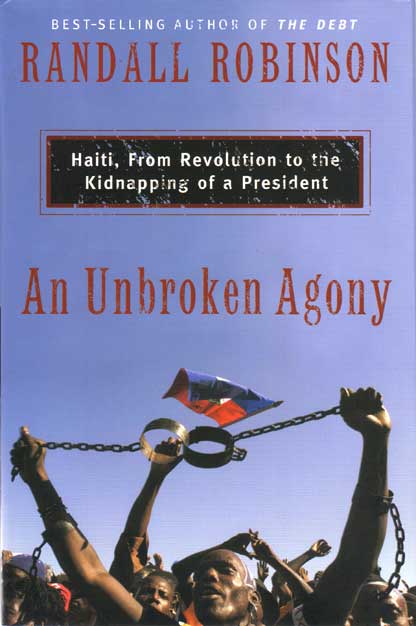
Review: An Unbroken Agony by Randall Robinson

This is the second, long overdue, post in my series on the 5th anniversary of the second overthrow and exile and Jean-Bertrand Aristide. The first can be found here and a posting dealing with current events in Haiti can be found here.

An Unbroken Agony is a much different kind of book to Damming the Flood, the book we had previously reviewed in this series. Damming the Flood is a highly detailed and well researched account of the rise and fall of Jean-Bertrand Aristide examining how and why he came to power as well as how and why he was overthrown.
Whilst An Unbroken Agony attempts to tell this story too as well as putting the events in a longer historical context than Damming the Flood, there is nowhere near the same amount of depth of research and explanation. Instead the main value of this book is in its insight into the life of Aristide through his friendship with the author.
Indeed, the book solves the question that Damming the Flood suggests an answer to but lacks the inside knowledge to conclude definitively on. That is the question of how Aristide ended up leaving Haiti for the second time on February 29th 2004 – did he flee or was he kidnapped?
Robinson is rather equivocal on the subject, he was kidnapped. In the book Robinson reproduces e-mail correspondence with Aristide and his wife and other information that make it blatantly clear that in the space of a few short hours the plans of the Aristide’s changed dramatically, they had made plans for a major interview on the 29th which was never cancelled. The change was precipitated by the arrival of US soldiers at Aristide’s house who escorted him to the airport.
Robinson points out that US TV news stations showed old footage of Aristide making a trip by himself abroad and attempted to pass this off as Aristide fleeing the country (as Robinson points out, his wife is nowhere to be seen in this footage. Moreover, why would Aristide flee to the dictatorship of the Central African Republic when neighbouring Jamaica had offered him asylum?
Although the book makes contributions on a few other points it is its utter demolition of the argument that Aristide fleed Haiti of his own free will, that is its strongest point.

Wednesday, 1 July 2009

Haitian Election Boycotts: Masses Reject UN Occupation

Whilst the mainstream media maybe talking up US forces pulling out of cities and towns in Iraq there is another occupation that the US initiated that is still ongoing. On February 29th 2004, US special forces kidnapped the Haitian President, Jean-Bertrand Aristide and dumped him in the dictatorship of the Central African Republic after funding guerrilla insurgents and others to destabilise the country. US, Canadian and French forces moved to occupy the country, ostensibly as peacekeepers, and were later replaced by a Brazilian-led UN peacekeeping (read occupation) force.

Even 5 years on thousands still marched through Port-au-Prince to mark the anniversary of Aristide’s overthrow demanding his return to the country. Aristide is still associated with the hope the masses felt with the end of the hated Duvalier dictatorship and is seen as having achieved improvements for the mass of the population (such as increases to the minimum wage) despite the concession he made to imperialist countries to get international aid, such as the privatisation of public services. Indeed, the 2006 election of the Lespwa candidate and former associate of Aristide, Rene Preval, to the presidency was seen as a vote for the return of Aristide. But with huge food shortages leading to rioting in the capital, Post-au-Prince last year and no return of Aristide, support for Preval has massively diminished.

On April 19th the first round of Haiti’s senate elections were held with a record low turnout. According to the Provisional Electoral Council (Conseil Electoral Provisoire - CEP) the turnout was 11%, although other observers place the figure as low as 5%. Prior to the elections, the CEP excluded all 14 candidates of Aristide’s party, Fanmi Lavalas.

In the run-up to the second round of elections, a prominent Fanmi Lavalas supporter, who was imprisoned in the run-up to the 2006 to stop him being a candidate in the Presidential elections, Father Gerard Jean Juste died from cancer. His funeral was used as a rallying call by Fanmi Lavalas activists to call on the population to again boycott the elections. Yet the funeral was yet another scene of vicious attacks by UN troops, killing one of the mourners. Despite denials by the UN force, a video has emerged showing two Brazilian troops firing into the crowd. The boycott appears to have been equally effective the second time round prompting the government to claim that imaginery ‘violence and intimidation’ are to blame for the low turnout.

Whilst Marxists support the right of Fanmi Lavalas to take part in the elections, and the right of Aristide to return to Haiti, neither will solve the problems of the Haitian masses. If either were to return to power, they would be forced into the position that they were in previously of giving concessions to foreign imperialist and capitalist interests in return for meagre aid packages. The Haitian masses must look towards the small but significant working class in Haiti and the development of a revolutionary party that can lead serious struggles to improve their living standards.

Sunday, 19 April 2009

Review - Damming The Flood: Haiti, Aristide and the Politics of Containment by Peter Hallward

Is is the first of three posts about Haiti - the 5th anniversary of the second coup against Jean-Bertrand Aristide would have been on February 29th this year (had there been one) and this article comes from the March 2009 issue of Socialism Today.

DAMMING THE FLOOD tells the tale of Haiti over the past two decades. This Caribbean nation had been the scene of the successful slave revolt which threw off French rule way back in 1804, but it had suffered economic isolation and ‘underdevelopment’ from the vengeful imperialist powers ever since. It was only in 1987 that it began to emerge from the dictatorships of Papa Doc and Jean Claude Duvalier.
The book begins with the period leading up to Haiti’s first democratic election in 1990 when a Catholic priest from a liberation theology background, Jean-Bertrand Aristide, won a large majority in the presidential elections at the head of the Lavalas (the flood) movement. He was elected on a pro-poor platform with his regime lowering food prices and increasing the minimum wage. He also attempted to reign in the army which had acted with impunity during the dictatorship and the few years after, and it was this that precipitated his overthrow in 1991, which unleashed a torrent of repression on the Lavalas movement.
In exile in the US, Aristide tried to negotiate for his return to the country and the removal of the coup dictatorship. He was eventually restored to power by the US in 1994, for which he made many concessions towards neo-liberal imperialism. He introduced World Bank and IMF sponsored ‘structural adjustment plans’ and the privatisation of some state enterprises, although he also dismantled the armed forces.
His successor as president, Rene Preval, Aristide’s first prime minister, continued these policies. Yet support for Aristide remained very high, and he again won an overwhelming majority in the 2000 presidential elections (now as the candidate of his own party Fanmi Lavalas). But yet again, despite many pro-poor policies (such as again increasing the minimum wage), he made concessions to imperialism in order to restore international aid they were withholding to strangle his regime.
Former soldiers, backed by the ‘democratic opposition’ (local capitalists and politicians that had fallen out with Aristide) launched a wave of guerrilla operations from the Dominican Republic that overwhelmed Northern Haiti and eventually led to Aristide being forced into exile in the Central African Republic by the US. Yet this overthrow, in February 2004, was not without opposition from the people who took to the streets to demand Aristide’s return, in a manner reminiscent of the mobilisation of the Venezuelan masses to demand Chavez’s return after the 2003 coup attempt in Venezuela.
The despicable role of the imperialist powers is nowhere more clearly shown than in its ‘humanitarian intervention’ forces which, rather than trying to prevent abuses of human rights, actively perpetrated them, in particular repressing the remnants of Fanmi Lavalas with many deaths and its leading activists thrown into prison. This clearly shows how the imperialist powers will intervene in a country, not to protect ordinary people, but to defend their own economic and strategic interests.
Peter Hallward’s book has several strengths. Firstly it is clearly very well researched and he is able to quote from a variety of sources to refute several myths that have been promoted by various groups (including some well-known human rights organisation) about the period. These include a dispute over a technicality in the 2000 elections, how Aristide left the country in 2004, and the links between the armed forces and various oppositional groups. He also explains how such myths originated from the biased opposition press which, after being repeated without verification in the US, became unchallengeable ‘facts’ for much of the rest of the worldwide media.
Hallward also interviewed many of the participants in the Lavalas movement and the Fanmi Lavalas party and thus provides a clear view of the amount of support that Aristide still holds to this day, despite his exile. Hallward actually compares him to Chavez (however, Chavez is clear on the need for socialism and Aristide is not in the slightest) as both movements in Venezuela and Haiti clearly depend on their leading figures to a large extent. Yet there are similarities with the social organisation basis of Evo Morales in Bolivia too, as Fanmi Lavalas still continues to operate with well-established leaders and is not wholly dependent on the figurehead leader. This is clearly evidenced by the actions of the Latortue regime (the dictatorship that replaced Aristide) in imprisoning these leaders so they could not contest elections.
However, there are a few obvious weaknesses in the book too. One is the continual insistence by Hallward that there was no other route that Aristide could have taken apart from compromise with the major imperialist powers (in this case the US and France). He gives two reasons for this. The first is that Haiti was dependent on foreign aid and that as Haiti ground to a halt without these funds Aristide could not carry out his pro-poor initiatives. Yet a resolute programme to nationalise the major parts of the Haitian economy (especially the assets of those funding the armed opposition) would have countered this. It is true that, as Hallward notes, large sections of the economy are geared towards export. But an appeal for further assistance from Cuba and, during his second term, Venezuela – who both before and since Aristide’s presidency have had significant trading agreements with Haiti – could have overcome economic dependence on foreign aid. Of course, due to the nature of those regimes it would not be guaranteed that they would have come to Aristide’s aid, but such an appeal would certainly have been supported by the workers and poor of those countries, and would also have pointed towards the need for a socialist confederation of those countries with Haiti.
The second reason Hallward gives is related to the first. He argues that because Aristide had no armed forces he could rely upon he was therefore at the mercy of foreign armies if they chose to invade, and also the armed opposition. Yet at the same time Hallward praises Aristide’s pacifist stance, which meant that Aristide ended up demobilising the spontaneous attempts of Haitian workers and poor to defend themselves against the opposition forces.
This is linked to another issue that Hallward is weak on, the existence of pro-Aristide gangs (referred to by the opposition as chimeres). As he states the gangs, led by some Lavalas supporters, formed in the wake of the first coup to defend themselves and the communities they were based in from paramilitary violence. However, the gangs also relied on criminal and thuggish activities to support themselves. But such gangs would not have existed if Aristide and other Lavalas supporters had mobilised a movement aimed at stopping either of the coups in their tracks. Such examples can be found from history, such as the mobilisations that stopped the attempted coups of Kornilov in Russia in 1917, of General Spinola in Portugal in 1975, or even the ‘tancazo’ plot to overthrow Allende in Chile in June 1973. Such mobilisations could also have formed the basis for opposition to foreign military intervention. Although around 200 years ago, the slave revolts in Haiti show that technically superior foreign armies intervening into a social revolution can be successfully defeated, especially as at this time the US was already tied up in Afghanistan and Iraq.
One certainly can see another resemblance between the events in Haiti in recent years and the Haitian slave revolution. Like the brave, but continually compromising Toussaint L’Overture, Aristide made concessions where he should have been decisive. The main ingredient that has been missing from Haiti over this period is a revolutionary party that will take decisive measures – more in the manner of another slave leader, Jean-Jacques Dessalines – which could bring about the necessary conditions for the real freedom and liberation of the Haitian masses, a socialist Haiti and socialist world. This conclusion is not presented in the book, but it is the task that Marxists will have to take up in the country. Despite these criticisms, however, this is an excellent book and deserves attention.
Friday, 6 February 2009

Some Cases of Humanitarian Intervention

This is the second part of a recent essay I wrote on the moral justifiability of humanitarian intervention. This section examines several case studies of humanitarian interventions. I'd refer the reader to the previous piece for some general background and discussion of humanitarian intervention (see comments box for link).
Also, one further point. Readers will note the example of Bangladesh in this essay. In this instance I included it in the essay because I was basically taking Walzer at his word on the situation there. As I will develop in the final section of the series, I don't think Humanitarian Intervention by a capitalist country is necessarily ruled out, certainly historically it isn't, but it is very unlikely.


Whilst we would argue that moral justification is guided by general considerations as above, every particular intervention must be justified in its own context. In this sense we are guided by the approach undertaken by Michael Walzer in looking at historical cases to generate these general considerations. In passing we will note that the examples used are ones the writer of this essay way already familiar with, and thus could perhaps be slightly unrepresentative. But nevertheless they yield important facts bearing upon the subject of this essay and are thus valuable in this sense.
It is the case of Haiti that we shall turn to first. As Hallward (2007) discusses, Haiti has had two humanitarian interventions into it in the last 15 years. The first occurred in 1994. The Lavalas government of Jean-Bertrand Aristide had been overthrown by a military coup in September 2001, and after negotiating with the US government was returned to power by a US force which intervened humanitarianly to disarm the Haitian army and paramilitaries. As Hallward (2007) discusses there were several factors that related to the decision to do this, not just humanitarian considerations, including the stream of Haitian refugees coming to the US and its political relationship with the army junta that governed Haiti was deteriorating. However, Hallward (2007:52) goes on to point out that

“It is more than likely that the occupation that began in September 1994 may prove, in the long run, to have been just as damaging to the interests of Haitian democracy as the first US occupation of 1915-34. It gave the occupying power profound and temporarily irreversible influence over the reconfiguration of a state apparatus more compatible with its own practices. As the soldiers themselves began to leave over the course of 1995, a whole swathe of para-civilian advisers, trainers and consultants remained behind to administer the consequences of their work…”

Although the military intervention took place over a short period of time, it gave the US government economic and political influence over the country which played a pivotal role in the second coup against Aristide in 2004 which led to the second, and much longer humanitarian intervention. In this case the backdrop was an insurgency, which Hallward (2004) argues was secretly supported by the political opposition to Aristide who were themselves funded by US government aid.
The humanitarian intervention in 2004 to the present was again premised on disarming the ex-army and paramilitaries, yet the US troops deployed in Haiti, at best, did not do this for several months, as Hallward (2004) after discussing journalistic reports that identify US troops colluding or directly participating the murder of people in the suburbs of the Haitian capital, Port-au-Prince, charges the US government as having “…direct complicity in the mass murder of Haitian civilians…” (Hallward, 2004:258).
Indeed, Hallward (2007:52) states that humanitarian intervention “…has come to replace traditional forms of military action as the primary means of neo-imperial control.”
It would be inaccurate to state that this example is anything but justifies humanitarian intervention on its own. But we should not draw our conclusions on the basis of just one solitary example. Indeed, in his book, Just and Unjust Wars, Walzer (2006) compares two different examples, those of the US intervention into Cuba in 1898 and Indian intervention into Bangladesh in 1971.
The Cuban example appears to be somewhat similar to the events that occurred in Haiti in 1994, which differed in the fact that it was war from independence from Spain, yet the consequence of the intervention was similar in that the US imposed itself economically and politically on Cuba, even establishing a military dictatorship in the immediate four years (Gott, 2004), in the aftermath of the intervention. Indeed, the intervention in Cuban life by the US government at this point and the years afterwards have surely impacted on the hatred on the ‘yankee imperialism’ in Cuba today.
The Bangladeshi example differs in some fundamental ways, although like the Cuban example above, the humanitarian intervention was in support of an independence movement. As Walzer describes, it

“…is a better example of humanitarian intervention – not because of the singularity or purity of government’s motives, but because its various motives, but because its various motives converged on a single course of action that was also the course of action called for by the Bengalis. This convergence explains why the Indians were in and out of the country so quickly, defeating the Pakistani army but not replacing it, and imposing no political controls on the emergent state of Bangladesh. No doubt, strategic as well as moral interests underlay this policy: Pakistan, India’s old enemy, was significantly weakened, while India itself avoided becoming responsible for a desperately poor nation whose internal politics was likely to be unstable and volatile for a long time to come. But the intervention qualifies as humanitarian because it was a rescue, strictly and narrowly defined.” (Walzer, 2006:105)

The distinction that Walzer makes here between the two interventions is summed up when he says that the Indian intervention coincided with what the Bengali population wanted. What makes a humanitarian intervention different from a military intervention in the interests of the intervening which hides behind humanitarian phraseology, is that very factor of being subordinated to a large extent to the interests of the repressed population.
Another consideration that we could make is that of a type of revolutionary war as a type of humanitarian intervention. This may seem like an odd conception to the reader, as a revolutionary war is an attempt to carry forward a new revolutionary type of government in one country into another ‘at the point of a sword’. Yet, consider the following, an uprising occurs in a country, the government of said country attempts to crush it; if a bordering revolutionary country then intervened militarily to stop the repression (which it is likely would include killings) – would this not be a military intervention for humanitarian means?
To further examine this question we will look at the advance of the Soviet Red Army on Warsaw in late 1920. It will be noted that this came first after an offensive of the Polish army against Soviet Russia which turned into a retreat. As Trotsky (2005:527) explains in his autobiography “There were high hopes of an uprising of the Polish workers. At any rate, Lenin fixed his mind on carrying the war to an end, up to the entry into Warsaw to help the Polish workers overthrow Pilsudski’s government and seize the power.” This is not a humanitarian intervention, as it is only coming to the support of a hypothetically existing population that is being repressed rather than an actual one. However, if the Polish population was in danger at that time, ie (an uprising had occurred or was imminent before the decision to march on Warsaw). This is the consideration Trotsky reports he made himself at this time and thus opposed the offensive. It also is what several previous uprsings in various European countries at this time, for example Bavaria in 1919 (Watt, 2003), had counted upon occurring. This would have, in some ways, paralleled Walzer’s example of the intervention into Bangladesh that we have examined above.