Showing posts with label books. Show all posts

Wednesday, 30 September 2009

Review: The Everlasting Staircase: A History of the Prison Officers’ Association 1939-2009

From the September 2008 issue of Socialism 2008.

By David Evans with Sheila Cohen, Pluto Press, 2009, £15

Reviewed by Iain Dalton

WHEN PRISON officers went on their first ever nationwide strike two years ago, it propelled their organisation, the Prison Officers Association (POA), into the spotlight as, ironically, their leaders were threatened with imprisonment if they did not call off the action. Yet the history of trade unionism within the prison service goes back way further than this action or even the formation of the POA in 1939. Until now, it has been a relatively unwritten story, so the publication of a fairly comprehensive history is most welcome.
David Evans begins his narrative with the coming into being of the modern prison in the late 19th century and the attempts of the newly-created salaried gaolers to resolve their grievances. While a few attempts were made to form a trade union organisation in the early 20th century, it was not until the setting up of the National Union of Police and Prison Officers (NUPPO) in 1913 and the Prison Officers Federation (POF) in 1915, that this was achieved. Both unions were illegal, as a Home Office standing order was interpreted by then home secretary, Winston Churchill, as meaning that prison officers should be treated like the police, soldiers and sailors and banned from organising a union.
However, the NUPPO-organised walkout of the Metropolitan police in August 1918 over pay changed everything, with the government verbally backtracking over pay, conditions and the right to form a union. The apparent success of the action led to NUPPO and the POF merging. Yet, within a year of this apparent success, the government felt strong enough to pass the 1919 Police Act which once more took trade union rights away, at the same time attempting to buy off police officers with a substantial pay increase. NUPPO organised strike action in protest, but this was badly undermined with only a small number of police officers coming out as well as a few prison officers in Birmingham and 70 from Wormwood Scrubs. All those who took action were dismissed. The additional disillusionment following the failure of the 1924 Labour government to reinstate the strikers severely disappointed many who had been involved with NUPPO.
Instead of trade union rights, prison officers were left with an ineffectual representative board and, for the next 20 years, pay and conditions deteriorated, steeling the determination of prison officers to secure trade union rights once again. Despite the earlier association with police officers and the fact that the Police Act was used by the Home Office to designate prison officers as having police constable status and so banning them from forming a trade union, the struggle for union rights in the prison service has more in common with those of civil servants. Indeed, it was two leaders of the Civil Service Clerical Association who assisted in spearheading the POA’s right to exist and represented the fledgling POA in negotiations.
The newly-formed POA quickly reached a very high density of membership within the prison service, covering all prisons in England, Wales, Scotland and Northern Ireland. It quickly expanded in 1942 to win rights to represent staff at special hospitals such as Broadmoor. The period after the second world war saw a massive expansion of the prison population, almost doubling between 1945 and 1950. Prisons became overcrowded, with prison officer numbers failing to keep up with the increased population which, when combined with reforms improving prisoners’ conditions, began to breed resentment.
As Evans explains, it was not because prison officers were fundamentally reactionary, as some would claim, but that many of the improvements in conditions came without increasing staffing levels to ensure the safety of both prisoners and staff. This is not to say that the POA did not support improvements in prisoners’ conditions. For example, the POA was instrumental in ending ‘slopping-out’ and forcing the prison service to invest in integrated sanitation. But the overcrowding and extra duties imposed on officers led to the situation in the 1970s and 1980s where prison officers were required to do massive amounts of overtime just to keep prisons functioning.
The period from the late 1960s to the late 1980s was full of POA disputes and struggles which there is not the space to go into here. Importantly, however, this was when the POA discovered one of its most potent dispute tactics: refusing to admit prisoners above the Certified Normal Accommodation (CNA) limits, which highlighted both prison overcrowding and understaffing. There are also other interesting points that Evans raises, such as how prison officers treated the Pentonville Five dockers imprisoned for trade union activities, for instance, by leaving their cell doors open.
But it was the confrontation with the Tory government of John Major in the early 1990s that shaped the major concerns of the POA in recent years. Continued overcrowding of prisons led in 1993 to refusals to accept more prisoners at Hull and Preston, the latter already operating at 200% of the CNA. The Home Office went to court to seek an injunction against this action, and the judge, as well as ruling the action illegal, went further than the Tories in declaring that the POA was not a trade union. This was formalised by the Tories in the 1994 Criminal Justice and Public Order Act, which instituted the infamous section 127 which criminalised calling for prison officers to take industrial action.
Combined with this was the beginning of prison privatisation. Even the Thatcher government thought this was a step too far. But, in the early 1990s, starting with Wolds remand prison and court escort services, the Tories began opening up prisons and related areas to privatisation as well as privatising any new-build prisons. Not only did the privatised prisons attack the pay and conditions of staff, they also refused initially to recognise the POA. Instead, they recognised the scab Prison Service Union, which had been set up by disgruntled ex-POA officials, in ‘sweetheart’ deals. Faced with the market testing of public-sector prisons, the POA decided to organise within privatised prisons and fight for their return to the public sector. The POA’s campaign has been partially aided by some privatised prisons returning to the public sector after private mismanagement, as well as the embarrassing failure of any private-sector tenders to run Brixton prison when it was market tested.
Despite assurances from New Labour in opposition that it would fully reinstate prison officers’ trade union rights and reverse privatisation of the prison service, the POA has been let down on both counts. This led to the POA general secretary, Brian Caton, tearing up his Labour Party membership card at the 2009 POA annual conference. Trade union rights were partially restored on condition that the POA signed up to a no-strike agreement. However, such were the appallingly low pay offers that prison officers were receiving (even compared to other public-sector workers) that the POA pulled out of the agreement and undertook national strike action in 2007. The Ministry of Justice then reinstated the Tory legislation banning strikes by prison officers. This has led to the POA calling for the TUC to organise general strike action against the anti-union laws, as well as bracing itself for the possibility that the courts will be used against it if the POA is forced to take action to defend its membership.
Overall, the book is a very detailed history of the POA. However, there are several areas where more detail on particular issues would be welcome, as well as some areas which are not commented on, such as the alleged influence of the National Front in prisons and the POA in the 1970s. Also, on some points, the narrative is a little confused, jumping backwards and forwards in time rather abruptly. This is partially due to having to cover the specific intricacies of the issues the POA was dealing with in Northern Ireland and Scotland. But these criticisms should not put off anyone who is interested in the POA from reading this well-researched book.

Sunday, 23 August 2009

Review – Guilty and Proud of It by Janine Booth (2009)

There are certain struggles of the British working class that modern day socialists should make themselves aware of. Amongst those struggles are the 1984-5 Miners Strike, Chartism, 1926 General Strike, but there are also localised struggles that are worth our attention, and the struggle of the Poplar councillors is one of them. Booth, who writes for the blog Stroppyblog and is also a member of Workers Liberty, has done a service by bringing these events to a new audience including myself.
During the huge growth of the Labour Party in the aftermath of the first world war, Labour councillors began to be elected in ever larger numbers to local councils and even began to win control of some of them posing the question of what such councillors should do with their new found powers. After all, what local councils basically do is administer certain aspects of the capitalist system in a given area – should labour councils try and do this in a more humane manner or should they challenge the status quo by attempting to provide local services to meet the needs of the population?
As Booth demonstrates, the Poplar councillors chose the latter, demanding the money to be able to provide higher council wages (including equal pay for males and females!) and pay unemployment benefits without sending people to the dreaded workhouse. Their tactic in this campaign was to withhold the rates that they paid to all London bodies, demanding that rates should be equalised across London to pay for the larger welfare services needed in poorer boroughs, for this action they were imprisoned.
This section of the book is very well detailed, with a very good contrast between the actions of the Poplar councillors and the neighbouring councillors in Hackney which Labour also controlled who pursued the former policy mentioned above under the guidance of Herbert Morrison. One other important thing Booth notes is role of the paper, the Daily Herald, edited by the leading figure of the Poplar councillors, George Lansbury in terms of explaining the councils policy and actions.
Yet I feel the book has several points where I feel it falters. Firstly, whilst being excellent on the background to the struggle all the way up the imprisonment and release of the councillors, the book fails to portray a coherent reason for the eventual failure of the councillors struggle to spread further – certain points are raised, the role of the London Labour Party under the reformist Herbert Morrison, Lansbury being forced to sell the Daily Herald, the defeat of the 1926 General Strike etc. Yet the way these are discussed is like a list rather than explaining how these factors interlinked with each other. The role of different tendencies within the movement, apart from the divide between the councillors and the likes of Morrison, is also not explored with the detail needed to understand fully their roles in the struggle, although there is more detail in this respect within the movements of the unemployed.
A final gripe is in the final chapter dealing with the long-term aftermath of the struggle, whilst this chapter is brief in the events it deals with that is necessarily so, it is a book about Poplar and not everywhere else! Yet I feel it is to brief in dealing with the similar situation in Liverpool in the 1980s – this dispute is just lumped in with the others of that time, but Liverpool was significantly different, firstly it won concessions from the government in 1984 and secondly for the role of organised Marxists within the council. Whilst the author does refer to two books for further reference I do not feel that this does the comparisons between the two struggles enough justice.
In summary the book is well worth reading, despite the above mentioned drawbacks the depiction of the core of the struggle of the councillors around the non payment of London wide rates is excellent, and that after all is the main topic of the book.

Sunday, 2 August 2009

Review – Teamster Rebellion by Farrell Dobbs

I have to say, that when I recently read this book it was not for the first time, rather this book is one that I hold in great regard and wished to re-read it to clarify in my mind some of the issues that the 1934 Minneapolis Teamster strikes raises.
These strikes which the book covers marked the beginning of an upsurge in union activity in the United States that eventually led to the formation of the industrially based CIO. Moreover it was really the first serious labour dispute that the Communist League of America, part of the International Left Opposition, became involved in. The book depicts these strikes in a very easily readable format whilst pointing out the steps taken, tactics chosen that the union local took and why they were taken. To my mind this is a book that all militant trade unionists should read.
But one thing I want to focus on is the way that the defence of the pickets from police attacks and brutality during the strike was organised. Unlike some on the left who seem to cry for workers to be given arms at any occasion as if the main issue is some desire to beat up the police (or at least this is the impression that can often be given), Dobbs is rather more sane as he explains why the strike committee deemed it necessary to arm pickets against attacks from the police as well as from the employer-organised special deputies.

“Up to now the workers had gone about their activities bare-handed; but they found that attempts to exercise their right to peacefully picket were being repressed with police clubs and blackjacks. They decided to take steps to enforce their democratic right to prevent scabs from grabbing their jobs. It would have been a tactical blunder for members of an isolated vanguard to attempt measures such as the strikers were about to take; they would only get themselves clobbered by the police. In this case, however, the means used in self-defence had their origin in a spontaneous mass mood that had been generated by capitalist repression. Since these means were appropriately limited in the given situation to matching the police club for club, the tactics employed were completely valid.”(pg.81)

Later on in the book he deals with the run-up into the third strike, when workers were making preparations for this and the question was raised again.

“At the first strike committee meeting, chaired by Kelly Postal, the question of ‘picketing equipment’ was put on the agenda. For the first time since the truce at the end of the May strike, the bosses would be trying to operate trucks in defiance of the pickets. The last attempt had been stopped when the pickets won a pitched battle with the cops, fought club against club. At this new juncture many pickets were inclined to start where they left off in May, again arming themselves with clubs. In the changed circumstances, however, this would have been tactically inadvisable. It would have given the cops a pretext for immediate violence against strikers who were trying to peacefully picket; and the union would have lost the tactical advantage of reacting to police violence under defensive slogans.”

And finally he discusses the question again in the aftermath of the police shooting at the strikers and killing two whilst injuring several others.

“In the meantime Local 574’s pickets were reacting to the police assault in full keeping with their magnificent fighting spirit. After the shooting, many who had escaped injury dropped from sight briefly, only to return soon armed with various kinds of weapons. They now had shotguns, deer rifles, revolvers, hunting knives, and various types of souvenirs from World War I, which the veterans among them had brought back from France. Having bested the cops club-against-club in May, the strikers were now prepared to face them gun-against-gun. Although their cause was just and their courage admirable, it would have been a grave tactical mistake to attempt to go through with such an undertaking.
“The situation was now qualitatively different from what it had been during the earlier battle with clubs. Despite the fact that a club can kill, it is not usually classified as a deadly weapon. By virtue of that fact, self-defence of the kind used in May could be sustained tactically for several reasons: it was carried out by a massive body of pickets who had widespread sympathy within the city as a whole; for reasons described previously, Governor Olson found it difficult to use the state militia against the union; and due to the insular nature of the conflict and the local politics involved, President Roosevelt had little inclination and no ready pretext to intervene with federal troops. Consequently the fighting in May remained confined to a showdown between pickets and the local cops.
“As matters stood after Bloody Friday, however, the situation was entirely different. Being so deadly, their use in self-defence against the gun-toting cops could have been twisted around by capitalist propaganda into the appearance of an ‘insurrectionary offensive’ by the strikers. The bosses would have screamed bloody murder, claiming proof of their contention that our aim was not to build a union but to make a revolution. At the first armed skirmish between strikers and police a clamour would have been raised for Olson and Roosevelt to send in troops against the union…
“Local 574, against which such military repression would have been directed, was engaged in an isolated local action. Nationally, our struggle was paralleled only by two other similarly isolated conflicts… Hence, it could not have withstood the heavy military pressure; the strike would have been broken and the union crushed.
“This was a situation in which the central strike leadership had to act swiftly and decisively. Otherwise impulsive pickets, looking for a showdown with the cops, could have done irreparable damage to the union’s cause while the policy question was being debated. The pickets had to be disarmed forthwith, and the central leaders had to do it on their own responsibility…
“…Once again, Local 574’s incomparable soldiers went out barehanded to face cops with riot guns.
“Our action was promptly reported to a meeting of the strike committee, and the reasons were given for the policy we had followed. After considerable debate the committee approved the course taken, issuing picketing orders accordingly. The orders, which were published in The Organizer, contained a deliberately obscure formulation: “All pickets are hitherto instructed to continue tactics of peaceful picketing as hitherto. They are, however, to defend themselves against any attacks.” Since we hadn’t troubled to let the cops know whether or not the pickets were armed, they weren’t sure what permission to ‘defend themselves’ meant and being aware of the strikers’ anger, the cops weren’t in a hurry to find out.”

As these quotes amply demonstrate, at each stage the strike committee measured the objective situation facing the workers and prepared themselves accordingly. The task was not to repeat demands for arming of the workers but to act in a manner that sought to defend the interests of the workers at each stage in response to the course the struggle took. It is a lesson that some ultra-lefts who repeat demands blindly should do well to note.

Saturday, 4 July 2009

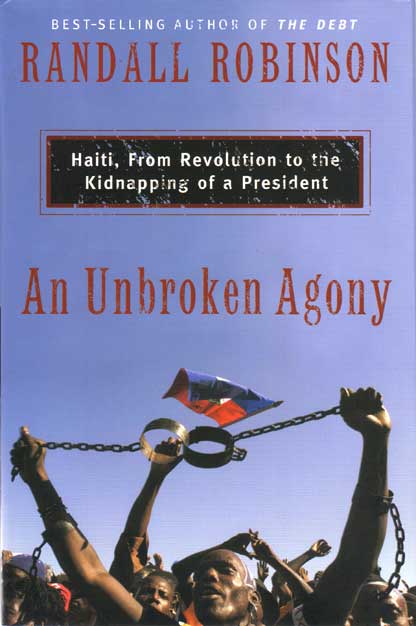
Review: An Unbroken Agony by Randall Robinson

This is the second, long overdue, post in my series on the 5th anniversary of the second overthrow and exile and Jean-Bertrand Aristide. The first can be found here and a posting dealing with current events in Haiti can be found here.

An Unbroken Agony is a much different kind of book to Damming the Flood, the book we had previously reviewed in this series. Damming the Flood is a highly detailed and well researched account of the rise and fall of Jean-Bertrand Aristide examining how and why he came to power as well as how and why he was overthrown.
Whilst An Unbroken Agony attempts to tell this story too as well as putting the events in a longer historical context than Damming the Flood, there is nowhere near the same amount of depth of research and explanation. Instead the main value of this book is in its insight into the life of Aristide through his friendship with the author.
Indeed, the book solves the question that Damming the Flood suggests an answer to but lacks the inside knowledge to conclude definitively on. That is the question of how Aristide ended up leaving Haiti for the second time on February 29th 2004 – did he flee or was he kidnapped?
Robinson is rather equivocal on the subject, he was kidnapped. In the book Robinson reproduces e-mail correspondence with Aristide and his wife and other information that make it blatantly clear that in the space of a few short hours the plans of the Aristide’s changed dramatically, they had made plans for a major interview on the 29th which was never cancelled. The change was precipitated by the arrival of US soldiers at Aristide’s house who escorted him to the airport.
Robinson points out that US TV news stations showed old footage of Aristide making a trip by himself abroad and attempted to pass this off as Aristide fleeing the country (as Robinson points out, his wife is nowhere to be seen in this footage. Moreover, why would Aristide flee to the dictatorship of the Central African Republic when neighbouring Jamaica had offered him asylum?
Although the book makes contributions on a few other points it is its utter demolition of the argument that Aristide fleed Haiti of his own free will, that is its strongest point.

Sunday, 19 April 2009

Review - Damming The Flood: Haiti, Aristide and the Politics of Containment by Peter Hallward

Is is the first of three posts about Haiti - the 5th anniversary of the second coup against Jean-Bertrand Aristide would have been on February 29th this year (had there been one) and this article comes from the March 2009 issue of Socialism Today.

DAMMING THE FLOOD tells the tale of Haiti over the past two decades. This Caribbean nation had been the scene of the successful slave revolt which threw off French rule way back in 1804, but it had suffered economic isolation and ‘underdevelopment’ from the vengeful imperialist powers ever since. It was only in 1987 that it began to emerge from the dictatorships of Papa Doc and Jean Claude Duvalier.
The book begins with the period leading up to Haiti’s first democratic election in 1990 when a Catholic priest from a liberation theology background, Jean-Bertrand Aristide, won a large majority in the presidential elections at the head of the Lavalas (the flood) movement. He was elected on a pro-poor platform with his regime lowering food prices and increasing the minimum wage. He also attempted to reign in the army which had acted with impunity during the dictatorship and the few years after, and it was this that precipitated his overthrow in 1991, which unleashed a torrent of repression on the Lavalas movement.
In exile in the US, Aristide tried to negotiate for his return to the country and the removal of the coup dictatorship. He was eventually restored to power by the US in 1994, for which he made many concessions towards neo-liberal imperialism. He introduced World Bank and IMF sponsored ‘structural adjustment plans’ and the privatisation of some state enterprises, although he also dismantled the armed forces.
His successor as president, Rene Preval, Aristide’s first prime minister, continued these policies. Yet support for Aristide remained very high, and he again won an overwhelming majority in the 2000 presidential elections (now as the candidate of his own party Fanmi Lavalas). But yet again, despite many pro-poor policies (such as again increasing the minimum wage), he made concessions to imperialism in order to restore international aid they were withholding to strangle his regime.
Former soldiers, backed by the ‘democratic opposition’ (local capitalists and politicians that had fallen out with Aristide) launched a wave of guerrilla operations from the Dominican Republic that overwhelmed Northern Haiti and eventually led to Aristide being forced into exile in the Central African Republic by the US. Yet this overthrow, in February 2004, was not without opposition from the people who took to the streets to demand Aristide’s return, in a manner reminiscent of the mobilisation of the Venezuelan masses to demand Chavez’s return after the 2003 coup attempt in Venezuela.
The despicable role of the imperialist powers is nowhere more clearly shown than in its ‘humanitarian intervention’ forces which, rather than trying to prevent abuses of human rights, actively perpetrated them, in particular repressing the remnants of Fanmi Lavalas with many deaths and its leading activists thrown into prison. This clearly shows how the imperialist powers will intervene in a country, not to protect ordinary people, but to defend their own economic and strategic interests.
Peter Hallward’s book has several strengths. Firstly it is clearly very well researched and he is able to quote from a variety of sources to refute several myths that have been promoted by various groups (including some well-known human rights organisation) about the period. These include a dispute over a technicality in the 2000 elections, how Aristide left the country in 2004, and the links between the armed forces and various oppositional groups. He also explains how such myths originated from the biased opposition press which, after being repeated without verification in the US, became unchallengeable ‘facts’ for much of the rest of the worldwide media.
Hallward also interviewed many of the participants in the Lavalas movement and the Fanmi Lavalas party and thus provides a clear view of the amount of support that Aristide still holds to this day, despite his exile. Hallward actually compares him to Chavez (however, Chavez is clear on the need for socialism and Aristide is not in the slightest) as both movements in Venezuela and Haiti clearly depend on their leading figures to a large extent. Yet there are similarities with the social organisation basis of Evo Morales in Bolivia too, as Fanmi Lavalas still continues to operate with well-established leaders and is not wholly dependent on the figurehead leader. This is clearly evidenced by the actions of the Latortue regime (the dictatorship that replaced Aristide) in imprisoning these leaders so they could not contest elections.
However, there are a few obvious weaknesses in the book too. One is the continual insistence by Hallward that there was no other route that Aristide could have taken apart from compromise with the major imperialist powers (in this case the US and France). He gives two reasons for this. The first is that Haiti was dependent on foreign aid and that as Haiti ground to a halt without these funds Aristide could not carry out his pro-poor initiatives. Yet a resolute programme to nationalise the major parts of the Haitian economy (especially the assets of those funding the armed opposition) would have countered this. It is true that, as Hallward notes, large sections of the economy are geared towards export. But an appeal for further assistance from Cuba and, during his second term, Venezuela – who both before and since Aristide’s presidency have had significant trading agreements with Haiti – could have overcome economic dependence on foreign aid. Of course, due to the nature of those regimes it would not be guaranteed that they would have come to Aristide’s aid, but such an appeal would certainly have been supported by the workers and poor of those countries, and would also have pointed towards the need for a socialist confederation of those countries with Haiti.
The second reason Hallward gives is related to the first. He argues that because Aristide had no armed forces he could rely upon he was therefore at the mercy of foreign armies if they chose to invade, and also the armed opposition. Yet at the same time Hallward praises Aristide’s pacifist stance, which meant that Aristide ended up demobilising the spontaneous attempts of Haitian workers and poor to defend themselves against the opposition forces.
This is linked to another issue that Hallward is weak on, the existence of pro-Aristide gangs (referred to by the opposition as chimeres). As he states the gangs, led by some Lavalas supporters, formed in the wake of the first coup to defend themselves and the communities they were based in from paramilitary violence. However, the gangs also relied on criminal and thuggish activities to support themselves. But such gangs would not have existed if Aristide and other Lavalas supporters had mobilised a movement aimed at stopping either of the coups in their tracks. Such examples can be found from history, such as the mobilisations that stopped the attempted coups of Kornilov in Russia in 1917, of General Spinola in Portugal in 1975, or even the ‘tancazo’ plot to overthrow Allende in Chile in June 1973. Such mobilisations could also have formed the basis for opposition to foreign military intervention. Although around 200 years ago, the slave revolts in Haiti show that technically superior foreign armies intervening into a social revolution can be successfully defeated, especially as at this time the US was already tied up in Afghanistan and Iraq.
One certainly can see another resemblance between the events in Haiti in recent years and the Haitian slave revolution. Like the brave, but continually compromising Toussaint L’Overture, Aristide made concessions where he should have been decisive. The main ingredient that has been missing from Haiti over this period is a revolutionary party that will take decisive measures – more in the manner of another slave leader, Jean-Jacques Dessalines – which could bring about the necessary conditions for the real freedom and liberation of the Haitian masses, a socialist Haiti and socialist world. This conclusion is not presented in the book, but it is the task that Marxists will have to take up in the country. Despite these criticisms, however, this is an excellent book and deserves attention.

Sunday, 5 April 2009

Review – The Ragged Trousered Philanthropists by Robert Tressell

After having this book recommended to me several times I finally got around to reading it over the last few months. And the reasons that it was recommended to me, for its exposition of the capitalist system and a vague explanation of how Socialism could work are very good. The chapters which feature the debates the workmen have about socialist ideas are excellent parts of the book.
Yet, for me there were several things I disliked about the book too. Firstly, at 700 or so pages, I felt that the book was overly long for the story it was telling. Secondly, I found the story quite depressing. Not that that is a reason necessarily to dislike it, but what was most depressing was the fact that the Socialists were just abstractly arguing for their ideas without trying to engage in struggles alongside other workers. There is one bit towards the end when the main character, Frank Owen, finally stands up to his employer to defend an apprentice at the company, and I found myself thinking ‘at last!’.
The Ragged Trousered Philanthropists depicts the brutality of capitalism for the working classes excellently, and despite the gap since when it was published those same conditions apply in similar form today. But whilst you’ll find an exposition of Socialist ideas in the book, what you won’t find is how to bring these ideas to the working class.

Sunday, 15 February 2009

Book Review – Cuba: A New History by Richard Gott

With this January being the 50th anniversary of the 1959 Cuban Revolution, I thought it was about time I delved a little more into the history of the island in preparation for the very successful public meeting Bangor Socialist Party held last week.

The real strength of the book is Gott’s presentation of the pre-revolutionary history of the island. Apart from knowing the island had been invaded by the United States during its struggle for liberation from Spain, I knew relatively little about the country in this period. Gott’s presentation of this period is very illuminating.

Yet the part that most people would be interested in is his account of the 1959 revolution and the regime led by Castro afterwards. However, for me this is the weaker part of the book. I felt that Gott covered it fairly superficially, you are reading it waiting for him to go into further detail. There are some exceptions such as Castro’s relationship with the Soviet Union and the support given by Cuba to anti-imperialist conflicts in the third world.

I suppose this is somewhat clichéd, but I just get the feeling that Gott is approaching Cuba from a different direction to me. Gott seems to approach it from middle-class intellectual’s point of view and various trials, middle class opposition groupings etc. take up the focal point of his narrative and you are left wondering what the ordinary peasants and workers thought of what was going on. He also takes the view that all that Cuba had to do with socialism was just words whilst they had Soviet support, and that element of Cuba is now gone due to the collapse of the Soviet Union. He also, mistakenly, seems to believe that Cuba had returned to Capitalism with the reforms instituted in the 90’s that led to the creation of the dual dollar-peso economy.

As I said at the beginning, the early parts of Cuba’s history are really interesting reading. The latter part, although still interesting, leaves the impression on you of events that are only half-analysed. It is a book of two halves, but the latter doesn’t undermine too much the strengths of the former part.

Friday, 9 January 2009

Review – The Kings Depart by Richard M. Watt


What with last November being the anniversary of the beginning of the 1918-19 German Revolution, I was recommended this book as a good introduction to the events of that period.

What this book really is, though, is a book about the treaty of Versailles, that has to spend a considerable portion of its contents explaining the revolution in Germany and also other events, particularly in Poland and Hungary around this time. To be honest though, I actually found the bits on the creation of the treaty interesting too as things which are relevant to my dissertation on Truth Commissions and War Tribunals cropped up here too.

The book is not a complete history of the German Revolution, but rather describes the main events and discusses some of the fundamental driving forces which does serve very well as an introduction to the topic. However, Watt is not a Marxist and there really isn’t a serious discussion of the tactics, and the mistakes of the German Communist Party and its allies.

Nevertheless I would recommend the book as an introduction to the events of the German Revolution, but also for anyone interested in studying the creation of the Versailles peace treaty.

Monday, 29 December 2008

Socialism 2008: Review of China Seatshop of the World (2008)

Yes, the final Socialism 2008 post at last - only a matter of a month and a half after the event. But this wasn't a session at the event I'm reporting on (although as I said before it was pretty impressive seeing and hearing a Chinese Trotskyist speak at the main rally), it rather is a book I managed to get a hold of at the event.

The book is a collection of articles by two of the writers for Chinaworker.org, the CWI website for China. The majority of the articles are ones that have already appeared on the site over the last two years - however, they are some of the most interesting ones such as the one on Xinjiang province, the one on the Hong Kong Legco elections or the one on the Chinese coal industry. However, three of the articles were written especially for the book - one of which is on the Bejing olympics and it's green credentials and has also appeared on the site too, but the introductory chapter and closing chapters are both new for the book. The first examining low-paid sweatshop labour which seems to be the backbone of China's huge growth and the second examining all the points where struggle could erupt in China over the next few years.

I have to say, the more I read about China, the more interested I get. It is a huge country with a large portion of the world's population living there and what happens in China will be significant for people everywhere. And hence I recommend this book to people as a series of articles that will help you get a deeper understanding of the events in that country written by Chinese socialists. But it isn't all the material on China the CWI has been producing recently, for a start there is the excellent chinaworker.info website with in depth analyses of events in China and the region as well as reports of workers struggles (the most recent one as I write this being a strike of airport workers in Hng Kong). Over the past year or two both the Socialist and especially Socialism Today have carried some really good articles on China too. It is worth getting much more interested in the issues in China and this book will certainly help with that.

(You can order the book from Socialist Books, http://www.socialistbooks.org.uk/ - although it doesn't come up on the online bookshop)

Friday, 28 November 2008

Socialism 2008 – Review – Socialism and Left Unity by Peter Taaffe (2008)

Whilst this isn’t really a session at Socialism 2008, this book was launched there and is a critique of the ideas and methods of the Socialist Workers Party (SWP). It does take up some of the points that were debated in the session at Socialism 2008 on Building a Revolutionary Party (of which there is a video of on the Socialist Party website - http://www.socialistparty.org.uk/articles/6614).

The book begins with some general points about why the Socialist Party (SP) thinks debates on the methods and ideas of organisations are important for serious attempts at left unity. The first section proper discusses the origins of the SWP and the Socialist Party and their ideas in relation to Stalinism – particularly criticising their idea of the USSR and other states as being state capitalism and the problems with this definition. The next chapter begins with focussing on how these ideas led to problems after the collapse of Stalinism in the early 1990’s and their idea of this decade being “the 1930’s in slow motion”.

It then moves on to discuss the approach of the SWP towards the anti-capitalist movement – in particular their use of the slogan – another world is possible - compared to the SPs – a socialist world is possible. It also takes up Trotsky’s transitional programme, what the SP believes to be the misapplication of the idea of transitional demands.

Next up is the attitude of the SWP to the rest of the left – its role in relation to the Socialist Alliances and also the role of its sister organisation in Germany. To this the approach of the SP is contrasted with that of the SWP, particularly how the SP argued for a federal approach in that organisation with the SWPs ‘rule or ruin’ approach. It then deals with the RESPECT saga too. This area is then dealt with again later in the book in a section entitled “United Front Today and the Left in Germany”.

The book then goes discusses a few incidents in the trade unions in the 90’s before taking up disagreements in the PCS and NUT between the SP and the SWP. The section after this discusses the SWP’s anti-fascism work – after discussing the successes of the Anti-Nazi League – it critiques what the SP believes were some of its failures – it’s “Don’t vote Nazi” slogan which leaves open the possibility of voting for other capitalist parties and the lack of democracy within that organisation and then deals with the role of Unite Against Fascism in recent years.

The final section deals with the internal regime of the SWP, in particular the use of top-down bureaucratic methods when dealing with serious disagreements inside the organisation giving examples of the expulsion of their US sister organisation and in relation to break up of RESPECT and then contrasts this with the SP and the CWI.

Although the book is a critique of the SWP and many of the arguments may be familiar to people already, the book touches on many other points which are of interest to anyone on the left in terms of history, theory and various movements. The debate on revolutionary ideas, organisation and methods will become increasingly important and this book is worth reading for anyone who agrees with the necessity of this, especially current members of the SWP.

Saturday, 15 November 2008

Review – What’s Going On? By Mark Steel (2008)

I wrote this review quite a while back, but given that Mark Steel was a speaker at the sunday rally at Socialism 2008 and some of the points he raised were also raised in this book it think it is apt to publish it now.

Mark Steel’s latest book is a tale of his very own personnel mid-life crisis. As his personal life breaks down seeing him sleeping on the couch at home, he also goes through a political divorce with the organisation he’s belonged to since he was a teenager, the Socialist Workers Party (SWP).
But both these personal episodes illustrate the bigger issue that Steel discusses throughout the book, the question of how we can take the anger that exists at the capitalist system and do something about it.
On of the main things Steel disputes throughout the book is the notion that the working class no longer exists. Although the large factories of traditional industrial working class are slowly being transferred abroad, Steel notes how layers such as civil servants and teachers now form parts of the working class. More importantly he notes how the supermarkets and other large retail stores have in effect become the factories of the 21st century with customers being the object the workforce there are processing – Steel picks out a good comparison of how in Subway customers order their sandwiches in a manner that is effectively a conveyer belt system.
Steel notes how events such as the movement against the Iraq war have drawn large numbers of people into opposition to the government , yet the potential for building a new party to represent workers has been squandered on several occasions, particularly by the leadership of the SWP.
Steel focuses on the ruins of Respect, noting how the SWP leadership were willing to overlook various factors ie. George Galloway’s lack of accountability to Respect etc. (of which the Socialist Party has been critical of Respect), but for George Galloway to issues a document mildly criticising John Rees, the National Secretary of Respect (and SWP Central Committee member) – this was a step too far.
The rest is history as they say. Steel gives plenty of examples of the control-freakery of the SWP leadership in the downfall of Respect. But given he also cites examples prior to this, including the inflation of membership numbers, the reader wonders why it took him so long to break politically from such people.
The book however, is well worth the read. Steel writes in a manner that is easy to understand and in a very humourous manner (as is to be expected being a comedian), but he also helps even those very politically aware understand things in new and insightful ways at the same time.

Wednesday, 1 October 2008

Review - McMafia: Crime Without Frontiers by Misha Glenny

This review of this recently published book was written by myself and featured in this weeks The Socialist.

As the title indicates, this book is a penetrating insight into the close co-existence of big business and organised crime throughout the world.
Glenny, a former BBC correspondent during the break-up of Yugoslavia, starts his journey through worldwide organised crime with where he knows best, the Balkans. He interviews law enforcement agencies and current and ex-criminals and describes the web of corruption in these newly capitalist states that have allowed smuggling to establish itself so strongly. He goes on to trace the explosion of organised crime worldwide.
Unlike other authors discussing the relation between organised crime and the break-up of the USSR, he doesn't see the rise of the mafiya in Russia as an aberration on its path to transforming into a full-blown free market economy. He demonstrates that the rise of the mafiya and the gangster capitalist society it brought with it were linked.
Mafiya bosses transformed themselves into 'legitimate' businessmen who would then cut and run with their new money and status to the west.
Glenny then examines the effect this transformation of the former Stalinist states had on other countries. He demonstrates how globalisation, in particular the deregulation of financial markets, has led to a bonanza for organised crime as the boundaries between legality and illegality have blurred.
He points out that the main recruiting sergeant for organised crime gangs and syndicates is capitalism's inability to provide even the hope of a decent future for many people, whether it be the street gangs in Mumbai, the Yakuza in Japan, drug mules in South Africa or coca growers in Colombia.

Maintaining 'order'

He also notes the role that organised crime plays in helping to maintain capitalist society in many countries - not just by occasionally doing big business' dirty work but also in maintaining 'order' through their own rule of terror that law enforcement agencies co-exist with rather than tackle.
An extreme example was when the boom in the Japanese economy ended, leaving several financial institutions with bad debts owed to the yakuza. To reclaim these debts the yakuza made an example of one leading banker by murdering him. To stop a crime wave setting off, instead of punishing the yakuza for this act, the government underwrote all the financial institution's bad debts, effectively buying the yakuza off.
The book offers no serious way forward. Instead Glenny is rather despondent, understanding that the financial and other loopholes that organised crime exploit are the same that benefit big business.
He says in the conclusion that: "The need for strong, well-equipped law-enforcement agencies to combat organised crime is axiomatic. But appeals like this, which offer solutions based on the greater engagement of the police or military alone, betray a profound abdication of political responsibility."
Getting halfway there, he then adds that these appeals "are the product of unimaginative politicians who lack either the vision or the interest to address the great structural inequalities in the global economy upon which crime and instability thrive."
Glenny explains that it is not in the interests of the major capitalist countries to do this but at this point he reaches his limits.
It is socialists who have both the vision and interest to tackle inequality and really begin a fight to eradicate crime.

Thursday, 11 September 2008

Review – The Red Book by Leon Sedov

There are few serious books that can make you laugh, and this one did which sort of makes me ashamed given the seriousness of the topic it discusses. But Sedov’s ridiculing of the ineptitude of those preparing the Moscow show trials and the glaring contradictions he reveals in the case the accusers are trying prove had me laughing in disbelief.

But the topic is deadly serious, Sedov writes about the first Moscow show trial which saw Zinoviev and Kamenev, two long-standing Bolsheviks shot for a crime they didn’t commit (the Kirov assassination) and the prosecutors trying to make some sort of case to argue that the assassination had been ordered by Trotsky (who was in exile) and Sedov, his son.

Dates are made up, people and places invented and the ‘terrorist network’ that Trotsky supposedly led appears to be the most incompetent in history, calling off all the assassinations they were supposed to be attempting at the last minute. The book leads one very well through the contradictions in the arguments and is well worth a read even today.

But it also got me thinking about whether show trials are not just limited to this period or whether you could group such trials together where the trial is really just a symbolic denunciation of someone done for mostly political reasons with the verdict fixed in advance. Despite Saddam Hussein being guilty of what he was tried for, I think his trial could fit into this category, due to all the things he could have been, but wasn’t, tried for.

Sunday, 7 September 2008

Review – Comrades in Conscience by Cyril Pearce (2001)

I couldn’t help but pick up this book when I saw. The book covers Huddersfield, where I lived for a few years, during World War One. In particular it deals with working class resistance to the war.
It is a well researched book, examining not only academic reports but examining both the local and national press reports (including the Huddersfield weekly workers paper simply called ‘The Worker’). Indeed it is able to discuss academic work and put forward his own views without boring the casual reader (which is something I which I could say for many other books).
Pearce starts by giving the background to the opposition to the war, covering the state of the two working class parties (the Independent Labour Party (ILP) and the British Socialist Party (BSP)) in Huddersfield as well as the remnants of radical Liberalism and also other organisations in Huddersfield (such as Adult Schools, Socialist Sunday Schools, Huddersfield Trade Council, the local press etc.)
At the time the workers parties were in a bit of disarray but, ironically, the war fused them together and saw them organising jointly against the war, in particular, through the Trades Council. Such a no-go area for pro-war views was Huddersfield that it was labelled ‘a hotbed of pacifism’ (of course people were still recruited for the war from Huddersfield, just fewer than some other areas).
Pearce details the different stages of the war, the governments initiatives to supply themselves with troops for the front and the various tactics used by the workers parties and their sometime radical Liberal allies. In particular he focuses on conscientious objectors (COs and hence the title), not only refuting other academics work in this area, but explaining how support for working class COs was mobilised and how although leaders of the working class parties becoming imprisoned for their resistance for the war affected them, they were able to gather more support and replace them.

There are some problems with the book however. Firstly, it is £15 which I think is a bit steep for a book whose actual content covers only 210 pages (it has over a hundred pages of appendixes and notes however). Secondly, it ends rather abruptly at about mid 1917, although it does mention a few events after much more detail of the after effects of their struggle would have been interesting. And thirdly, for me the book lacks much analysis of the tactics of the various parties and organisations – it is more concerned with presenting the facts of how successful the tactics are, perhaps this a task for another writer though.
Despite these criticisms, the book is a very good read about a topic that contains lessons for all socialists and is worth reading if only to acquaint oneself with the history of this period in England.

Monday, 4 August 2008

Top 100 Books Meme

This meme seems to be about a bit at the moment as seeing as i've only just got back from holiday, I won't do a proper post til tomorrow. Anyway the blurb and stuff is below. As you can see I've read more than 6 (I don't think it's that hard really, my little brother has read more than 6 too - okay, quite a few are more aimed at children though) I have to say though - a lot of these wouldn't be in my top 100 books

The Big Read reckons that the average adult has only read 6 of the top 100 books they’ve printed.
1) Look at the list and bold those you have read.
2) Italicize those you intend to read.
3) Underline the books you love.
4) Strike out the books you have no intention of ever reading, or were forced to read at school and hated. (LWC - I've starred them at the end instead)
5) Reprint this list in your own blog so we can try and track down these people who’ve only read 6 and force books upon them

1. The Lord of the Rings, JRR Tolkien
2. Pride and Prejudice, Jane Austen
3. His Dark Materials, Philip Pullman
4. The Hitchhiker's Guide to the Galaxy, Douglas Adams
5. Harry Potter and the Goblet of Fire, JK Rowling
6. To Kill a Mockingbird, Harper Lee
7. Winnie the Pooh, AA Milne
8. Nineteen Eighty-Four, George Orwell
9. The Lion, the Witch and the Wardrobe, CS Lewis
10. Jane Eyre, Charlotte Brontë
11. Catch-22, Joseph Heller
12. Wuthering Heights, Emily Brontë
13. Birdsong, Sebastian Faulks
14. Rebecca, Daphne du Maurier
15. The Catcher in the Rye, JD Salinger
16. The Wind in the Willows, Kenneth Grahame
17. Great Expectations, Charles Dickens
18. Little Women, Louisa May Alcott ***
19. Captain Corelli's Mandolin, Louis de Bernieres ***
20. War and Peace, Leo Tolstoy
21. Gone with the Wind, Margaret Mitchell ***
22. Harry Potter And The Philosopher's Stone, JK Rowling
23. Harry Potter And The Chamber Of Secrets, JK Rowling
24. Harry Potter And The Prisoner Of Azkaban, JK Rowling

25. The Hobbit, JRR Tolkien
26. Tess Of The D'Urbervilles, Thomas Hardy
27. Middlemarch, George Eliot
28. A Prayer For Owen Meany, John Irving
29. The Grapes Of Wrath, John Steinbeck
30. Alice's Adventures In Wonderland, Lewis Carroll
31. The Story Of Tracy Beaker, Jacqueline Wilson
32. One Hundred Years Of Solitude, Gabriel García Márquez
33. The Pillars Of The Earth, Ken Follett
34. David Copperfield, Charles Dickens
35. Charlie And The Chocolate Factory, Roald Dahl
36. Treasure Island, Robert Louis Stevenson
37. A Town Like Alice, Nevil Shute
38. Persuasion, Jane Austen
39. Dune, Frank Herbert
40. Emma, Jane Austen
41. Anne Of Green Gables, LM Montgomery
42. Watership Down, Richard Adams
43. The Great Gatsby, F Scott Fitzgerald
44. The Count Of Monte Cristo, Alexandre Dumas
45. Brideshead Revisited, Evelyn Waugh
46. Animal Farm, George Orwell
47. A Christmas Carol, Charles Dickens
48. Far From The Madding Crowd, Thomas Hardy
49. Goodnight Mister Tom, Michelle Magorian
50. The Shell Seekers, Rosamunde Pilcher
51. The Secret Garden, Frances Hodgson Burnett
52. Of Mice And Men, John Steinbeck
53. The Stand, Stephen King
54. Anna Karenina, Leo Tolstoy
55. A Suitable Boy, Vikram Seth
56. The BFG, Roald Dahl
57. Swallows And Amazons, Arthur Ransome
58. Black Beauty, Anna Sewell
59. Artemis Fowl, Eoin Colfer
60. Crime And Punishment, Fyodor Dostoyevsky
61. Noughts And Crosses, Malorie Blackman
62. Memoirs Of A Geisha, Arthur Golden
63. A Tale Of Two Cities, Charles Dickens
64. The Thorn Birds, Colleen McCollough
65. Mort, Terry Pratchett
66. The Magic Faraway Tree, Enid Blyton
67. The Magus, John Fowles
68. Good Omens, Terry Pratchett and Neil Gaiman
69. Guards! Guards!, Terry Pratchett
70. Lord Of The Flies, William Golding
71. Perfume, Patrick Süskind
72. The Ragged Trousered Philanthropists, Robert Tressell
73. Night Watch, Terry Pratchett
74. Matilda, Roald Dahl

75. Bridget Jones's Diary, Helen Fielding
76. The Secret History, Donna Tartt
77. The Woman In White, Wilkie Collins
78. Ulysses, James Joyce
79. Bleak House, Charles Dickens
80. Double Act, Jacqueline Wilson
81. The Twits, Roald Dahl
82. I Capture The Castle, Dodie Smith
83. Holes, Louis Sachar
84. Gormenghast, Mervyn Peake
85. The God Of Small Things, Arundhati Roy
86. Vicky Angel, Jacqueline Wilson
87. Brave New World, Aldous Huxley
88. Cold Comfort Farm, Stella Gibbons
89. Magician, Raymond E Feist
90. On The Road, Jack Kerouac
91. The Godfather, Mario Puzo
92. The Clan Of The Cave Bear, Jean M Auel
93. The Colour Of Magic, Terry Pratchett
94. The Alchemist, Paulo Coelho
95. Katherine, Anya Seton
96. Kane And Abel, Jeffrey Archer ***
97. Love In The Time Of Cholera, Gabriel García Márquez
98. Girls In Love, Jacqueline Wilson
99. The Princess Diaries, Meg Cabot
100. Midnight's Children, Salman Rushdie

Wednesday, 21 November 2007

New Book - Science, Marxism and The Big Bang

The Socialist party has recently published a new book, Science, Marxism and The Big Bang, which is a critical review of Woods and Grants Reason in Revolt. In it the book charts the developement of modern cosmology and it's relation to philosophy and marxism. It's a very good read.
The review points out some major flaws in Reason in Revolt, including not understanding how water boils, confusing Galileo and Einstein's relativity and most bizarely confusing the use of the term 'observer' in scientific literature (which means a point of reference) with there having to be an actual observer there (and thus Woods and Grant go on to say that modern science suffers from subjective idealism).
Those most alert may notice my name in the acknowledgements, for their information i proof read the draft for spelling errors and also spent some time discussing the problems of everyday life with the author.
Below I publish the introduction, but it can be read online here http://www.marxist.net/sciphil/reasoninrevolt/index.html or bought here
http://www.socialistparty.org.uk/books/thatbookframe.htm?bkno=247

Introduction
Einstein was determined to re-write the laws of physics… From the standpoint of relativity, steady motion on a straight line is indistinguishable from being at rest.
― Woods and Grant, Reason in Revolt, 1995

First Law of Motion: Every body perseveres in its state of rest, or of uniform motion in a right line, unless it is compelled to change that state by forces impressed thereon.
― Isaac Newton, Principia, 1687

Reason in Revolt, Marxist Philosophy and Modern Science, written by Ted Grant and Alan Woods (hereafter abbreviated to Woods), attempts a Marxist critique of science.
A Marxist critique of science is a laudable project. But such a critique requires not only an understanding of Marxist theory, but also a thorough comprehension of scientific theories and their historical development. Marxism does not provide a ready-made key for making judgements about scientific ideas. It cannot substitute for a detailed knowledge of the appropriate scientific material. Unfortunately, Woods’ analysis, as we will show, reveals a poor understanding of the science he seeks to elucidate.
The past century has seen a transformation of the world through scientific development, whether for good or bad. There has also been a transformation of science itself, many times over, since Karl Marx and Friedrich Engels began the development of what they termed ‘scientific socialism’, which came to be known as Marxism. Marx and Engels often exchanged correspondence about scientific matters and they were close friends with Carl Schorlemmer, a member of the Royal Society (the UK's national academy of science), who advised them on the latest advances in chemistry.
Engels highlighted the role of scientists in human history. The "immortal work" of Nicolaus Copernicus showed that the earth revolved around the sun. Engels describes its publication as a "revolutionary act". Copernicus "shows theology the door" at the dawn of the Enlightenment, but Isaac Newton closes the period with his "divine first impulse". (Dialectics of Nature, Introduction) Engels endorses Immanuel Kant’s realisation, at that time unproven, that all "celestial bodies" originated from swirling clouds of gas. Engels calls this conception, "the greatest advance made by astronomy since Copernicus". For the first time, Engels comments, "the conception that nature had no history in time began to be shaken. Until then the celestial bodies were believed to have been always, from the very beginning, in the same states." (Anti-Dühring, p72)
Marx and Engels particularly admired Charles Darwin, a revolutionary, iconoclastic scientist in his own modest and hesitant way. Darwin showed how species developed and changed, discovering the secret of life’s evolution on our planet. Engels emphasises that "nature does not just exist, but comes into being and passes away".
One of the cornerstones of scientific socialism is usually termed ‘dialectical materialism’, although Marx and Engels never used the term themselves. Marx and Engels took the dialectical method of the German philosopher Georg Wilhelm Friedrich Hegel and used it as a tool to understand the historical development of human society, once they had placed his philosophical method on a materialist basis.
In the last century, Marxists debated the revolutionary work of Albert Einstein and the Big Bang theory of the universe, with its origins in the observations of Edwin Hubble. Einstein’s theory of relativity and the Big Bang theory combined to overturn every last remnant of the old Newtonian science, which was saturated with the belief in the "absolute immutability of nature", as Engels emphasises. It is these two revolutionary theories, the theory of relativity and the Big Bang, with which the first half of Reason in Revolt (first published in 1995) is chiefly concerned.
For this reason our study of the relationship between Marxism and science will focus on the historical development of cosmology and in particular the contribution of Einstein and the Big Bang. We know that our universe exists, but did it come into being and will it pass away?
* * *
"Einstein was determined to re-write the laws of physics," writes Woods. "From the standpoint of relativity, steady motion on a straight line is indistinguishable from being at rest." (Reason in Revolt, p161) But, as we will show, this is not just the standpoint of relativity – it is not a re-write of the laws of physics by Einstein. It is the principle enshrined in Newton’s first law of motion. Einstein based his relativity on this law, or more specifically on the principle of relativity expounded by Galileo Galilei, dating back four centuries, on which it is based.
After discussing dialectics, Woods moves on to Einstein’s theory of relativity, the Big Bang theory, the origin of life, of mind and matter, and other universal matters. Reason in Revolt attempts to discuss ‘life, the universe and everything’. The jacket cover asks whether this "encounter" between Marxist philosophy and science will "provide the basis for a new and exciting breakthrough in the methodology of science?"
Woods attempts to make philosophical judgements about scientific ideas based on what he believes to be the dialectical materialism of Marx and Engels. But as Hegel, to whom Woods often appeals in Reason in Revolt, wrote nearly two centuries ago, "Truth is concrete". Hegel explains that without a concrete grasp of the subject under study, no clarity can be found. Following Hegel, many other Marxists – Vladimir Lenin in particular – have emphasised that truth is always concrete.
Reason in Revolt’s representation of dialectics is rigid and abstract. Lenin’s first "element" of dialectics (of which we find no mention in Reason in Revolt) is that every thing must be considered "in its relations and in its development". (Lenin, Conspectus of Hegel's Book, The Science of Logic, Collected Works, volume 38, pp221-2) By comparison, Woods approaches scientific theories too narrowly, and with insufficient knowledge or consideration of their overall historical development.
Woods tells us: "Decades ago, Ted Grant, using the method of dialectical materialism, showed the unsoundness… of the big bang theory." (Reason in Revolt, p189) Woods argues: "From the standpoint of dialectical materialism, it is arrant nonsense to talk about the ‘beginning of time,’ or the ‘creation of matter’." (Reason in Revolt, pp198-9) Grant and Woods believe that their knowledge of dialectical materialism bestows on them an ability to make decisive judgements on the correctness of science with little need to grapple with the evidence and its scientific interpretations. This is a misunderstanding of dialectical materialism, a misrepresentation of the method of Marx and Engels and of the materialist dialectics they developed.
In our discussion of cosmology, unlike that of Woods, we entertain no illusions that we, as Marxists, have, on the basis of materialist dialectics, ready-made criteria by which we can judge scientific theories. Science is, in any case, always incomplete. The solving of apparent contradictions which perturb scientific theories is the life-blood of scientific endeavour. A minority of scientists do not accept the current theories about the origins of the universe. The Big Bang theory itself began as no more than a curiosity supported by a minority – presenting a solution to Einstein’s equations which appeared to fit the observational evidence, but which had little support.
Nevertheless, beginning with the discovery of the cosmic background radiation – the ‘fossil evidence’ of the Big Bang – in 1965, there has developed a very broad degree of agreement with ‘four pillars’ of evidence for a hot dense origin to our universe. We intend to demonstrate the historical path along which mainstream science passed until it reached that astonishing cosmological viewpoint – the Big Bang theory of the universe – which Woods incorrectly believes to be incompatible with the philosophy of Marxism. We intend to test Woods’ grasp of the subject, his methods, and the criticisms he makes.
* * *
Reason in Revolt accuses modern physics of a retreat into "mysticism", a "mediaeval view", and is appalled at the "Creation Myth" of the Big Bang theory. Yet it is Woods who retreats to the standpoint of Newton, a standpoint which was overthrown a hundred years ago, as it came increasingly into conflict with scientific experiments. In fact, Newton himself was aware of contradictions in his theories of the universe. He admitted he had no idea, for example, on what basis gravity, his greatest discovery, perpetrated its mysterious instantaneous ‘action at a distance’ – the effect that binds planets in the vastness of space to their orbits round the sun.
Reason in Revolt claims: "Dialectical materialism conceives of the universe as infinite." (Reason in Revolt, p189) We will attempt to refute this claim. Viewed historically, it was Newton who argued that god is infinite and that therefore space and time must be infinite. Newton was also concerned that his ‘universal gravitation’ should have caused all the stars in the universe to have attracted each other – they should have all fallen into "one great spherical mass". Newton’s solution was to summon the hand of god to set an infinite universe in perfect balance.
Newton’s infinite universe, as embraced by Woods, is essentially a product of religious ideology. The physicist Brian Greene says: "Experimenters never measure an infinite amount of anything. Dials never spin round to infinity." (The Fabric of the Cosmos, p335) Infinity is a key concept in the history of philosophy and science, and anyone serious about the subject must be clear on the issues involved. This is no quibble over terminology but a crucial discussion of ideas.
In the fourth century BCE, (BCE – “Before the common Era”, a secular alternative term for BC, “Before Christ”) the ancient Greek philosopher Aristotle drew a distinction between ‘potential’ infinity, where any number, no matter how big, can always be increased by adding more numbers, and what he called "actual infinity". He pointed out that a potentially infinite series of numbers never reaches actual infinity and, in fact, never leaves the finite. The ‘actual’ infinite, Aristotle argued, does not exist.
Despite his references to Aristotle, Woods makes no direct mention of this seminal and essentially materialist position. Of course, the study of the concept of infinity has developed over the millennia. But as the physicist Lee Smolin recently wrote, in nature, "we have yet to encounter anything measurable that has an infinite value". Infinities which occur in scientific theories are not likely to be reflecting natural phenomena but errors or limits within the theory itself. Infinites in scientific theories are most likely to be "the way that nature punishes impudent theorists". (Smolin, The Trouble with Physics, p5)
Woods takes the opposite view. The universe, he repeats, "as Nicolas of Cusa and others thought, is infinite" (Reason in Revolt, p184) and, "The universe has existed for all time." (Reason in Revolt, p199) Woods claims support from Hegel and Engels but we will show that Woods has turned some of their central views upside down.
Einstein’s elegant general theory of relativity, published in 1916, solved the mysterious ‘action at a distance’ of gravity which so puzzled Newton. Einstein showed that gravity and motion are "intimately related to each other and to the geometry of space and time". (Smolin, The Trouble with Physics, p4) In 1929, Hubble famously discovered that the universe was rapidly expanding. This strongly inferred that the universe had issued from a hot dense origin and this expansion presented a real solution to Einstein’s equations.
In this way twentieth century science removed from cosmology the paradoxes arising from Newtonian notions of infinite time and space. It removed the need for the "divine first impulse". Far from leading to ‘creationism’, once very tangible evidence of the Big Bang arrived in the form of the discovery of cosmic background radiation, science soon began investigating what we here term the material ‘substratum’ from which the universe emerged in the Big Bang.
Of course, these new discoveries have not eliminated contradictions from science – there is always a dialectical interplay between theory and data. Our understanding of the universe will continue to advance and change. As we write, particle physicists are nervously awaiting the first results from the Large Hadron Collider, the latest and most powerful particle collider, now expected to be operational in early 2008. Many guess the findings will cause upsets and pose new challenges to the current attempts to unify quantum mechanics and Einstein’s general relativity – one of the great unsolved problems of physics.
Yet Woods scorns Einstein’s general relativity. He describes it as "mediaeval". Yet, to take one example, the pinpoint accuracy of GPS (Global Positioning System) navigation is achieved by continually recalculating the satellite data using Einstein’s equations. Without Einstein’s theory, GPS navigation would be less accurate by tens of metres. Woods desires to defend the "fundamental ideas" of Marxism by endorsing the fundamental concepts of the Newtonian universe – in the name of dialectical materialism, moreover. Woods says science has been set back "400 years", yet he wishes to set the clock back to the publication of Newton’s Principia in 1687.
* * *
Woods neither properly represents nor understands the last century of discoveries that have so completely changed the scientific conception of the universe. He misunderstands both dialectical materialism and its approach to science. In his obituary to Ted Grant, Woods claims that Reason in Revolt defends "the fundamental ideas of the movement". This review argues that, on the contrary, Reason in Revolt misrepresents the fundamental ideas of the movement. Grant, who died in July 2006, undoubtedly contributed much to Marxist thought, but he was not a scientist. With the appearance in the summer of 2007 of a second English edition of Reason in Revolt we felt it necessary to attempt to set things to rights. (Page references are to the first edition.) We wish, in the course of this discussion, to defend the genuine ideas of Marxism and suggest that Marxism takes quite a different approach to modern science.
In addition to our scientific survey of the last few centuries of revolutions in cosmology, we will argue that Engels was essentially antagonistic to the idea that our universe is infinite. Almost a hundred years before the Big Bang theory was accepted, Engels discussed both the birth and the death of our universe. We find no mention of this in Reason in Revolt. Woods confidently predicts that the infinite universe contains only "galaxies and more galaxies stretching out to infinity". (Preface to the 2001 Spanish edition of Reason in Revolt) But Engels refers the reader to Hegel who says that such predictions are merely a "tedious" repetition of known phenomena (in this case galaxies), which never leaves the finite. Support for an infinite universe in this form is a failure of imagination, rather than its triumph.
For two-and-a-half millennia, many philosophers have supported the view that infinity is an imaginary concept which has no actual existence. Hegel arrived at a dialectical proposition which can be expressed like this: you can always imagine an unending series of galaxies following one after another, but in concrete reality, at a certain point, quantity turns into quality and a new phenomenon emerges. Whatever existed before is negated. From this point of view there may be many galaxies undiscovered, or many universes beyond our own – it is speculation – but at some point, some other property will arise that ends the tedious repetition, whether of galaxies or universes, the conception of which is beyond our current scientific horizons.
A comment on the preface to the second English edition of Reason in Revolt
In May 2007 the publication of a second English edition of Reason in Revolt was announced. In the Preface to the new edition, Woods tells us that when Ted Grant and he were writing Reason in Revolt in 1995:
… we were still unsure about the existence of black holes. (Preface to the second edition of Reason in Revolt)
Ted Grant was scathing about the science of black holes, at least until 1990, and whilst Reason in Revolt takes a more equivocal stance in part, Woods was certain, in 1995, that the modern physics of the black hole was quite wrong. Woods says:
Singularities, black holes where time stands still, multiverses…These senseless and arbitrary speculations are the best proof that the theoretical framework of modern physics is in need of a complete overhaul. (Reason in Revolt, p174)
Now Woods appears to unreservedly embrace the science of "black holes where time stands still". In the 2007 preface to the second edition he states:
They are present at the centre of every galaxy and serve to hold galaxies together, giving them the cohesion without which life, and ourselves, would be impossible. Thus, what appeared to be the most destructive force in the universe turns out to have colossal creative powers. The dialectical conception of the unity of opposites thus received powerful confirmation from a most unexpected source!
Yet black holes are not proven. They "remain largely theoretical" and even problematic, as the New Scientist pointed out its recent cover story, ‘The Truth About Black Holes’. (6 October 2007) Woods’ original scathing condemnation of the modern science of black holes has been replaced by a contrary position which just as surely misrepresents modern science. Black holes are not by any means known to be – or even generally regarded to be – at the centre of "every" galaxy. Black holes are thought to be at the centre of a certain type of galaxy (including our own), at least in most cases, according to a study which Woods came across and misreports in the preface to the 2001 Spanish edition of Reason in Revolt.
Reason in Revolt reaches the pinnacle of its ridicule of modern science in its condemnation of the modern science of black holes and the Big Bang theory. Yet there is no direct mention of this in the 2007 preface. Instead, Woods comments on the correct method by which to apply dialectical materialism. Woods quotes Engels, who criticises the idealism of Hegel. Engels says:
The mistake lies in the fact that [the laws of dialectics] are foisted on nature and history as laws of thought, and not deduced from them. (Dialectics of Nature, Chapter 2)
In our critique we ask: Does not Woods make the same type of mistake? Does not Woods attempt to foist on cosmology what he believes are the laws of dialectical materialism? Reviewing, with complete incomprehension, the modern science of the Big Bang in relation to Einstein’s general theory of relativity, Woods cries, "Here the study of philosophy becomes indispensable." (Reason in Revolt, p216)
Reason in Revolt tells us that science has regressed to:
…the world of the Creation Myth (the "Big bang"), complete with its inseparable companion, the Day of the final Judgement (the "big crunch"). (Reason in Revolt p183)
Yet only seven years later, in the 2002 USA edition of Reason in Revolt, Woods offers his support to a mainstream re-working of the old speculative cyclical Big Bang theory, complete with its infinite Big Bangs and Big Crunches.

Tuesday, 26 June 2007

Review - Justice in England (1938) by "A Barrister"

This book, originally written for Victor Gollanz's Left Book Club, gives an overview of the legal system in England at this time. The book describes the whole sawthe of this topic from how judges are appointed or trained, their role in courts, procedure of those courts and lots of other related issues. The great merit of the book is how it tries (usually succesfully) to explain this complex system to the lay person and the inherent class bias within it. Even though there have been several changes to the legal system in England since then, the general thrust of the analysis remains relevant today.
There are two large drawbacks to my mind with the book. Firstly is the authors insistance that simple proffessionalisation of the judiciary would result in a much fairer system, and following this his attack of juries as inherently unproffessional and thus bad justice. However, the author, as already noted, rallies against the class bias within the system which sees almost every single judge drawn from the upper or middle classes. His dismissal of juries contradicts this as this is where more working class people play a role within the legal system. Furthermore, greater professionalisation of the judiciary would probably result in a further class polaristaion, as the rich tend to have access to the best education and training, thus pushing the legal system further out of the orbit of ordinary working class people.
The second criticism to some extent flows from this, that is of the authors underlying belief that reforms are needed to better serve working people (such as greater professionalisation of judges), which comes out despite his contradictory arguement that change of the law has been resisted at every opportunity by the ruling class. History shows that workers have been forced every single concession from the ruling class or through the threat of struggle. Reformism however, pervades this book, you can see it quite clearly in the conclusion where the author talks about a 'socialist state' (an expression of Stalinist socialism in one country or Fabian reformism - see V.I. Lenin State and Revolution for a deeper understanding of the State). Unfortunately this book doesn't really provide a way foraward and that is it's biggest flaw.

Some demands they could have made (off the top of my head)

+ Regular democratic election of judges
+ Subject the judiciary to the right of recall and on no salary higher than the wage of a an average skilled worker
+ Extension of legal aid
+ Scrap the house of lords

Friday, 18 May 2007

Review - Why I Write by George Orwell

Why I write is a collection of four essays of various sizes published in 2004 by Penguin as part of their Great Ideas collection. Of the four essays, A hanging is the shortest, which describes an execution during Orwell's time in Burma. Why I Write is another short essay dealing with the motivations of writers and journalists when they put pen to paper, intermingled with a brief depiction of Orwell's life. Politics and the English Language is not much longer, but in it Orwell discusses the quality of writing in 1940's political material. This is a piece which I think is still highly relevant today, particularly the points Orwell makes of the overuse of metaphors, lack of clarity of writing and using more words to ake a point than is necessary. The Lion and the Unicorn is by far the longest, larger than the previous three combined. Writing this during the Blitz, Orwell comments on the situation in Britain at that time. Despite, in my opinion, his misconception of situation leading him to support patriotism and wanting a form of utopian socialism (a misconception more than likely due to his middle class background), Orwell makes several good points. The first is a condemnation of the Stalinists (which of course Orwell makes in other writings) for their crying out for pacifism and their pro-Hitler behaviour. Secondly the ineptness of the British ruling class in their foreign policy, which shows how much of a brake on development they were (and still are). Thirdly the need for a complete break with capitalism, which was missed by the very Labour Party Orwell canvassed for in 1945 along with the Social Democratic and Stalinist parties of Europe who saved capitalism from revolutionary overthrow. There are better accounts of the political situation during the second world war, but Orwell demonstrates the three above poiints excellently. This book isn't a must for socialists but it is a worthwhile read.

Tuesday, 27 February 2007

Marxist Interntet Archive

I just received this message today

Friends of the Marxists Internet Archive, This message is going out to all supporters and friends of the MIA. As many of you know, the MIA came under an intense "Denial of Service" attack, originating in China, in January. Since then we have had to reorganize to meet this attack. While the MIA continues to provide the texts of classic Marxism online, we have been unable to add new works. This will change, March 1, at which time our new server will go on line and we will be fully functioning again. We would like to thank you for all your support during this period,David WaltersMarxists Internet Archive

I can only say this is great news.
For those who haven't come across the Marxist Internet Archive, it is a brilliant resource with tons of texts, letter, speeches and other marxist goodies within from a huge range of authors. I've used it several times to get access to read various pamphlets written by marx, engels, lenin and trotsky.
If you've never used it before then you should, the address is

www.marxists.org

Monday, 26 February 2007

Myself & Books

By now, if people have been reading this, you'll notice that I always have several books on the go. This is to some extent because I have to balance between reading for uni and reading for my own pleasure and also cos if I get a new book I tend to start reading it before i've finished the last one. (so reading time for similar sized books can vary from a day to several months)
Anyway, I just finished George Orwell's road to wigan pier, which is an interesting read, the description of working class living conditions in the 1930's is very interesting (I live in a back to back which isn't that much better than the ones he describes), but his criticism of other radicals and lefts at the time is a bit all over the place, there are times i agree with him, and then times he misses the point i think. anyway worth reading for the first part.
then i've got the 18th brumaire which i haven't really managed to get into. that's probably because my knowledge of france around that time isn't great, but i'll have another go soon
there's also some books i'm reading for my course, the penal system books on prisons and the judiciary, and uprising about the riots in the early eighties.
then i just got out marx and engels on the paris commune, which in typical myself fashion i've started reading straight away, although in my defence i've wanted to read this for a fair bit, particularly the civil war in france.
anyway, i think i'll finish my rant for the night